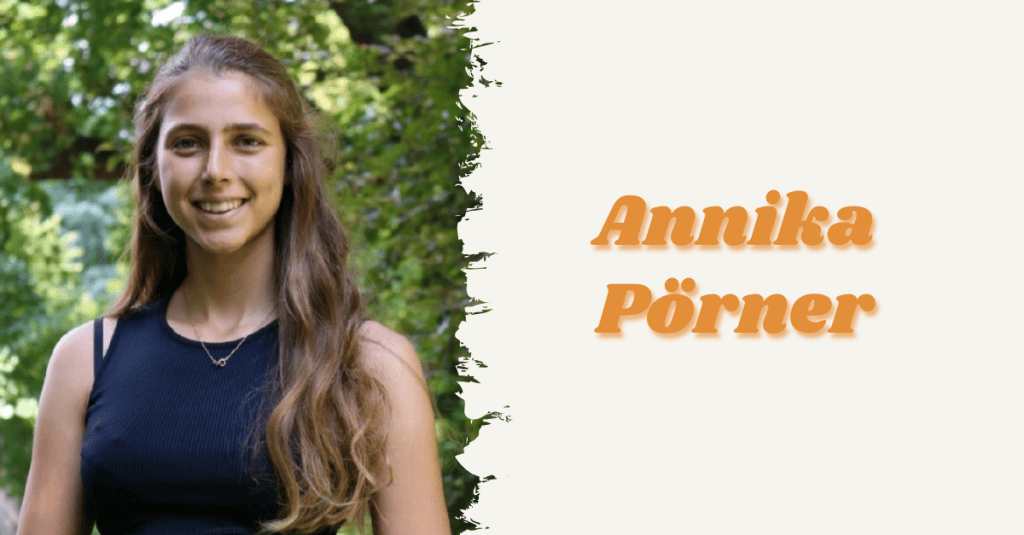
Annika Pörner is a PhD fellow at DTU Physics, Technical University of Denmark – and a member of the board of KIF.
What motivated you to pursue a career in physics, and how did you choose your area of interest/specialization?
I would not say it was a well-considered decision. I chose to study medical engineering initially because it combined two things I cared about: a field with real relevance to society, and topics that just sounded genuinely interesting to me. It wasn’t a narrow physics path from day one.
The real turning point came during my master’s thesis. I had supervisors who sparked my interest in quantum sensing and gave me the motivation to really dive deep into the topic. That’s when my specialization started to take shape. But I never fully left my original background behind. My current work still carries a biomedical part, which I think gives me a slightly different perspective than someone who came into quantum sensing from a pure physics route.
Where have you studied, and what did your career path look like until now?
I did both my Bachelor’s and Master’s in Germany, at TU Darmstadt. After finishing my Master’s, I actually started my career outside academia. I took a position as a product manager. But it didn’t take long to realize: managing products is not that exciting.
So I made a fresh start and I am now doing my PhD in Denmark in physics.
What is the focus of your current research, and why is it significant?
My current research focuses on widefield magnetic sensing using NV centers, with the goal of measuring the magnetic fields generated by nerve excitations in biological tissue.
This matters for a few reasons. Traditional methods for measuring neural activity are invasive, and even non-invasive techniques such as MEG typically require bulky, cryogenically cooled equipment and lack the spatial resolution to see activity at a fine scale. NV-center-based magnetometry has the potential to offer high spatial resolution, non-invasive measurement, and operation at room temperature, which could make it far more accessible and applicable.
Looking ahead, which area of work are you most excited to explore (in or outside of academia)?
I’d say I’m excited to keep working at the intersection of physics and biomedical applications, in whatever form that takes. I do not know yet whether that ends up being continued academic research, or eventually a more applied setting like a start-up or in industry. I’ll let the opportunities that arise along the way guide that decision.
What keeps you motivated in your studies and research, and how do you maintain that drive?
I try to stay curious. A lot of what I’m working with is still fairly new to me, so there’s a constant sense of discovery rather than routine, which makes it easy to stay excited.
As for maintaining that drive long-term, I think it comes down to two things: a good work-life balance, so the motivation doesn’t burn out, and being surrounded by the right people.
Do you engage in public outreach or science communication related to your research? If so, what does that involve?
Not yet, no. At this stage of my PhD, most of my focus has been on getting the research itself off the ground. But it’s definitely something I’d love to get more involved in going forward.
Do you have any hobbies or activities outside of work that you are passionate about, and what makes them meaningful to you?
I love biking but it’s quite different here in Denmark compared to what I’m used to. There are no mountains, everyone bikes, and the wind can be painful, but I still enjoy it. Beyond that, I like exploring the city, discovering cafés, trying pastries, and getting to know new people along the way.
I wouldn’t say I have one single hobby I do every day. It’s more that I value staying active, and I like variety. It keeps things balanced alongside the research.
What are your thoughts on the importance of being a mentor and advisor to students and younger scientists, and what is your own approach?
For me it’s less about having a fully developed mentoring philosophy right now, since I’m still fairly early in my own path, and more about intention: I hope to one day be able to give that same kind of support to newer students, the way it was given to me.
Have any mentors played a significant role in your career, and how have they supported you?
The clearest example for me is actually my master’s thesis supervisor. He really sparked my motivation to dive deeper into quantum sensing, which ended up shaping the direction of my whole PhD.
Beyond that, I wouldn’t say I have one single standout mentor story to point to. It’s been more a matter of accumulating support from different people along the way, rather than one person shaping everything.
What advice would you give to young people, in particular women and minorities, who would like to pursue a career in science?
You can do it! Science can feel lonely from the outside, but it’s genuinely exciting, and I think people underestimate how supportive the community actually is. In my experience, people have been much nicer and more encouraging than I expected.
I’d also say: don’t let the image of who belongs in science hold you back. There are more women and people from diverse backgrounds in these fields than you might assume from the outside. It’s just not always visible until you’re actually in it. Once you’re there, you realize you’re far from alone.
What motivated you to join the KIF board, and what does the organization mean to you personally?
Everyone should feel confident pursuing whatever excites them, regardless of background. I wanted to actively contribute to that.
Personally, it means a lot to me because it ties directly into giving visibility to underrepresented groups, especially women, in MINT fields. I know firsthand that seeing role models and having a supportive community can make the difference between someone pursuing a STEM path or being discouraged before they even start. Being part of KIF lets me help create that visibility and confidence for others.
What perspectives or experiences do you hope to bring to KIF’s work?
I’d like to bring my own experience of having taken a slightly non-linear path: from medical engineering, through a brief stint outside academia, to now specializing in quantum sensing. I want to show that there isn’t just one ‘correct’ route into science. I think that perspective can be reassuring for people who feel like they need to have it all figured out from the start.
What is your vision for KIF’s future – either in the physics community or in the broader landscape of STEM?
I’d love to see KIF help put more female scientists in the spotlight, so that younger women considering STEM have concrete role models to look up to, not just abstract encouragement.
But if I think further ahead, my honest hope is that organizations like KIF eventually won’t need to exist in their current form anymore. I’d love to see a future where representation across gender in STEM is simply even, as a baseline, and initiatives like this become less about correcting an imbalance and more about celebrating an already diverse field.
Are there particular issues or initiatives within KIF that you are especially passionate about working on?
I’m still fairly new to KIF, so I wouldn’t say I’ve landed on one specific initiative yet. I’m more in an exploring phase right now, getting a feel for the different areas of work before committing my energy to one in particular.

