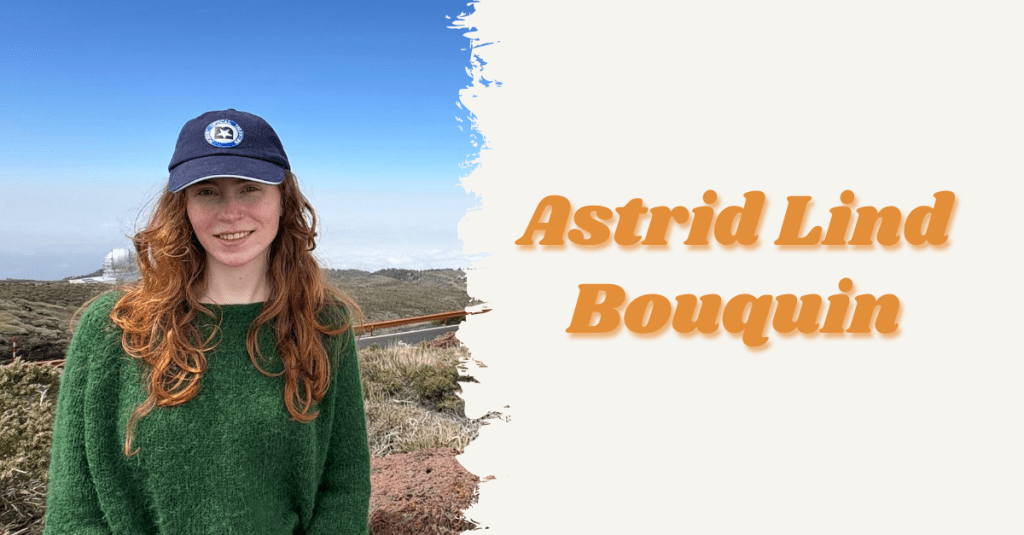
Astrid Lind Bouquin recently completed her Master’s degree in Earth and Space Physics and Engineering at DTU Space, Technical University of Denmark. She is currently working as a Student Support Astronomer at the Nordic Optical Telescope (NOT) on La Palma, where she supports astronomical observations and telescope operations while working alongside researchers from around the world.
In this interview, Astrid shares what it is like to help operate a professional telescope, reflects on her journey into astronomy, and offers a glimpse into life at one of Europe’s leading observatories.
You recently completed your master’s degree in Earth and Space Physics and Engineering at DTU Space. What first inspired you to study physics and astronomy?
I’ve been fascinated by natural sciences since I was a child. Learning about the universe was always particularly interesting to me, so long before university, I aspired to work in this field. The engineering degree at DTU offered a technical approach to this field, which I found particularly interesting, as it focuses not only on the theoretical aspects of astrophysics, but also the technical ones, such as instrumentation involved with studying the universe.
Your master’s research focused on X-ray binaries. What fascinated you about that field, and what did you enjoy most about your research?
I stumbled on the X-ray binary research area rather randomly, and it was not something I was familiar with prior to university. It was first introduced to me in a small 5 ECTS point project during my bachelor’s degree, but I was immediately fascinated by the mechanisms in these systems and continued working with these for both my bachelor’s and master’s theses. X-ray telescopes must be located in outer space, and for this reason, it is a relatively “young” field, with the first data collected in the 1960’s. Therefore, there are still many unanswered questions and a lot of work to be done to understand the high-energy processes that lead to the emission of these rays. All these unknowns make the field particularly interesting to me and enjoyable to work with.
How did you become a Student Support Astronomer at the Nordic Optical Telescope on La Palma?
I learnt about the internship positions at the Nordic Optical Telescope from other students at my university, who could highly recommend it as it offers a great opportunity to get some hands-on experience with astrophysical observations. Once or twice a year, a call for new student support astronomers will be sent out. This date depends on when the contract of the current students ends and will therefore vary from year to year, so I had to keep an eye on the website for new updates on when the next call for applications would be. I applied before starting my master’s thesis, so I would be working on this during the studentship. Since you will be living on La Palma during this time, students will usually get this position when they are working on a master’s or PhD thesis, which can be done remotely and does not require in-person participation at the university.
What exactly does a Student Support Astronomer do, and what are your main responsibilities during an observing run?
As a student support astronomer, you are expected to spend on average a third of your work week working for the Nordic Optical Telescope, and the remainder of the time working on your university degree. The work for the telescope consists of both observation duty nights at the telescope, and staff meetings and other small tasks and projects that are carried out in the sea-level office.
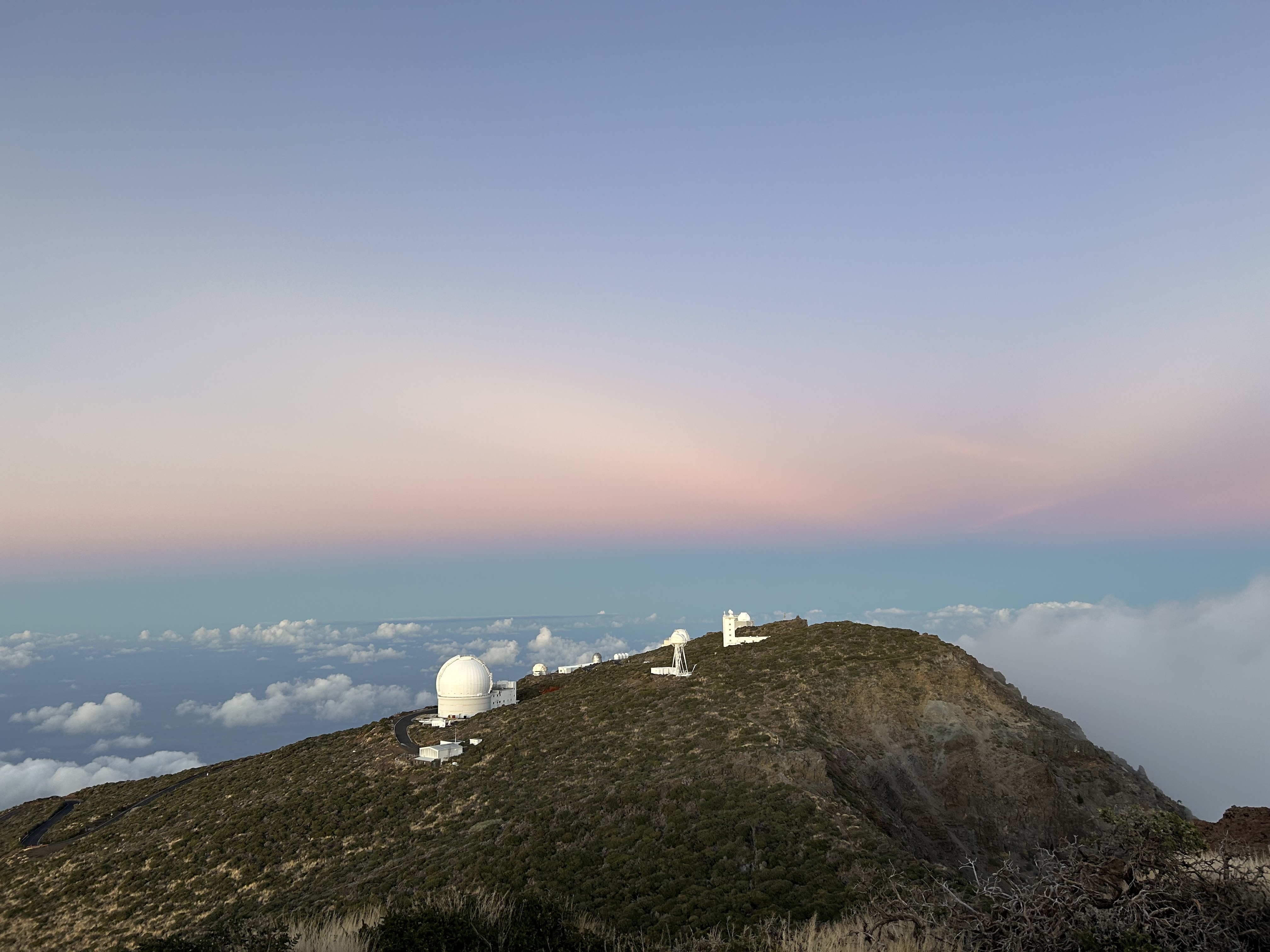
The students have on average 3 or 4 observation nights a month, which will often be grouped together. During observation duty, I stay on top of the mountain where the telescope is located. Since the observation conditions are so extraordinary on La Palma, many other telescopes are also found here.
There is a residence with a canteen and bedrooms, and this is where all the astronomers live during their observation run.
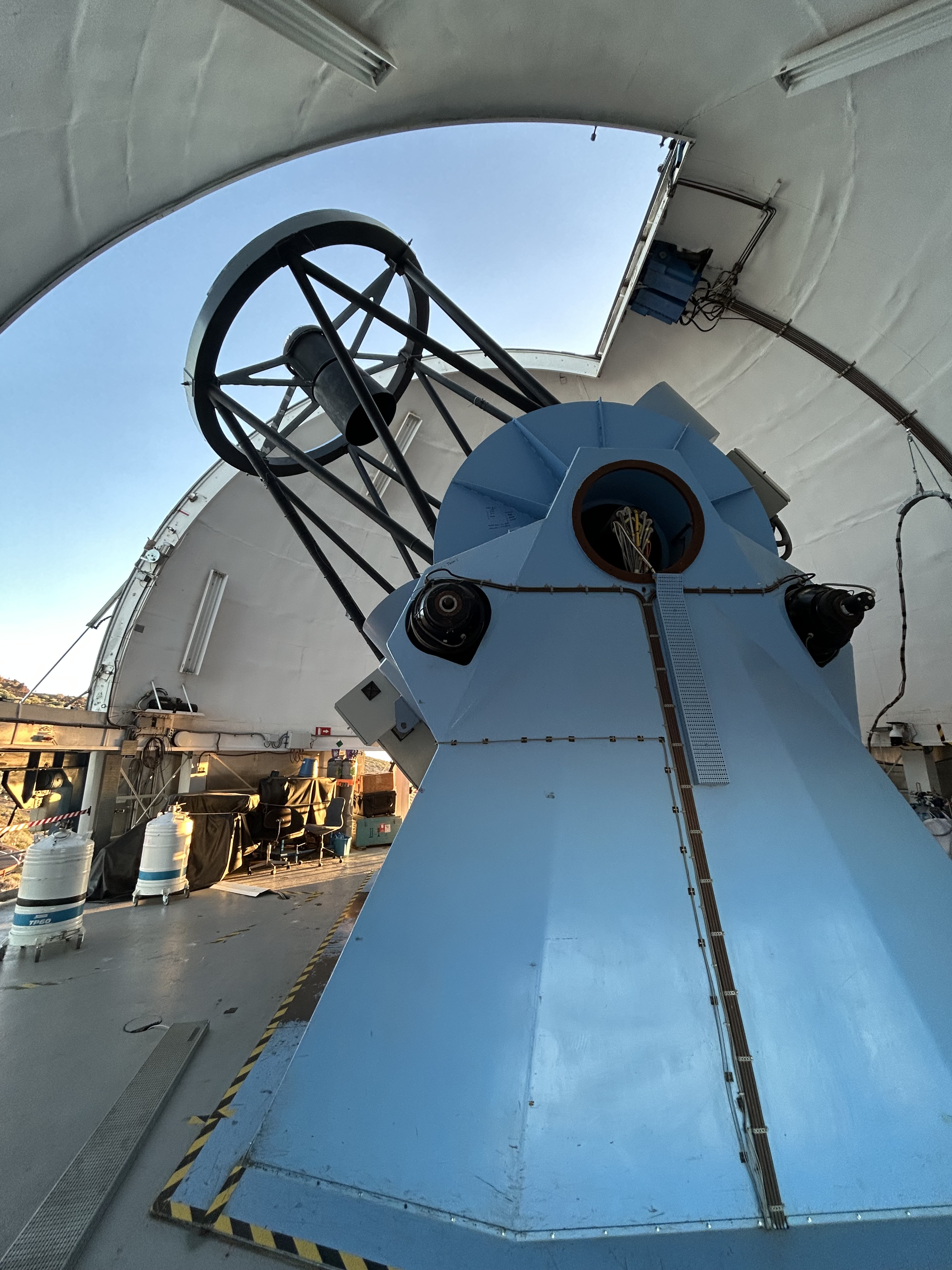
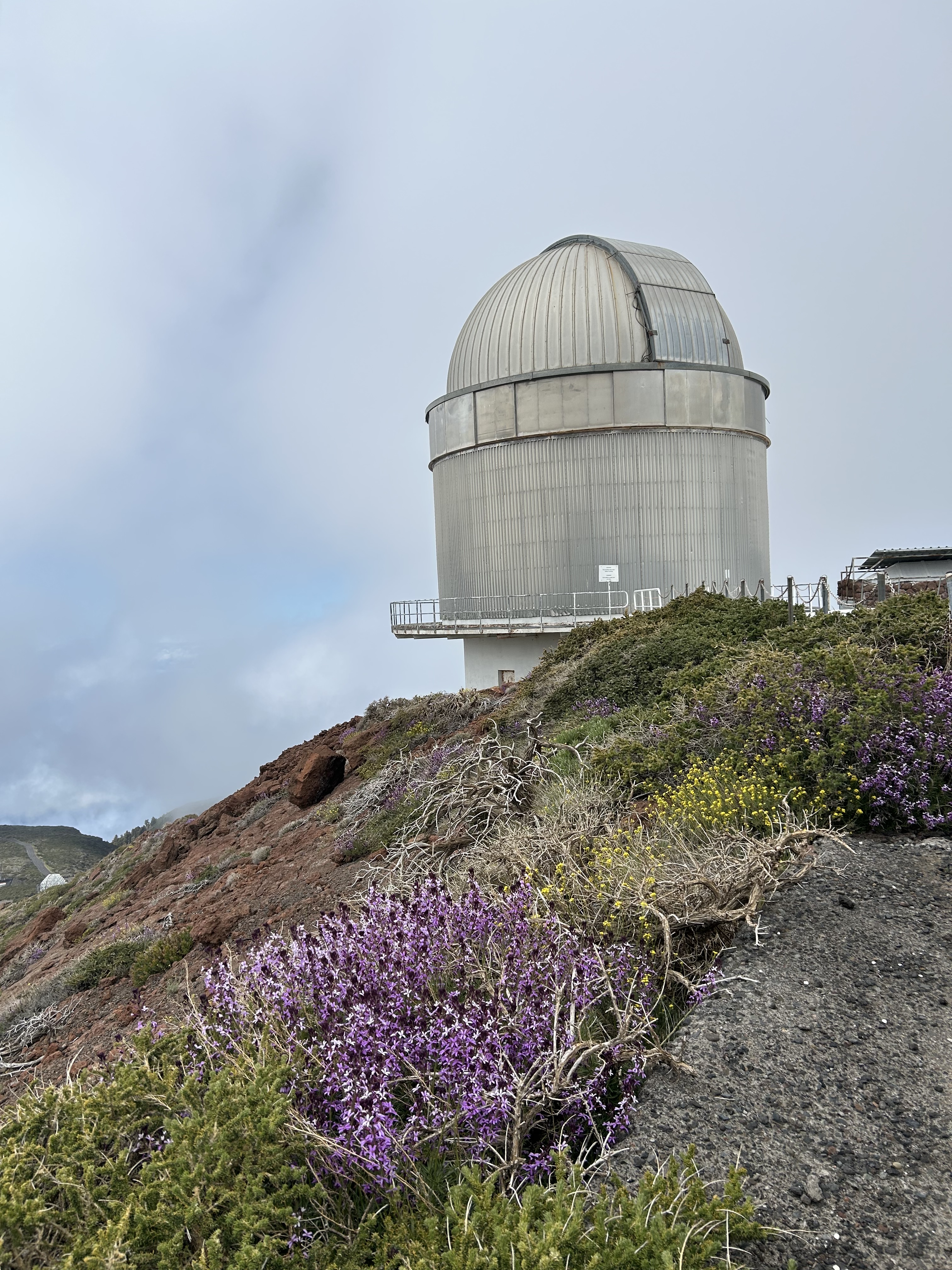
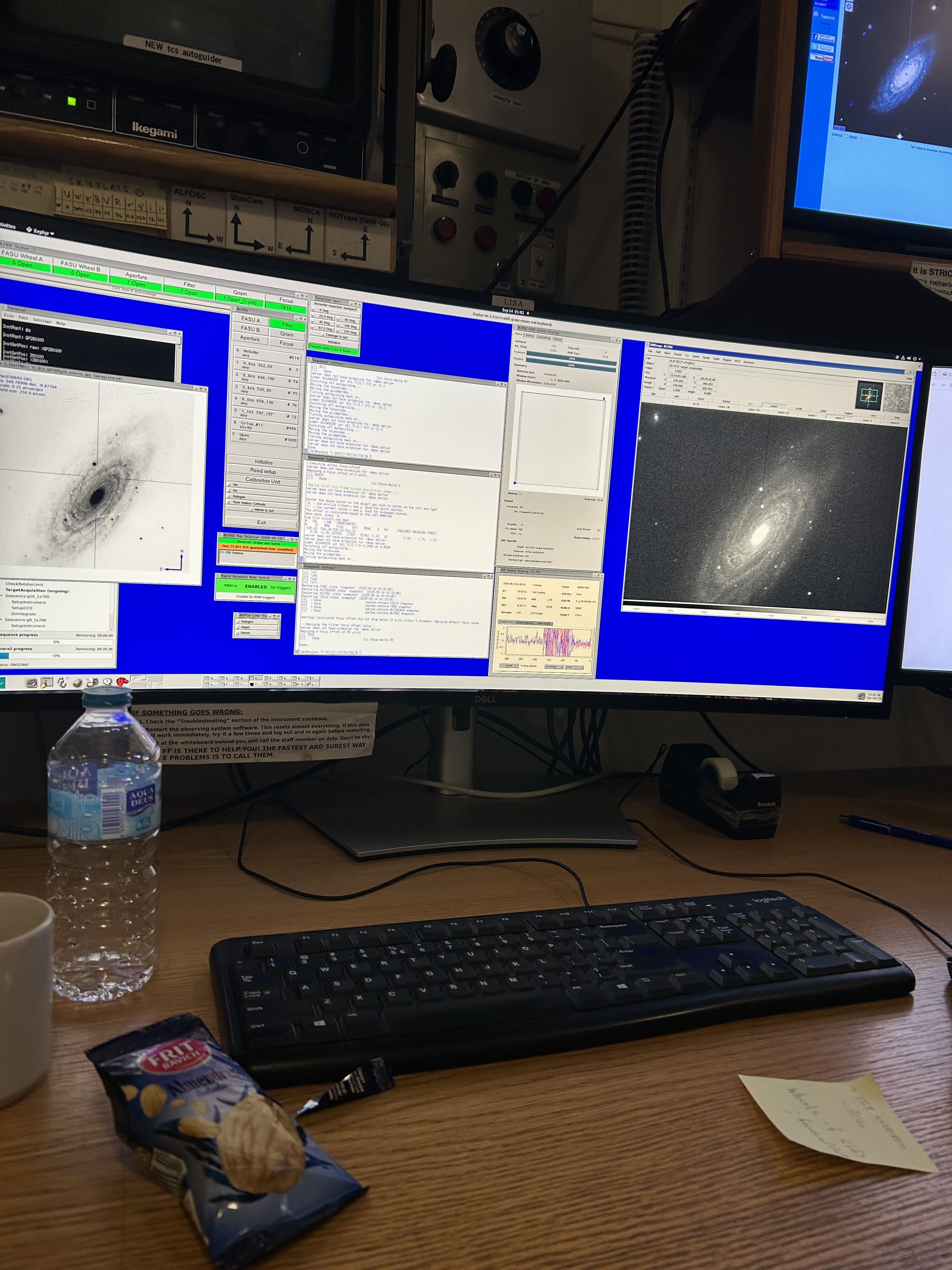
The first task for an astronomer at the Nordic Optical Telescope is in the early afternoon. Researchers from all over the world will send in requests for observations of different celestial objects with different instrumental setups. At this time, I must make a schedule for all the observations I’m doing that night, and check the instrumental setup to see if I need to change any grisms, slits or filters. I also fill the instruments with liquid nitrogen so the detectors stay cold, which is important to get the best data quality. I then start running some calibrations that the researchers will need to process the data later. About an hour before sunset, I will start ventilating the dome where the telescope is located to match the outside temperature. This is done by opening the telescope hatches and side ports. A few minutes before sunset, I am ready to start doing sky flats with different imaging filters, another type of calibration file the researchers will need. Once this is done, I wait for the sky to be dark enough to do the astrophysical observations. I follow the instructions of each researcher, meanwhile keeping an eye out for any weather changes that may require closing the telescope. The shift is over at sunrise, where I start the last set of calibrations and drive back to the residence to go to sleep.
What has been the most exciting, challenging, or unexpected part of working at a professional observatory?
Once you are done with the training period, the astronomer will stay at the telescope alone when on duty. This level of independence is a little scary in the beginning as many different types of problems can arise during a shift. Of course, you can contact co-workers down at sea-level for help, but at the end of the day, you are the only person at the telescope, so it is your responsibility to fix anything. Once, for example, I had to open a hatch and crawl down to the machinery space under the telescope to address a leak that had occurred during a storm. After having experienced a bit of everything, I have become very confident in my ability to problem solve, even if it is something I have never encountered before, though it can still be challenging and frustrating at times.
You work with astronomers from many different countries and research fields. What have you learned from being part of such an international environment?
I really enjoy the international environment. When I’m not observing, I live with some of the other students in a student flat provided by the Nordic Optical Telescope. Hence, I am always surrounded by people from different cultures. We learn a lot from each other through sharing food and interests, as well as discussing our experiences from the different universities we are from. I really appreciate this broadened perspective on what being an astro-student looks like in different places.
If you could invite a young physics student to spend one night with you at the Nordic Optical Telescope, what would you most hope they would experience or take away from it?
I think my job is extremely cool, and I hope a visiting student would feel the same. It’s really incredible knowing that we are looking at objects lightyears away from us. I also would hope that the student learned a lot about astrophysical instrumentation. The environment around the telescope is also incredibly beautiful, and I hope the student would take some time to admire the night sky with the naked eye.
Is there a particular night at the telescope, an observing run, or a memorable experience that you will never forget?
One of my favorite nights at the telescope was when a good friend visited me. It was really nice to be able to share what I do with her, and once the moon had set, we had the most beautiful view of the Milky Way ever. We were able to take some incredible photos just using her phone camera.
Another memorable time on the telescope is among my least favorite. On what was supposed to be my first solo-night after I had completed my training, a huge snow storm hit the mountain. During the afternoon, I had to get to the telescope to fill the instruments with liquid nitrogen to keep them cool. On my way there, I was hit by a strong gust of wind that pushed me so hard that I lost traction on the icy ground under me and slid a meter before I managed to get down on the ground and crawl the rest of the way to the telescope. This event gave me a lot of respect for the harsh conditions on top of the mountain and I have made it a habit to always keep an eye on wind speeds before going outside.
What does being a physicist mean to you?
Being a physicist is being a part of a team, consisting of people from all over the world. It requires working together with others. A big element is being able to convey the methods and conclusions of your work in a congestible manner that opens up for others to collaborate with you.
Living and working at an observatory is quite different from a typical university environment. What has life on La Palma been like, both professionally and personally?
I find that my life has been a lot more relaxed on La Palma, both personally and professionally. In the culture of the Canary Islands, things don’t have to move at max speed and be the most efficient all the time. In many ways, this has been very beneficial and has allowed me to really be present in the moment. I have had time to be curious about everything I learn, which is not always the case in the usual busy university life.
Looking ahead, what kinds of scientific questions or career opportunities would you like to explore in the future?
When my internship at the Nordic Optical Telescope ends in March, I would like to either continue with a PhD in astrophysics or find an interesting engineering position, possibly within the field of space technology and telescopes.
Outside of physics, what hobbies or interests help you relax and maintain a good work-life balance?
La Palma has incredible weather and nature for outdoor activities. I like to go hiking, jogging, and swimming in the ocean. I recently obtained scuba diving certification, so I am planning to go on many under-water adventures. When at home, I like to do craft nights with the other students. We each have little projects and share our skills with different materials with each other. At the moment, I am crocheting a cardigan. I also spend a lot of time with my cat, Luna. I adopted her in January after she was found in very bad condition alone up at the telescopes. There is no better way to relax than cuddling with her.
What advice would you give to students—especially young women and other underrepresented groups—who are considering studying physics or astronomy?
Studying the night sky and wondering about the physics in the universe has been done for millenia by groups of people all over the world. Astronomy belongs to everyone, and anyone with the interest and motivation to study it can do so. If you are wondering if this is something you want to do, but are not yet sure, most universities will offer “student for a day” opportunities where you can follow a student around for a day and see what the classes and projects are like in that field. If you already have a network of people in astronomy, I recommend asking around for different summer schools and other fun opportunities that you can part-take in. This is, after all, how I came across my position at the Nordic Optical Telescope.