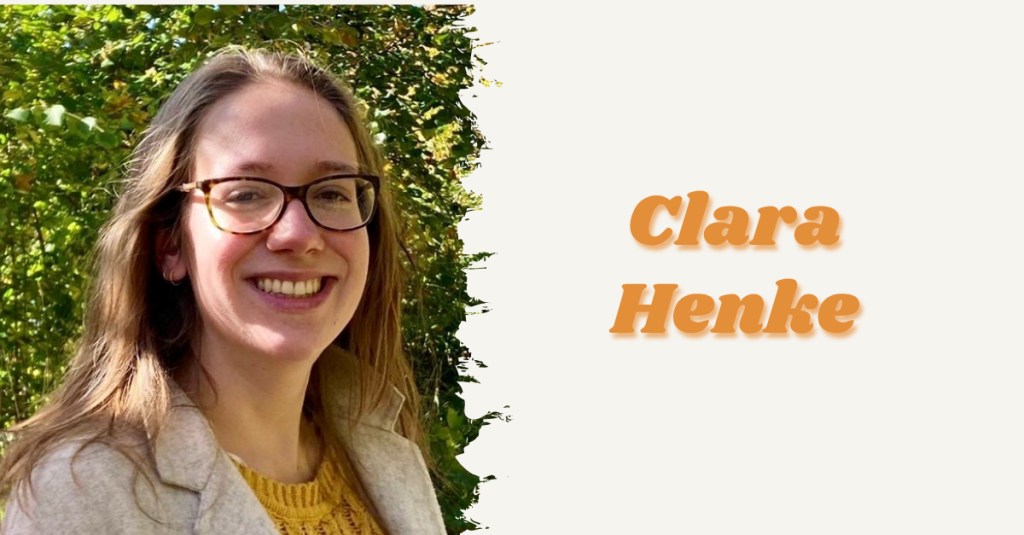
Clara Henke is a PhD student at Niels Bohr Institute, University of Copenhagen, in the quantum optics section.
What is your PhD project about?
I work in quantum optics and study the interaction of multiple quantum emitters in a waveguide with each other and with light.
What inspired you to study physics or engineering, and when did you realize you wanted to pursue this path ?
I come from a family of engineers who have instilled a lot of curiosity for understanding how things work in me from a young age onward. Then during my last year of high school I had an electrical engineering workshop class, where I made my own acoustic light switch. That was so much fun that I chose to study electrical engineering. During my bachelor’s I was very interested in optics and semiconductor physics, so I slowly drifted to physics to understand that better.
What made you choose to pursue a PhD degree?
I loved my master’s thesis but felt like the time was too short. So I wanted the time and space to focus on a topic more in-depth. In addition, I wanted to research with the purpose of understanding not commercializing. So I searched for a PhD, not an R&D job.
What hobbies or activities do you enjoy outside of your studies, and how do they help you maintain a work-life balance?
In my daily life I like to do sports: swimming, running, biking and yoga, to keep my body healthy. I also love to travel and learn about new cultures and customs. Going physically far away from the lab helps me to disconnect and refresh my mind. I think it also really helps with putting my problems in perspective and realizing that my problems are not really problems and there is no point in stressing about them too much.
What are three important skills you have gained during your PhD, and how have they contributed to your growth?
The most important skill is problem solving. I am much better and faster at analyzing a problem, breaking it down and finding solutions.
Second, what I’m still working on, is communicating and explaining complex problems in a simple way. Quantum physics is not very tangible, so finding analogies that make it easier to understand is important.
Lastly, I can now swim 100m of butterfly which grew my back muscles. It also helps with aligning lasers when you have to hold your arms up in awkward positions.
What does being a physicist or engineer mean to you?
Having fun solving problems and understanding fundamental interactions in the universe. I like the challenge of studying something that is everywhere but hard to see with our normal senses.
What kind of career do you envision after your PhD?
Right now, I’m really enjoying the experimental research so I would like to continue with a postdoc. But I have plan A-H for careers I find interesting after my PhD, ranging from patent attorney to R&D in a company and building sensors for example.
Do you have role models who have inspired you, and how have they impacted your decisions or goals?
A lot of people inspire me, so it’s hard to pick. But I had two amazing supervisors during my master thesis, Carola and Eleanor, who were both so fascinated about physics and overall awesome to work with. Their encouragement really motivated me to pursue a PhD.
Do you take part in public outreach, teaching, or science communication during your PhD? If so, what have you gained from those experiences?
I did a lot of teaching during my bachelor’s and master’s in Zurich and got the opportunity to TA a course at a university in Ghana. And then of course here during my PhD. So, I would say I learned how to teach to students with different cultural and learning backgrounds.
Outreach-wise I volunteered at a university info day where I talked for a long time to a girl who was undecided between studying electrical engineering or international relations. I met her again a year later in one of my exercise classes and she told me she decided to study engineering because of how fascinated by it I sounded and that she also really likes it. That was super heartwarming and showed me the importance of role models.
Are you involved in any student associations, networks, or initiatives, and what role do they play in your academic journey?
I am part of NPN, the PhD and postdoc network at NBI, where we organize social events and work together with management to improve the young people’s lives at NBI.
It’s very important to me to engage with researchers in other fields, so it’s been great to get outside of my quantum bubble through NPN. Furthermore, it also helps me understand university politics more and what problems you could deal with later in an academic career.
In Zurich I was part of a women’s network for engineers, where we organized events to connect female students with each other and industry. My favorite event we did was girls day, where girls from all over Switzerland visited the university and got to see all the cool experiments in the labs.
What advice would you give to young people, particularly women and minorities, who are interested in studying physics or engineering?
Just do it, be curious and have fun, don’t worry about what people will think. You will find your crowd.

