
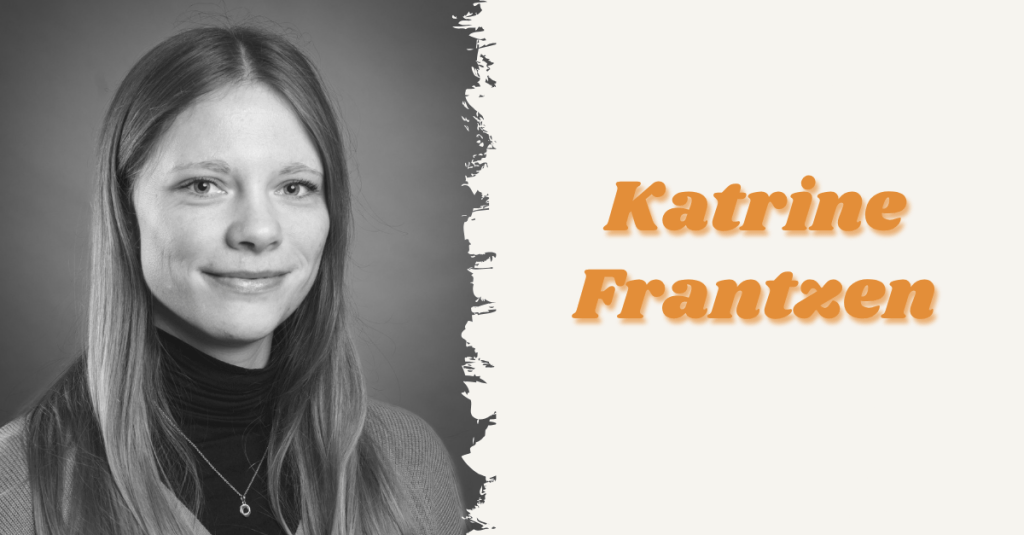
Katrine Frantzen is a Software Developer at Siemens Mobility.
Where did you graduate from and with which degree?
I obtained my Master’s degree in Astrophysics in November 2021 from the Niels Bohr Institute, University of Copenhagen.
Please give a description of the work you do in your current position.
I work as a Software Developer at Siemens Mobility, which is the Siemens division specialized in railway transportation.
My work involves designing, developing, and maintaining software solutions that support system diagnostics, operational insights, and data warehousing. These tools help provide information to both operators and our own service department, enabling better decision-making and more efficient service.
As a developer, I am involved in the full software development cycle from requirement specification and design to implementation, testing, and validation. I work with backend development, primarily in Python, and also contribute with test automation, where I apply relevant skills to help ensure the reliability and maintainability of our software solutions.
What motivated you to study physics or engineering in the first place?
I have always been interested in science and understanding the world around me. What attracted me to physics was the logical approach to problem-solving and the way mathematics can be used to find answers to complex questions.
Honestly, I think I could have chosen any science-related field and would have found it equally fascinating. What mattered to me the most was the opportunity to learn and apply logical reasoning, and physics enabled me to do exactly that.
Specializing in astrophysics came along the way, and I was especially drawn to the observational side of it – working with real data from space and learning how to extract information from it. One thing I found particularly fascinating was how much we can learn about distant systems like stars and galaxies almost entirely by analyzing the light they emit. That ability to obtain detailed insights from something so seemingly simple really caught my interest.
What made you decide to pursue a career in the private sector?
Choosing between academia and the private/public sector was not an easy decision. I have always enjoyed working with astrophysics, and there are aspects of research that I still miss. However, I realized along the way that academia was not the right path for me. I wanted to apply my skills in a more practical setting and see the direct impact of my work.
Working in the private sector, especially in a company like Siemens, allows me to use my competencies to contribute to something meaningful, like supporting sustainable transportation and working on green solutions. That sense of purpose, combined with the opportunity to work on real-world problems, made the private sector the right choice for me.
How do you use the skills you learned as a physicist or engineer in your work?
Being a physicist has taught me how to approach complex problems in a structured way, break them down into smaller parts and work with them with patience and persistence. During my studies I gained experience with fundamental programming, data analysis and working with large amounts of data – skills that I use every day in software development.
On the softer side, I learned how to work effectively in teams and gained a good understanding of my role within a group. I have learned to recognize where I can contribute most and how to collaborate and communicate to solve problems.
What does being a physicist or engineer mean to you?
To me, being a physicist means being curious and having the tools and mindset to be able to understand complex problems. It is a skill set that is applicable in many different contexts – from research to industry and software development.
I probably could have taken a more direct path into software development, but I value the route I took. My background in physics has given me a strong analytical foundation and a different perspective on problem-solving. Although I have had a lot to learn along the way, that foundation helps me approach challenges with structure and persistence, and I believe it adds something unique to the work I do.
What advice would you give to young people (in particular women and minorities) with a background in physics or engineering who would like to pursue a career in the private sector?
Do not hesitate asking questions, even the ones that feel stupid. Staying curious is one of the most valuable traits you can bring into any workplace, and it is essential for your growth. Also, speak up about what you want and what you need. It is okay to set expectations, ask for support and advocate for yourself.
It may sound like a cliché, but being a minority is a strength. You bring a different perspective, which is incredibly valuable, and most employers recognize that. Find a workplace where you feel respected and heard. At the same time, I know that for some women and minorities, the pressure to “prove yourself” or speak out can feel overwhelming. You don’t have to carry the weight of representation on your shoulders. Showing up, being authentic and doing your job well is already enough.

