

Article by Else Høyrup (Hoyrup), Historian of Physics
Hilde Levi was a German-born Danish physicist and biophysicist. She worked with radioactivity, isotope engineering, carbon-14 dating, nuclear medicine and radiation protection. Her research was mainly within radioactive isotopes in biology and medicine. She was a pioneer in all these fields.
Introduction
Hilde Levi was born in Frankfurt am Main, Germany, on 9 May 1909. She died in Copenhagen on 26 July 2003 at 94 years old.
Hilde Levi was unmarried, but she lived with Sophie Hellmann during the years 1937-1979. Sophie Hellmann was the German-Danish private secretary to Niels Bohr who was born on 4 July 1894 in Nürnberg, Germany and died in Copenhagen on 19 September 1979 at 85 years old.
Hilde Levi in Germany
In Germany, Hilde Levi experienced resistance to her desire to become a professional physicist. However, she did not let that put her off. She was awarded a Dr.phil. in 1934 in Berlin for a thesis on physics and chemistry which was highly praised. However, her strength was experimental physics, while she herself said that she needed help with maths. She received that help in Germany from mathematician Käte Sperling (later Fenchel) (1905-1983).

The escape to Denmark
When the Nazis began to rise in Germany, both Hilde Levi and Käte Sperling fled to Denmark. They were both Jewish. (I have written a short biography of Käte Sperling, married Fenchel. See the References).
One particular reason why Hilde Levi chose Denmark was that the University of Copenhagen’s Institute of Theoretical Physics (UITF), led by Niels Bohr, was a world centre for physics.
Conditions at the Niels Bohr Institute
Hilde Levi joined the Niels Bohr Institute. Here she started as a nuclear physicist, assisting male physicists and chemists.
Other biographies state that Hilde Levi was ‘employed’ at the institute. But according to her own memoirs from 1993, she did not have a ‘normal’ employment here.
Initially, Hilde Levi received money from home. However, this money stopped already the year after her immigration, in 1935, due to the Nazi regime taking control in Germany. Afterwards, Bohr got her a scholarship from the Rask-Ørsted Foundation.
The war was approaching
As the Nazis took over in Germany and war approached, Niels Bohr quietly began to help many of the Jewish immigrant physicists go elsewhere – away from his prominent institute. He sent the men abroad, especially to England and the USA, while he sent Hilde Levi to the Carlsberg Laboratory.
At the Carlsberg Laboratory, Hilde Levi could continue the biophysical research in radioactivity (especially isotope technique) that she had assisted the Hungarian chemical physicist, George de Hevesy (1885-1966), with at the Niels Bohr Institute. Hevesy was awarded the Nobel Prize in Chemistry in 1943.
The physicists Hilde Levi had worked with at the Niels Bohr Institute were all, like herself, experimental physicists. One of her favourite collaborators was Otto Robert Frisch (1904-1979), Lise Meitner’s nephew. Hilde Levi called him a gifted experimental physicist who could invent almost any kind of ‘gadget’.
The Copenhagen Conferences
These famous, international and rather informal conferences at the Niels Bohr Institute started in 1929. Hilde Levi attended her first conference in 1936.
There are a lot of photos from these conferences at the Niels Bohr Archive, which archivist Robert (Rob) James Sunderland has been kind enough to provide me with.

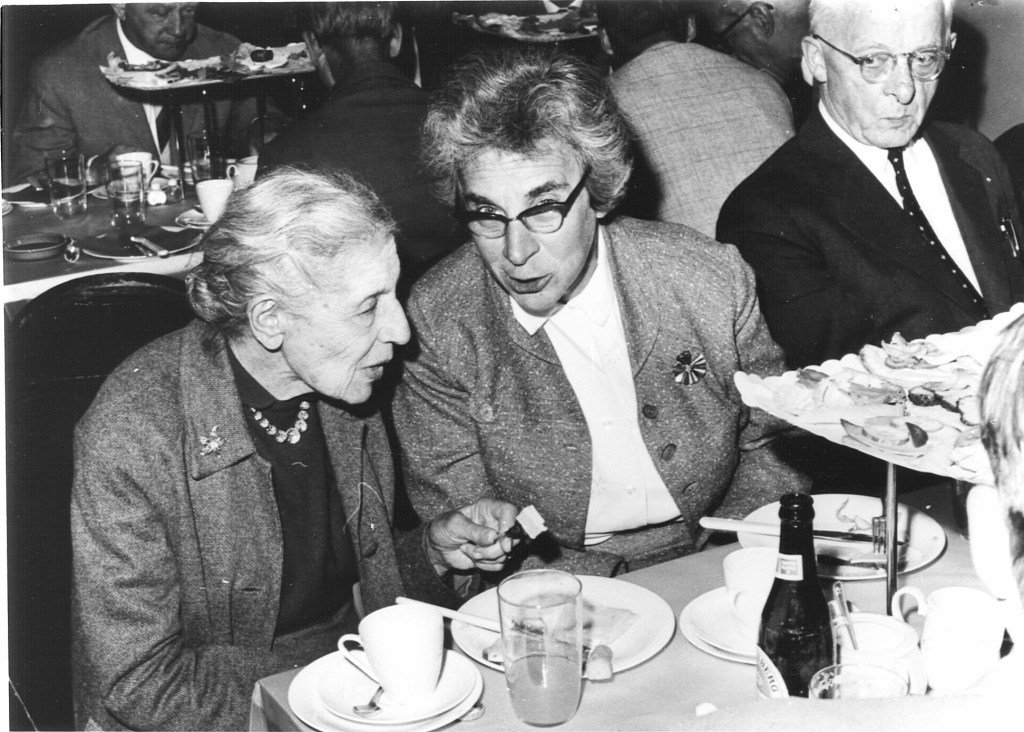
The group photos from these conferences at the University Institute of Theoretical Physics (from 1965 called NBI) are typical: Hilde Levi almost always sits in the back. Lise Meitner always sits in the front row. In addition, there were very few women at that time. Physics was a men’s club back then!
Then came the war!
Initially, the war did not affect Jews in Denmark. In 1943, however, the Nazis began a manhunt for Jews. To avoid the concentration camps, almost all Jews in Denmark fled to Sweden. This included Bohr and his family, Hilde Levi and Sophie Hellmann, as well as the Fenchel family.
In Sweden, Hilde Levi joined the Wennergren Institute for Experimental Biology in Stockholm. Her boss was John Runnström. Here, she continued to do biophysics, especially isotope techniques, which had just become fashionable. Her focus area after switching from nuclear physics to biophysics was radioactivity. George de Hevesy, her former boss, was also in Sweden.
Return to Denmark
After the war, Hilde Levi returned to Denmark. The Nazis had cancelled her Dr.phil. degree and she did not want to return to the politically inflamed environment that still existed in Germany. Hilde Levi also became more appreciated outside of Germany.
Hilde Levi now became a professional biophysicist.
Reading Hilde Levi’s memoirs 30 years later, as a female scientist, it is quite amazing to see how well she did both socially and professionally. It was unusual for women back then.
Hilde Levi’s professional work
“Of course, these things are written in biographies about Hilde Levi. But I am surprised that her name is not mentioned today under the carbon-14 method in encyclopaedias… Had she been a man, she would probably have been better remembered because she was, after all, a local pioneer.”
Biophysics
Hilde Levi started doing atomic/nuclear physics with Niels Bohr. She became an assistant to the Hungarian chemical physicist George de Hevesy (1885-1966), among others.
Before the war, Bohr had supported the biophysical research that George de Hevesy and Hilde Levi conducted at his institute. However, Hevesy stayed in Sweden after the war, unlike Hilde Levi. For some reason that I have not been able to find out, Bohr stopped biophysical research at his institute after the war. From then on, there was to be only pure, theoretical physics. – From today’s perspective, it seems a bit strange to exclude the applications of physics. After all, it is often something that society needs.
For Hilde Levi, this meant that she would no longer be working at the Bohr Institute. Many people would have seen that as a defeat. Inge Lehmann, for example, became bitter towards Niels Bohr because he thwarted her application for a professorship in geophysics.
When Hilde Levi had to leave the Niels Bohr Institute, she was lucky. Her skills were needed elsewhere. First, she became a consulting physicist at August Krogh’s Zoophysiological Laboratory. Poul Brandt Rehberg (1895-1989) had become a professor here in 1945, and he took over from August Krogh (1874-1949).
At the Zoophysiological Laboratory, Hilde Levi moved more and more into biophysics, and her title eventually became docent (a Danish term for a position in between the levels of associate professor and full professor). She ended up having a ‘normal’ career as a researcher. This was very unusual for women at the time and for many years to come.
Below is a closer look at Hilde Levi’s main areas of work.
Autoradiography and nuclear medicine
Autoradiography was Hilde Levi’s main research area at the Zoophysiological Laboratory. She started to work with this method during a stay in the USA in 1947-1948 and continued until her retirement in 1979. Much of what Hilde Levi worked on is now known as nuclear medicine.
Autoradiography is a photographic method of localising radioactive material in a sample.
Nuclear medicine is a field of medicine that uses radioactive isotopes to diagnose and treat diseases.
Applications of nuclear medicine and autoradiography:
A. Nuclear medicine has become increasingly important over the years and is combined with computer tomography, or computerised imaging. This involves taking a series of two-dimensional slice images by scanning, which are then combined into a three-dimensional image using computers. The technique was developed by Danish computer scientist Edda Sveinsdottir (1936-2022).
B. Autoradiography was used – among other things – to study the harmful effects of the radioactive contrast agent Thorotrast.
With her specialisation in autoradiography and nuclear medicine, Hilde Levi was able to help doctors and biologists, which she found very exciting. Her professional qualifications and positive personality made her very popular among them.
Hilde Levi’s assistant, Elise Frederiksen, also became a specialist in autoradiography. They worked together for more than 30 years, approximately 1949-1979, so Hilde Levi was a good employer. Hilde Levi retired in 1979.
Carbon-14 dating using isotopes
As we know, carbon-14 is a radioactive isotope, a radioactive variant of the common, non-radioactive carbon-12. Carbon-14 has a half-life of 5,700 years (Kaare Lund Rasmussen).
In 1947-1948, Hilde Levi made her first of many visits to the USA to learn more. Among others, she visited the physical chemist Willard F. Libby (1908-1980) in Chicago. In 1947, he invented a method of using carbon-14 to date carbonaceous samples that were very old, and in 1960, he received the Nobel Prize in Chemistry for it. Hilde Levi became a committed collaborator.
The method is based on the fact that the radioactive isotope carbon-14 has a half-life of 5,700 years. When you measure how much carbon-14 is left in the sample, you can calculate backwards and determine the age of the sample.
This method of quantitative age determination was particularly useful in archaeology and geology, where very old samples are found. Previously, archaeologists and geologists had only been able to make qualitative age determinations. Over time, more quantitative methods emerged, and the carbon-14 method was refined to become more accurate. After Hilde Levi returned home, she developed the method, and in 1951, it was ready for use in Denmark as the first country in Europe.
The Danish archaeologists and geologists were enthusiastic about the method. Hilde Levi was encouraged to hold courses in isotope technique. Niels Bohr also attended these advanced courses. The result was that they were looking for a place to build a laboratory, which ended up being at the National Museum of Denmark.
Hilde Levi was not interested in becoming the head of the new laboratory. She was happy enough with her work at the Zoophysiological Laboratory.
The Grauballe Man
The first success came in 1952, when the so-called Grauballe Man was found. It was an incredibly well-preserved body found in a peat bog. It was the body of a 34-year-old man who had been decapitated. The reason for the beheading is not certain, but perhaps it was part of a religious ritual.
The Grauballe Man is Denmark’s – and one of the world’s – best preserved bog bodies. He was found in a peat bog near Grauballe near Silkeborg on 26 April 1952, and today he is on display at Moesgaard Museum. It has also been possible to analyse the man’s state of health and what he had eaten before his execution.
The age of the find has been determined several times, especially by various carbon-14 analyses. Today, it is believed that the man is from the 300-200th century BC, i.e. the pre-Roman Iron Age.
It is this carbon-14 dating method that made Hilde Levi famous in her time. As mentioned, she was not the inventor of the method herself, but she was the first to introduce it in Denmark and Europe.
Of course, these things are written in biographies about Hilde Levi. But I am surprised that her name is not mentioned today under the carbon-14 method in encyclopaedias, for example on Lex.dk. Had she been a man, she would probably have been better remembered because she was, after all, a local pioneer.
Radioactivity and health risks
Hilde Levi writes several times in her memoirs that she has changed her research area many times during her life. This is in contrast to many other researchers who see it as something special to stay in the same research area for life. Some of her changes did not come as a free choice. Especially the ‘expulsion’ from the Niels Bohr Institute. This case was a mystery to me at first, but it must have had something to do with Bohr wanting to ‘cleanse’ his institute of applications. Hilde Levi’s boss, George de Hevesy, also stayed in Sweden after the war. But Hilde Levi did not become bitter. Bitterness did not seem to suit her, at least not according to her memoirs.
Most of the changes in Hilde Levi’s professional life were voluntary, and she found everything new exciting. She was also delighted that her expertise in radioactivity was so much in demand, first as purely professional help for doctors and biologists, later as work on radioactivity and health risks.
The National Board of Health (Sundhedsstyrelsen)
At one point, the radiation hazard situation was so serious that politicians asked the National Board of Health to set up a committee to control all procurement and use of radioactive substances and X-rays. Everyone, including the physicists and chemists, had to be controlled.
Chief physician Dr Eigil Juel Henningsen was appointed head of the committee, and he hired Hilde Levi as a consultant in 1952. Their collaboration was exemplary. She was a great admirer of his and considered him a very skilful doctor and administrator. He, in turn, also admired her.
However, Hilde Levi was given so much extra work that Juel Henningsen eventually asked Hilde Levi’s workplace, the Zoophysiological Laboratory, if they could borrow her more.
When the press learnt that radioactivity and X-rays could be dangerous, they came across the committee. Hilde Levi was given the thankless job of talking to the press, but she did a great job with this task as well.
Hilde Levi quit the committee in 1970, which was a relief for her. She maintained her friendship with Juel Henningsen until he died in 1992 (her memoirs were recorded in 1992-1993).
In general, it is remarkable how many good friends Hilde Levi made throughout her working life. And almost all of them were men.
The Niels Bohr Archive
In 1979, Hilde Levi retired at the age of 70. That same year, her partner, Sophie Hellmann, died. Hilde Levi did not want to be a passive pensioner, so she attached herself to the Niels Bohr Archive and its then director, Finn Aaserud.
A very close friendship developed between Hilde Levi and Finn Aaserud, and Finn Aaserud has written two very fine biographies about Hilde Levi.
Hilde Levi’s idea was to make another professional shift – from physicist and biophysicist to historian of physics. Her main work was a biography of her former boss, Nobel Prize winner George de Hevesy (1885-1966). She tried to collect everything she could about him from around the world and photocopied it. The biography was published in 1985.

Conclusion
Hilde Levi died peacefully in Copenhagen on 26 July 2003, aged 94.
She had had a long and rich life. Her bright mind and great professional skills had given her a happier working life than women could normally enjoy at the time. For example, both Lise Meitner and Inge Lehmann had been discriminated against. (However, Inge Lehmann was only discriminated against in Denmark!)
Photos from The Copenhagen Conferences are very revealing of the time. In other words, physics was a men’s club in the old days. – Fortunately, that tradition has been broken today!
Thank you
Finally, I would like to thank archivist Robert (Rob) James Sunderland from the Niels Bohr Archive. He has been an invaluable help in providing me with records from the Niels Bohr Archive. He is the one who sent me Hilde Levi’s Memoirs, and he has not only provided me with material on Hilde Levi, but also on other physicists. In particular, Rob sent me a lot of photos, including photos from The Copenhagen Conferences, but he has also sent me a lot of PDF files with letters etc. both handwritten and printed. It has been a lot of fun working with Rob!
Thanks a lot, Rob!
References
[1] Primary source: Hilde Levi: Erindringer, 1993. Niels Bohr Arkivet.
Memoirs which Hilde Levi recorded 1992-1993. A secretary later transcribed the Memoirs into English.
[2] Finn Aaserud: Hilde Levi. Dansk Kvindebiografisk Leksikon, 2000-2001.
[3] Finn Aaserud: Hilde Levi (1909-2003): An Obituary, 2003. Niels Bohr Arkivet: nbarchive.ku.dk.
[4] Annette B. Vogt: Hilde Levi. Jewish Women’s Archive: jwa.org.
[5] Else Høyrup (Hoyrup): Käte Fenchel (b. Sperling) (1905-1983) In: ”Women of Mathematics: A Biobibliographic Sourcebook.” 1987. Pp. 30-32.
Else Høyrup (Hoyrup) is historian of science and historian of physics, and she has worked extensively with women in the history of STEM subjects and physics. Read more about her life and career in this interview article.

 kvinderifysik.dk