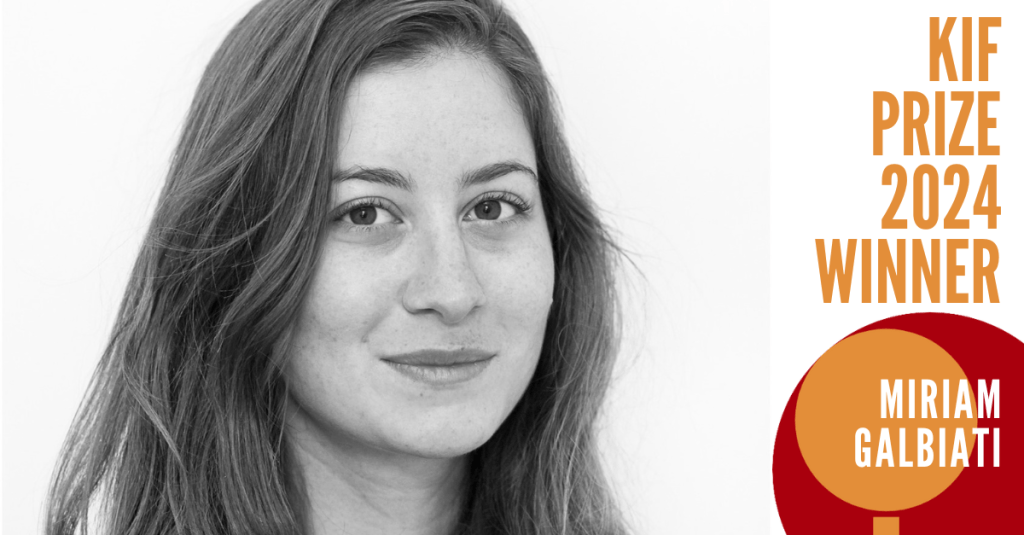
The KIF Prize is an honorary award that is awarded annually to raise awareness about the importance of women in physics and identify female physicists as role models.
Congratulations on being awarded the KIF Prize 2024! What does it mean to you to receive this prize?
Receiving the KIF Prize 2024 is an incredible honor that means a great deal to me. It is a validation of the hard work and dedication that I have put into my research over the years. This recognition not only reflects my own efforts but also the support and collaboration of my colleagues. It is very rewarding to know that all the hard work of these years has been noticed.
What was your motivation for pursuing a career in physics and how did you choose the field you are now specializing in?
My interest in physics began in high school when I first learned how fundamental principles can explain both everyday phenomena and complex cosmic events. My career path hasn’t always been straightforward. In my PhD I was an experimental researcher focusing on studying the electronic properties of nanostructured materials. I loved getting my “hands dirty” in the lab and I realized that I wanted to pursue a career that could translate my own work into a product. Thus, when such an opportunity presented itself, I decided to follow it and see where this journey might take me regardless of the fact that optics and terahertz technology fields were not in my background at that moment. I believed (and still believe) that hard work fueled by strong motivation can overcome the initial lack of expertise in the field.
Where did you study and which positions have you held before the current one?
I completed my studies at Politecnico di Milano, where I completed the BSc in Materials Engineering and Nanotechnology and obtained my Master’s in Nuclear Engineering. I then pursued my PhD in Physics at the Technical University of Denmark (DTU). Post-PhD, I held a position as a Postdoctoral Researcher still at DTU where I studied Terahertz spectroscopy to measure blood glucose non-invasively. The results obtained in those two years of research allowed me to found the company Glaze Life Sciences, where I currently serve as CEO.
Please tell us about your research and why it is important.
Researching terahertz spectroscopy to develop a non-invasive device for monitoring blood glucose is important because it enhances patient comfort by eliminating the need for painful finger pricks, thereby improving compliance with glucose monitoring regimens. This technology facilitates continuous monitoring, offering a comprehensive view of glucose fluctuations throughout the day, which can lead to more precise diabetes management. Non-invasive monitoring technology could prevent severe complications by enabling early detection of abnormal glucose levels. Furthermore, advancing terahertz spectroscopy could catalyze breakthroughs in other medical diagnostic areas, potentially reducing direct and indirect healthcare costs. Overall, this innovative approach promises to transform diabetes care and improve the quality of life of people living with diabetes.
You are the CEO of Glaze Life Sciences ApS, a company which you have created based on a side project you started working on during your PhD, and along the way, you have managed to raise several million DKK in funding for the project. Can you share some of the insights you have gained during this journey from fundamental research to forming a commercial venture?
Transitioning from fundamental research to establishing Glaze Life Sciences ApS has been a profoundly enlightening experience. One of the most crucial insights I’ve gained is the importance of flexibility and resilience. Innovations don’t follow a linear path, and being open to pivoting our strategy was essential. Another key lesson was the significance of building a strong, multidisciplinary team. The diverse skill sets and perspectives have been critical in addressing complex challenges and driving our project forward. Additionally, securing funding involves not just demonstrating the scientific validity of our project but also conveying its potential market impact and scalability to third parties that often don’t speak science. Understanding the business landscape and learning to speak the language of business developers, regulators and investors were pivotal in successfully raising several million DKK.
You have been awarded the KIF prize for being a role model to other women in physics, and this is certainly very well deserved. Who have been your own role models and mentors and how have they inspired and supported you?
Unfortunately, in academia none of them was a woman or non-male. I have had different great supervisors and managers. It would have been nice though to be mentored by someone that could understand the extra challenges that women have to face in a male-dominated environment. I hope I will be able to contribute and be of inspiration for other women researchers and entrepreneurs.
What advice would you give to other young people (in particular women and minorities) who want to become entrepreneurs?
My advice is to embrace your unique perspectives and experiences—they are your strength. Don’t shy away from ambitious challenges but seek them out, as they often lead to the most rewarding outcomes. Be prepared for setbacks and learn to view them as opportunities to grow and refine your ideas.
In general, what can in your opinion be done to advance the careers of underrepresented groups in physics and encourage a more diverse group to become entrepreneurs?
Embrace the fact that you bring something different to the table — these differences are not just valuable, they are essential for innovation. Seek support and encouragement from your peers – do not underestimate the power of a supportive network that believes in your potential. A simple gesture of trust or a word of encouragement can boost your confidence!
Remember that your identity and experiences empower you, not hinder you. By valuing your own strengths and embracing your identity, you not only enhance your own path but also pave the way for others behind you.

