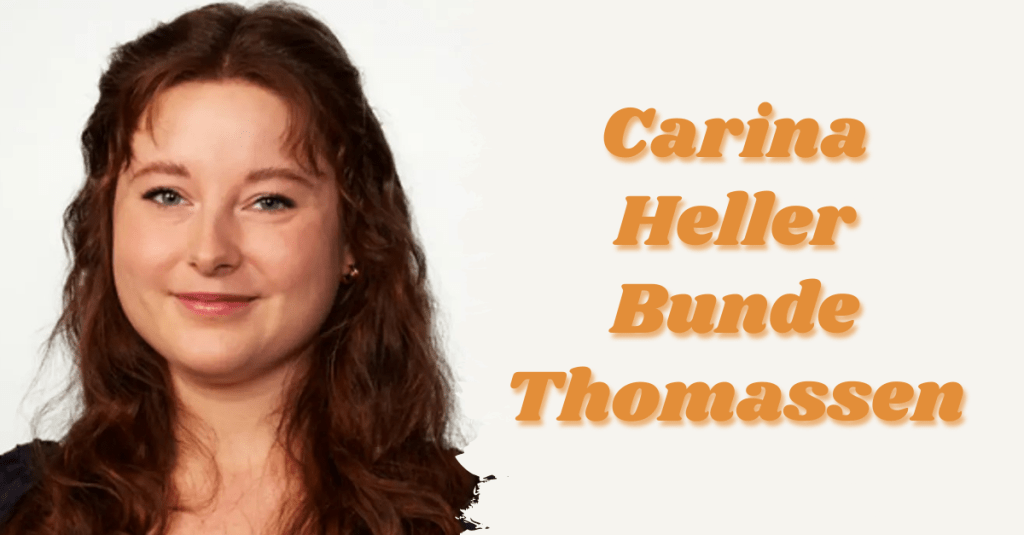
Carina Heller Bunde Thomassen is LCA Specialist at Miljømærkning Danmark
Where did you graduate from and with which degree?
I have a background in both physics and engineering. I graduated from Technical University of Denmark (DTU) with a master’s degree in environmental engineering, specialising in quantitative sustainability assessment, and I have a bachelor’s degree in physics from Niels Bohr Institute, University of Copenhagen.
Please give a description of the work you do in your current position.
I work with quantifying and documenting the environmental effects of ecolabel criteria. I work on the Nordic Swan Ecolabel and the EU Ecolabel, which are the two official ecolabels in Denmark that Ecolabelling Denmark manages.
The insights generated from our analyses are used both to document and communicate the impact of ecolabels, and to contribute to evaluations of criteria and the development of new criteria.
What motivated you to study physics or engineering in the first place?
I’ve always been deeply fascinated by the climate and history, especially by how conditions in prehistory can shed light on the underlying causes of human behaviour patterns. When I first learned about ice-core drilling back in high school, I realised how much knowledge of our prehistory is stored in the ice – almost like a time capsule that helps us understand the past and, in turn, better anticipate the future. That idea fascinated me: if we can understand the past, we can better prepare for what’s ahead.
This curiosity led me to study Physics at the University of Copenhagen, where I initially aimed to become a geophysicist and explore the scientific mechanisms behind the climate system that has influenced human behaviour for millennial. Over time, I felt a growing motivation to turn that scientific understanding into practical solutions for what we are facing today. That’s what guided me toward environmental engineering, where I could work hands‑on with climate and environmental challenges that we as a planet face, and more tangible how the companies can influence their impact, while staying rooted in data‑driven analysis and evidence‑based decision‑making to find solutions that actually works in real life.
What made you decide to pursue a career in the public sector?
Within quantitative sustainability assessment, Life Cycle Assessment (LCA) is the most widely used method for evaluating the environmental impact of products and systems. Yet despite its widespread use in research and policy, there are still relatively few positions where you can work hands‑on with LCA in a practical, data‑driven way – especially as a graduate.
When I graduated, I was fortunate that the timing aligned perfectly: Ecolabelling Denmark was looking for exactly the type of analytical and sustainability‑focused profile I had developed and were offering a position that offered a wide variety of areas to work with – from consumer goods to services and construction – and learn more about each product group and differences in their environmental impact.
This made it a natural choice for me to start my career in a publicly appointed, non‑profit organisation working with the official ecolabels in Denmark, where I could apply my technical background with clear societal impact to a variety of areas – ensuring that ecolabel criteria lead to real, measurable environmental improvements.
How do you use the skills you learned as a physicist or engineer in your work?
I use many of the skills I developed as a physicist and engineer directly in my work with quantifying and documenting the environmental effects of ecolabel criteria. My background gives me a strong foundation in data analysis, modelling, and evidence‑based assessment, which is essential when evaluating how specific requirements in ecolabelling influence environmental performance.
For example, I apply quantitative modelling and systems thinking to understand how individual criteria – such as material choices, chemical restrictions, durability requirements, or energy performance – affect the overall environmental impact of a product or service throughout its life cycle. I also use my experience with uncertainty analysis and scientific documentation to ensure that calculations are robust, transparent, and reproducible.
Finally, my technical communication skills support me in translating complex environmental calculations into clear documentation used for criteria development, stakeholder dialogue, communication to the public and decision-making.
What does being a physicist or engineer mean to you?
To me it means having a critically thinking – but problem-solving mindset. Being a physicist and engineer means approaching the world with curiosity, structure, and a want to understanding how things really work. I see it as the ability to break down complex problems, analyse them objectively, and build solutions that are grounded in evidence. It’s about combining logic with purpose, and I use it in both my personal and professional life, as I believe I have done most of my life, just without thinking deliberately about it nor known about the methodologies of doing so effectively.
What advice would you give to young people (in particular women and minorities) with a background in physics or engineering who would like to pursue a career in the public sector?
I would tell them that no matter which sector they want to work in, the most important thing is to stay true to their professional identity and choose roles and tasks that genuinely align with what they care about. I have worked in several positions already, before graduating, and workplaces vary a lot, but your motivation should come from the tasks you get to work on every day and the impact you want to create.
For minorities and young women in particular, I’d add that you don’t have to fit into anyone else’s idea of what a physicist or engineer “should” look like nor how a woman should be like in a workplace. Your skills and perspective are a strength. So, focus on building your skills, follow your curiosity, and look for environments where your perspective is valued and stay true to your professional self. If you pursue roles that match your interests and allow you to grow, you’ll find the right place for you – whether that’s in the public or private sector. And a place doesn’t need to be forever. Every experience is valuable – remember that.
 kvinderifysik.dk