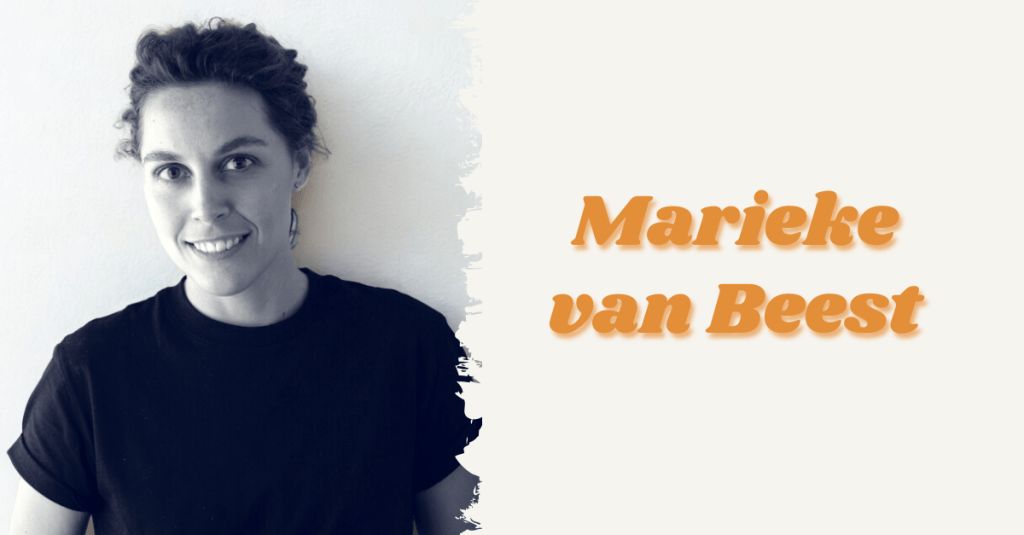
Marieke van Beest is a Senior Data Scientist at Halfspace AI.
Where did you graduate from and with which degree?
I did my bachelor’s degree in physics at the Niels Bohr Institute at the University of Copenhagen, with a year of exchange at Caltech during my final year. I then completed my master’s degree, also from the Niels Bohr Institute, where I specialized in high energy theory, and went on to do a DPhil in string theory and quantum field theory at the University of Oxford.
Please give a description of the work you do in your current position.
I design and build AI models for a highly specialized consultancy. Given my background, I focus on Numerical AI/ML (as opposed to GenAI), ranging from forecasting to probabilistic models and advanced mathematics. The work is technically challenging, which I love, and very high-paced. Because the field, and especially its application to industry, is still so young, I get to be a part of inventing how these methods are used and help make Danish and European companies really competitive for the future.
What motivated you to study physics or engineering in the first place
It was 100% a choice of passion – I was not a clever 18 year old, thinking about job opportunities or anything like that. I remember the moment I decided very clearly. I was in 2.g of gymnasium and we were learning about the special theory of relativity. I recall being completely mind-blown by the concept of time dilation, looking around at my class mates like “are you hearing this sh*?” But they didn’t quite have the same enthusiasm as me. I thought, this is better than magic and went to learn more. I was not disappointed either; special relativity, quantum mechanics, general relativity, QFT, quantum information, string theory… I had that same feeling every time.
What made you decide to pursue a career in the private sector?
After my DPhil I went into research in high energy theory as Research Assistant Professor at the Simons Center for Geometry and Physics in New York. I spent two years working on the then-emerging field of generalized symmetries in quantum field theory. I still loved the physics, but during that time I found myself becoming increasingly interested in AI. At the same time, the life of an academic researcher means spending many years abroad, and possibly settling there. That was not for me. I 100% wanted to return to Copenhagen. But aiming for that very specific professorship, which maybe comes once every 7 years, is like trying to hit a pinhead from a mile away. AI is a completely different ballgame. Another thing about physics is that, in my humble opinion, the golden age of high energy theory feels as though it largely happened in the last century. Whereas AI is happening right now, and it’s tempting to be part of something that is so alive and globally formative. So I found a place in Copenhagen doing the most advanced applications of AI/ML, with great reach into industry, and I joined them.
How do you use the skills you learned as a physicist or engineer in your work?
I use them a lot. The topic is different, the setting in consultancy versus research is different, but the skills are all the same. I very quickly discovered I had all the prerequisites to dive straight into machine learning algorithms, from time series modeling to deep learning. All the mathematical methods I needed I already knew like the back of my hand (it was my coding skills that needed a hard upgrade). I even use my research experience a lot: drawing on academic papers when I design solutions and using the storytelling I learned from conference presentations when explaining complex ideas.
What does being a physicist or engineer mean to you?
I think I will never not be a physicist. I know some friends who have taken a similar path feel differently, but for me it is so integral to the way I approach problems and the transition has been so smooth, it feels like a continuation of my path. Even though, objectively, it is a major career change. But that is also to the credit of the company I work for, who know how to play to my strengths. In a nutshell, being a physicist, to me, means being rational, inquisitive, and never backing down from a problem.
What advice would you give to young people (in particular women and minorities) with a background in physics or engineering who would like to pursue a career in the public sector?
Figure out what is important to you and find a job that gives you that. For me, it was working on interesting and technically challenging problems (AI) and having people around me I could learn from (it had to be a full department of data science, I did not want to be an island). For others, number one is contributing to the common good and giving back, or it might be working with friends. For many, salary is a high-scorer. All of them are perfectly okay priorities. But I strongly advise figuring out what yours are and acting on that. When I made my decision to go and do AI in the private sector, I applied to many jobs, but they all had these factors in common.
 kvinderifysik.dk