
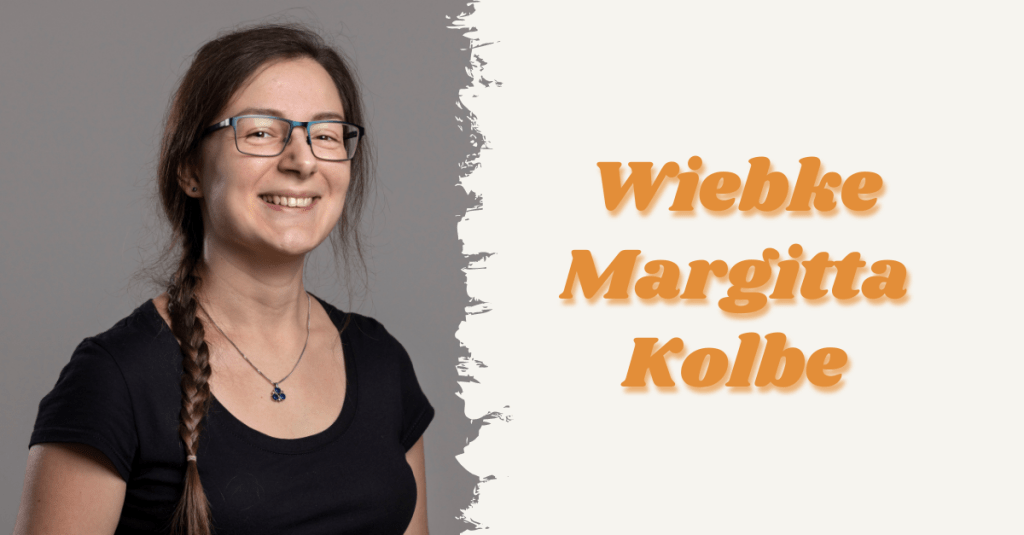
Wiebke Margitta Kolbe is a researcher at DMI.
Where did you graduate from and with which degree?
I received my PhD at DTU Space last year in Physics for the project: „Extension of Sea Ice Climate Time Series with Historical Satellite Data“ with focus on Remote Sensing and Climate Research.
Please give a description of the work you do in your current position.
Currently I’m employed at DMI’s National Center for Climate Research (NCKF) in the Satellites and Arctic unit as a researcher. While our main focus are the polar regions, I’m working with satellite data to analyse sea and sea ice on a global scale. In my work I’m part of several international collaborations and projects regarding climate research, sea ice development and satellite missions. My primary foci are surface temperatures and sea ice developments, such as sea ice concentration and extent.
What motivated you to study physics or engineering in the first place?
I have always been more interested in mathematics and science, liking to work with logical systems. Due to my curiosity on how the world functions and interest in stochastics I choose to study meteorology, which in Denmark is a specialization of physics. This really broadened my horizons and a bachelor was not enough to sate my appetite for knowledge, so a master and PhD in Geophysics followed suit. The more I learn, the more I become aware of what I don’t know and this continues to be a motivation for me today.
What made you decide to pursue a career in the public sector?
I was lucky to land a student job in remote sensing research and became fascinated by sea ice, its link to our earth’s climate and satellites. I feel like the public sector provides me the best opportunity for pure research with less other obligations. It helps a lot that I found a work group where I have a feeling of belonging and having each other’s backs.
How do you use the skills you learned as a physicist or engineer in your work?
Many of the skills, the trained mindset and approach for handling challenges, have carried over from my studies to my actual work life. Coding and data analysis with critical thinking is a daily part of my work.
What does being a physicist or engineer mean to you?
For me being a physicist means that I can try to understand the world, its past, present and future a little bit better. It helps me putting things into perspective and shows how former barriers can be overcome – what once seemed like a pipe dream might be reality tomorrow. We might not all work on the same topics, but most of us share a strong passion and drive for our research, which leads us to thrive and grow – as individuals but also as community.
What advice would you give to young people (in particular women and minorities) with a background in physics or engineering who would like to pursue a career in the public sector?
It might sound cliche, but if possible, follow your passions. Physics is exciting but not an easy field, which does require some extra effort at times. Having a passion for what you’re doing helps to change situations that might drain you to opportunities to thrive. Furthermore, people with the same desire to try and overcome these challenges can create great dynamics, as different as we might be (and I for one, am in a very diverse group).
 kvinderifysik.dk