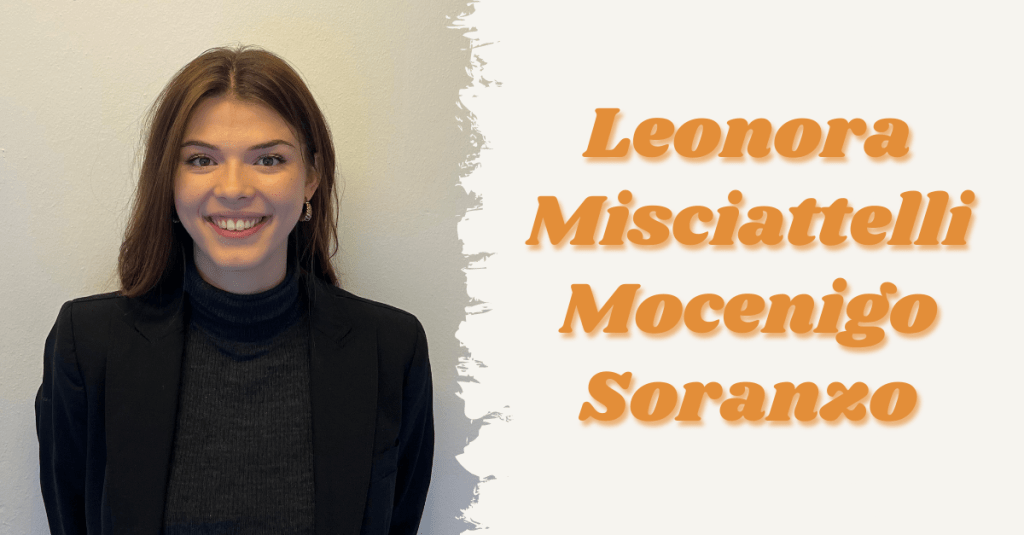
Leonora Misciattelli Mocenigo Soranzo is a Master’s student at Niels Bohr Institute, University of Copenhagen
Where are you studying, and what degree program are you enrolled in?
I’m currently studying in Copenhagen at Københavns Universitet, where I’m enrolled in the Master’s degree in Physics, with a focus on Quantum Physics (the broadest track). I’m specialising in Particle Physics by choosing my electives within this field, so I am taking both theoretical and experimental courses and writing projects within the experimental particle physics sector.
What motivated you to choose physics or engineering as your field of study?
I always knew I wanted to work with numbers and setting things in order, because I love systems and rules. For some time, I thought I wanted to be an accountant, but then I worked at an accounting firm during my sabbatical year and realised that my desire for order was deeper than taxes. It required something that felt more meaningful to me, and I felt a need to work with something that also engaged the creative part of my brain. I have always been incredibly fascinated by the laws of the universe and have dreamed of deepening my understanding of how the world works, so what better field to pursue this in than Physics? It might sound absurd, but I also realised that Physics could satisfy my need to work more creatively. And that is how I ended up at the Niels Bohr Institute for my Bachelor in Physics in 2022.
Which course or topic in your studies has excited you the most so far, and why?
I think the best course I have taken so far has been Modern Particle Physics, which I took last semester: it was a very broad course that really covered all the topics I’m interested in, which was great. Other than that, I also really enjoyed working on my Bachelor’s thesis last year: it was an incredible experience to work directly on real research topics, and it made me realise how much I love working in academia. It gave me back the sense of meaningfulness I had almost lost from just following the mandatory, more general physics courses, so I am very grateful.
Tell us about a project you’ve worked on (in class or beyond) that you found especially fun or meaningful.
I’m currently writing a project (PUK: Projekt Udenfor Kursusregi) on the Future Circular Collider (FCC), a proposed collider that would be built after the LHC stops operations at CERN, if it is approved in 2028. I’m working on simulations that will determine the physics potential of the different detector proposals. I think this is a very meaningful project as a young physicist because the FCC proposal is to become reality only in the 2040’s, which would be in the middle of my career: I really feel like I get to have a say on the future of experimental particle physics thanks to this research.
———————————————————————————————————————————————-
From Master’s Student to PhD School in Florence
Recently, you were invited to attend the “Frontiers in Nuclear and Hadronic Physics 2026” INFN GGI School in Florence, even though it is aimed at PhD students.
What is this school, and what was it like to participate as a Master’s student?
The school was a 2-week program of lectures organised in Florence at the historical Galileo Galilei Institute, near the town of Arcetri, where Galilei formulated the famous “Discorsi e Dimostrazioni Matematiche intorno a due nuove science”. The subjects ranged widely within heavy ion physics, as the title of the school, “Frontiers of Nuclear and Hadronic physics”, suggests: mostly the courses had a theoretical focus, but many connections to experiment were made.
I must admit I was very afraid of feeling out of place: not only am I a Master’s student, but I am a first-year Master’s student, so I was definitely fearing that I would be ‘behind’. And even though I felt a little behind, I was still able to discuss and understand the physics we were taught in our courses and that my fellow students were working on. I was not the only Master’s student at the school, there were about 5 of us (and, in total, 50 participants, so it was okay), but I was the only first-year Master’s student.
How did it feel to be invited to a PhD school as a first-year Master’s student?
It did feel like a very big honour! It is always nice to be recognised for the work you do, and to find out that the work you have done so far actually matters and is comparable (to some extent) to what the other participants have done, even though I am not as far up the academic career ladder as they are.
What was a typical day at the school like?
After all the students had breakfast together at the hotel we were staying at, we walked up to the Institute for our first lesson of the day at 9 AM, which would end at 1 PM, when we went to lunch in the Institute’s cafeteria. The lunch break would last until 3 PM, so fast eaters like me had plenty of time to work before the afternoon session started and went on until 5 or 6 PM. In the afternoon session, we usually had around 1 hour for student talks, where each of us presented the research we’re currently working on. After that, we would all return to the hotel and either work in the common room or take part in social activities, such as a group dinner or an aperitivo. We even went for a karaoke on the last night, which was a lot of fun!
Did participating in the school influence how you think about pursuing a PhD yourself?
Not really, but that is only because I was already sure that I wish to pursue a PhD when I finish my Master’s degree. The school simply confirmed that this is really something I want for myself and broadened the subfields in which I would be interested in doing a PhD.
How important do you think experiences like international schools and conferences are for young physicists?
I think it is very important to try this, especially for building a long-lasting network within one’s field.
Participating in a school was a very different experience from participating in a conference: at the conferences/workshops I have participated in, the focus was more tunnelled on displaying the newest results of your research, whereas this school was a lot more learning oriented, ensuring all the students were following and learning from the very basics of the course subfields and then building up their knowledge from there.
Conferences, workshops, schools and networking events are all a big part of working in academia, so I believe it is quite important to try these things out before ‘getting in too deep’ and then maybe finding out that this part is not for you.
Looking Ahead
What kind of career or future do you imagine for yourself – in or outside of academia?
I dream of staying in academia and hope to pursue a PhD after completing my Master’s. I think that if I end up outside academia after my degree, I probably wouldn’t go back, and I would definitely regret it if I didn’t give this a real try. I am not sure what my future looks like in the long run, but I’m passionate about many aspects of academia, not only research but also outreach and teaching.
What does being a physicist or physics student mean to you?
Being a physicist means building a deep understanding of the world, which you have developed both mathematically, by describing nature’s rules in a precise and objective way, and creatively, by imagining what those rules imply beyond what we can immediately see.
It means learning to think in a very disciplined way: to be curious, but also honest about what you do and don’t know, and to let data and logic guide you. Physics rewards patience and precision: you can’t talk your way through a calculation or a measurement, you have to be consistent. At the same time, it is a very creative field: you constantly switch between imagination, wondering “what if the world works like this?”, and reality checks, such as “does it match what we observe?”.
It also means being part of a community that tries to understand something bigger than ourselves.
Do you engage in any outreach, student organisations, or science-related activities outside your studies? If so, what do you enjoy about them?
I was a Student for a Day guide until recently; here I accompanied High School Students interested in studying Physics at KU and let them participate in a day-in-the-life of a physics student, for example, by attending lectures together. This was an incredibly giving experience that made me appreciate parts of my studies I otherwise wouldn’t have, just by seeing things from the new perspectives of these young, interested students.
I have also done some Science outreach: I recently showed a class of high school students from Aarhus around the new Niels Bohr Building and presented what work we generally do in the Experimental Particle Physics section and the specific research I have been working on. I had to convey complex information to this group in an engaging, easy-to-understand way, which ultimately deepened my own understanding. Knowing I might have increased their interest in studying Physics is an incredible feeling.
As of this year, I stopped working as a Student for a Day guide because I started to work as a student worker for NICE (National Instruments Center for CERN Experiments), where I also work with outreach, but in a very different way: I’m currently building a website about CERN activities with Danish participation.
Do you have hobbies or interests outside of physics that are important to you, and how do they shape your life as a student?
I am a very creative person, and even though Physics fulfils my need for creativity, I still do love finding time to paint and draw every now and then. I also enjoy art in the form of fashion, design and architecture, journaling, and even cooking.
I think that having so many non-passive creative outlets really keeps my brain up to speed when I have to use my creativity for Physics!
What advice would you give to other young people, especially women and minorities, who are considering a physics degree?
Just do it!
Starting physics can feel intimidating because it sometimes looks like you have to fit into a certain “group” to belong. In our minds, that “group” might be made up of only geniuses, only men, or only a certain stereotype, and it can feel like you need permission to enter.
But the truth is that you belong in Physics exactly as you are. You don’t need to become “one of the boys,” and you don’t need to shrink your personality, hide your interests, or give up your hobbies and passions to be taken seriously. In fact, those parts of you are strengths; they make you more resilient, more creative, and often a better collaborator.
You don’t have to ask the group for permission to do what you’re passionate about, so if you’re considering a Physics degree, my best advice is go for it!
 kvinderifysik.dk