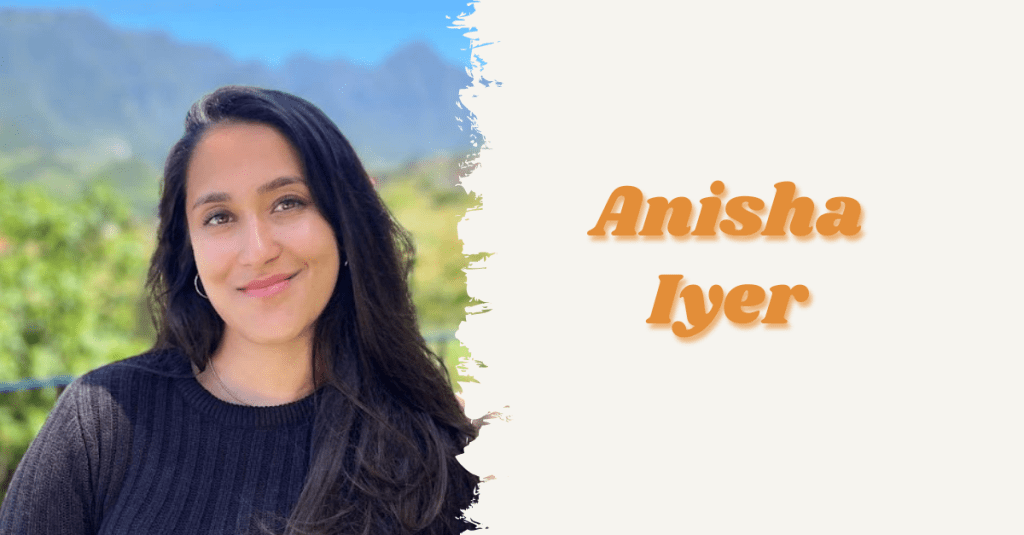
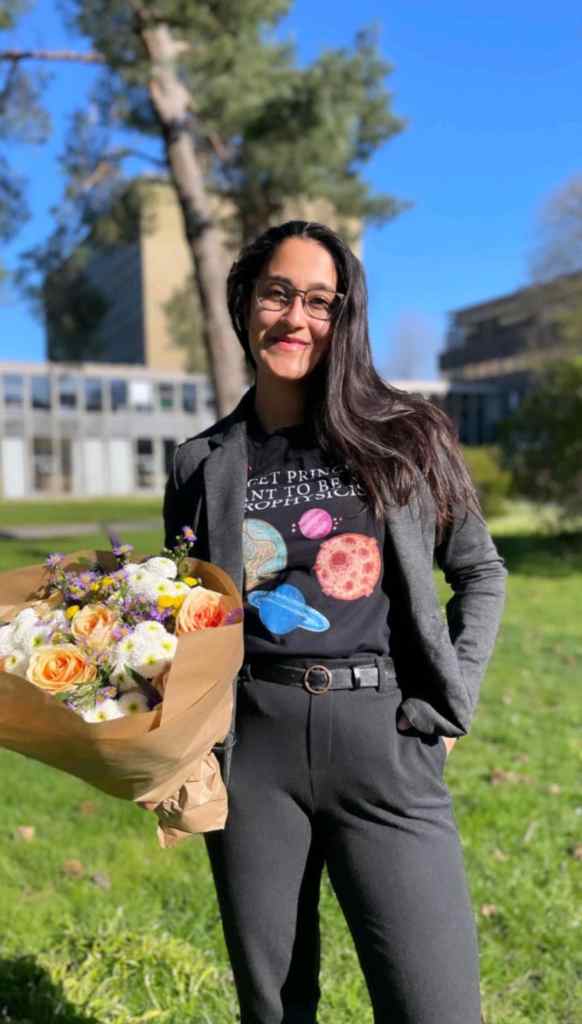
Anisha Iyer holds a master’s degree in astrophysics from the Niels Bohr Institute and has recently completed a Young Graduate Trainee position at the European Space Agency, where she worked with space education and didactics. She has a strong background in science communication from Planetarium Copenhagen, Experimentarium, and MentorDanmark, and she is the creator of the Danish astronomy podcast Afkørsel til Mælkevejen. Now based in Denmark, Anisha is pursuing science communication full-time, working to make space science accessible, engaging, and inspiring for audiences of all ages.
Growing Between Countries
You grew up between London and Copenhagen and attended high school in the UK. How did moving between countries and education systems shape your interest in science and your sense of identity in STEM?
The room was humid, with the smell of teenagers in the air. The teacher stood at the front, calling on people without warning. His voice raced across concepts I couldn’t quite catch. I tried to make myself as small as possible, hoping not to be called on – scared of exposing my lack of understanding… my broken English.
Moving to the English school system at 16 nearly broke me – and yet, it became the foundation I didn’t know I needed.
I had been “the smart one.”
I had been “the table tennis champ.”
I had been “the life of the room.”
Suddenly, none of it was true. My identity fell apart like a house of cards I had spent years building.
The only thing left was to start from the ground up. I began climbing again – problem by problem, weekend by weekend – until it felt like I’d reached the summit. I was getting everything right.
Then a teacher looked at my work and said, “That doesn’t mean you can’t get smarter.”
I felt a flash of annoyance. But for the first time, something in me also felt deeply seen. Not for what I already knew, but for what I could still become…
From failing the entrance exam to gradually falling in love with physics, I grew – supported by teachers who always had my back. It shaped how I see STEM today: struggling doesn’t mean you don’t belong; often, it means you’ve entered a space where real learning begins.
When did astrophysics first become “your thing”? Was there a particular moment, teacher, book, or experience that sparked your passion for space?
“Dear mum, the sky is so vast.
Dear mum, there are so many stars in the sky.
Dear mum, do you think someone might be living on the stars? Perhaps, looking down at me?”
My earliest memory of being fascinated by space comes from my mum singing the Danish nursery song “Solen er så rød” – “The sun is so red.” That song ignited a core sense of wonder that has stayed with me ever since: Is there anyone out there?
Finding Her Way in Physics
Looking back at your time at the Niels Bohr Institute, what courses, mentors, or experiences had the greatest impact on your path?
In a large auditorium, with the professor’s continuous lecture echoing across the rows, I slowly drifted away.
I knew I was “supposed” to be there, taking notes and following along – but passive listening didn’t work for me. I thrive through active problem-solving. So I skipped the lectures, wrestling with problems alone in the library, where silence often felt louder than the classroom itself. I worked through each challenge at my own pace until I hit a wall – and only then was I ready to step back into the world.
Usually, that meant getting together with a small group of peers where I felt safe admitting I didn’t understand. We learned by explaining concepts to one another, by stumbling together, by pushing through problems collectively. That experience taught me to trust my intuition, to forge my own path, and that the right way to learn is the way that works for you – even when it defies expectation.
From Astrophysics to ESA
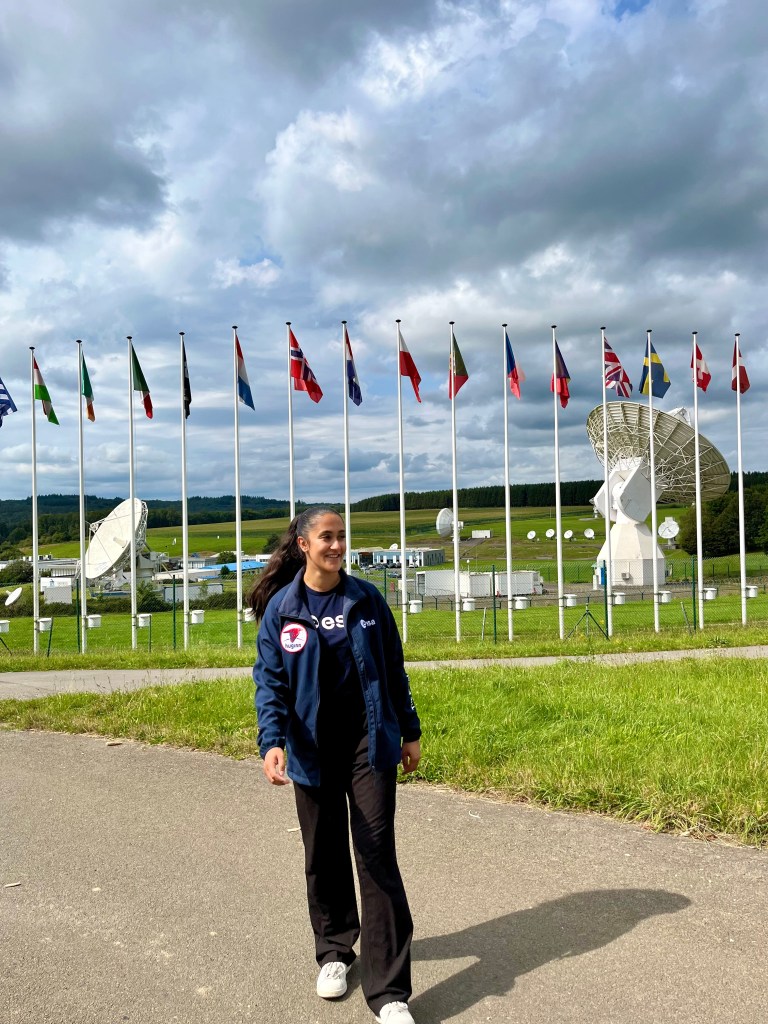
You recently completed your Young Graduate Trainee position at the European Space Agency, where you worked in didactics and educator training. What did that role involve, and what did you learn about teaching space science to diverse audiences across Europe?
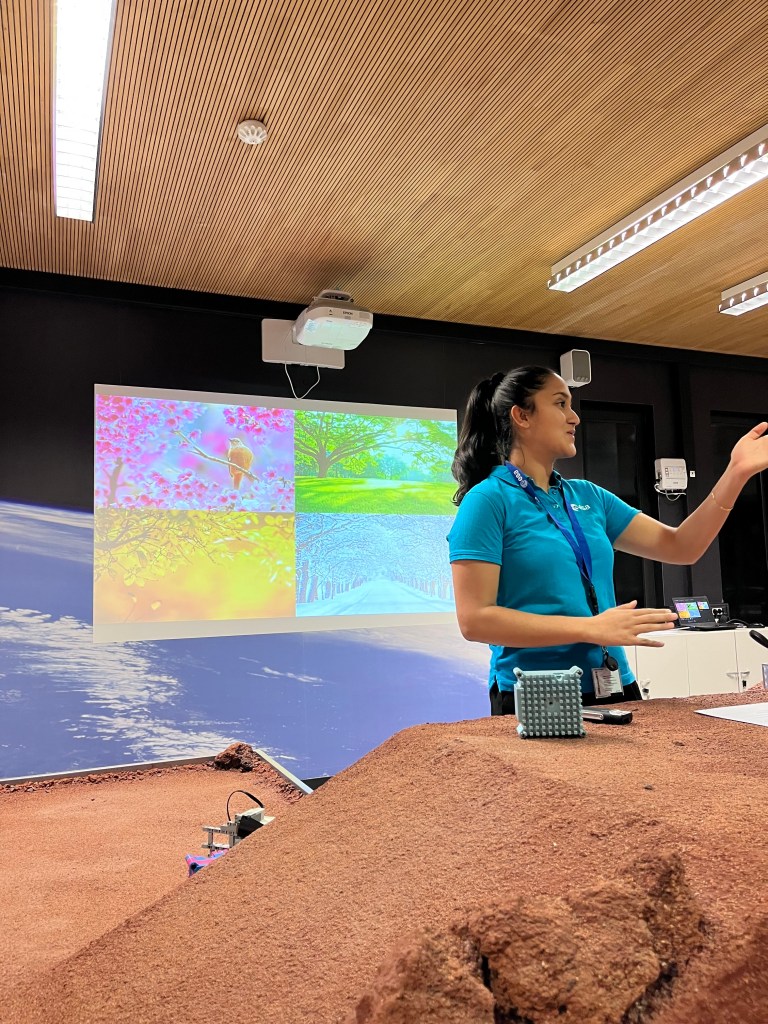
At ESA, I discovered what it really means to support teachers. My role involved managing school projects, developing educational materials, coordinating events, and delivering teacher training workshops – supporting teachers and students across all ESA member states.
During this work, I saw just how much teachers do. They aren’t just educators – they are mentors, counselors, friends. Sometimes, they are the only person a student truly feels seen by. Students who will grow up to shape our tomorrow. Students who will invent, lead, create, inspire. Yet so much of this work goes unseen. Unrecognised. Uncelebrated.
Supporting teachers isn’t just about creating more resources. It’s about giving them space to feel valued, connected, inspired. It’s about providing the tools, the confidence, and the community to guide students effectively.
This experience reinforced something I carry into all my work: learning doesn’t just happen through content. Learning happens when you feel supported. When you feel capable. When you feel empowered. When you feel free to explore – whether as a student in a classroom or a teacher guiding them.
ESA brings together many nationalities and scientific backgrounds. What surprised you most about working in such an international and interdisciplinary environment?
What impacted me most about ESA wasn’t just the mix of nationalities or scientific backgrounds – it was the people it attracts. Everyone there is ambitious, driven, and committed to being the best version of themselves. That shared energy creates an environment where dreaming big isn’t just accepted – it’s expected.
At ESA, it’s encouraged to imagine beyond current limits, challenge what’s possible, and pursue ideas that feel far-reaching or even audacious. Being surrounded by people who constantly aim for greatness is energising; it inspires you, fuels your confidence, and empowers you to pursue your own bold ideas.
Science Communication as a Calling
You have worked as a science communicator for many years – at Planetarium Copenhagen, Experimentarium, and as a mentor. How have these experiences shaped your approach to communicating science?
My roommate used to say she could tell whether I’d been to uni or work the moment I came home – I was always energised after my student jobs, and drained after university. Looking back, that was an early sign of where my passion truly lay: science communication.
At Experimentarium, I discovered the power of play and free exploration – how hands-on experiences, authentic conversations, and whimsical moments can spark curiosity far more effectively than explanation alone. At Planetarium Copenhagen, I refined my storytelling – learning how to turn abstract physics into stories that audiences could visualise, follow, and feel connected to. And as a mentor, I saw firsthand the importance of relationships: confidence grows when someone feels seen, supported, and believed in.
Together, these experiences shaped my approach to science communication. It’s not just about transferring knowledge – it’s about connection, curiosity, and creating moments where people feel inspired and capable of exploring science for themselves.
Your Danish-language podcast, Afkørsel til Mælkevejen, has become a key platform for reaching young listeners. What inspired you to start it, and what do you hope your audience takes away from it?
It was January 2nd, and I was nursing a mild hangover, shuffling through the streets of Copenhagen on my way to lunch with journalist Micha Fuglede. Over coffee, she asked, “Have you ever thought about starting a podcast?” My laugh was nervous; I didn’t even know where to begin. She smiled and said, “Sometimes it’s just about starting. I have the equipment – why don’t we record an episode in three weeks?”
My heart raced. Panic whispered. But I said yes anyway.
From that moment, I knew I wanted to create something I had missed deeply as a physics student: a space that was human – where doubt, curiosity, and ambition could coexist, and where it was allowed to struggle, ask naive questions, and admit uncertainty without questioning your right to belong. If it can help even one listener feel seen, less alone, or brave enough to stay curious when the path feels unclear, then saying yes that January morning was worth it.
You communicate science in many formats – live shows, exhibitions, podcasts, workshops, and now full-time outreach. How do you adapt your communication style to different audiences, from schoolchildren to space enthusiasts to teachers?
Communication begins with curiosity – a willingness to truly see your audience. Who are they? What do they care about? Are they seeking inspiration, fun, purpose – or simply to feel seen?
When you truly see your audience, you also see their constraints. Often, the difference comes down to time: students have the freedom to explore, while teachers need concrete tools that save precious minutes in their busy schedule. Yet whether it’s schoolchildren, teachers, or space enthusiasts, the elements that engage them are the same: stories that spark imagination, questions that invite participation, and hands-on moments that bring ideas to life.
At the end of the day, humans respond to being seen, challenged, and inspired. If I can leave anyone – child, educator, or enthusiast – curious, excited, and empowered to keep exploring, then I know I’ve done my job.
Belonging, Responsibility, and What Comes Next
As a young woman in astrophysics and space-related fields, have you ever struggled with belonging, confidence, or stereotypes? How have you navigated those moments?
At sixteen, I questioned whether I was smart enough to study physics. I was the only girl in my A-level class and often felt lost. I remember being told about a conversation between two teachers. One had asked, “How does she get such high grades when she seems so confused in class?” The other replied: “She asks until there’s no doubt left.”
That pattern followed me into university. Others seemed fluent in a language I was still learning – even when my results said I was doing well. And outside academia, the doubt took a different shape: people were surprised I studied astrophysics, or expected me to fit a narrow idea of what a physicist should look like or be interested in.
Over time, I realised that what I once saw as shortcomings were actually strengths. Asking questions, taking time, and refusing to fit the mould didn’t mean I didn’t belong – they were precisely how I learned, how I grew, and how I claimed my place.
In the media, you’ve been described as a role model and a catalyst for greater inclusion in STEM. How do you feel about being positioned in that way, and what does that responsibility mean to you?
As a young woman in STEM, I often felt out of place, questioning whether I belonged. Today, if I can help someone feel seen, supported, and empowered, I know my work matters. Being seen as a role model isn’t just recognition – it’s a responsibility, one that I translate into a purpose I choose, shape, and live every day.
Having experienced STEM environments in the UK, Denmark, and at ESA, what cultural or structural changes do you believe would make science and engineering more inclusive?
Inclusion begins with community. People must feel they belong, that their voices are heard, and that their presence is valued. Ask yourself: who do you invite to the table, whose voices are amplified, and what opportunities do you create so everyone can participate fully? Inclusion is a culture to be lived every day – in the choices we make, the spaces we create, and the perspectives we listen to. Diverse voices aren’t just fair; they lead to better ideas and richer solutions.
Science communication is a rewarding but not always straightforward career path. What motivates you to pursue it so passionately, and what challenges have you encountered that people might not see from the outside?
I didn’t choose science communication – it chose me. Every time I engage with it, my chest races, my mind sparks, and a hunger I cannot ignore takes over.
But it’s not easy. I’m planting seeds that often go unseen. From ESA to independent projects, the path is uncertain: people glimpse fragments, never the full vision I am constructing. Late nights, invisible effort, financial uncertainty – yet the flame of passion keeps me moving forward.
You’ve worked at the intersection of science, education, and storytelling for several years. How do you balance your scientific background with your creative and communicative side?
I love diving deep into complexity, yet I thrive on the bigger picture. Through my scientific lens, I see the details. I see the meaning. I see the potential. Through my creative lens, I translate science for others, and through others, science comes alive. Together, they create moments of curiosity, clarity, and connection. Science without communication is simply a secret kept too well.
For young people, especially girls, who dream of working with space or becoming science communicators, what advice would you give them?
Decide. Decide you are going to do it. Decide to paint the vision as vividly as you can. Paint it. See it. Believe it. Then work backwards – backwards to the steps, backwards to the first action. The first action you take today.
I failed my A-level entrance. I was rejected by the University of Copenhagen. I faced doors closing. Doors closing, yet I kept moving. I never took no for an answer. Once you decide, the only path left is forward – forward to learning, forward to growing, forward to trying.
Because. You. Are. Not. Failing. If. You. Are. Still. Trying.
And finally, what’s next for you? Are there upcoming projects, collaborations, or ambitions – scientific or creative – that you’re excited about and would like to share?
My immediate goal is to make Afkørsel til Mælkevejen one of Denmark’s largest science podcasts. My dream is to build an international community where young people feel they belong in science. I’m planting seeds across multiple projects, nurturing them carefully, waiting for them to grow. Right now, most of my time is spent at the roots – in the dark, on late nights, with hidden effort and patience. But the passion for my vision keeps me going. I strongly believe that one day, the fruits will be visible, and the impact will be real.
 kvinderifysik.dk