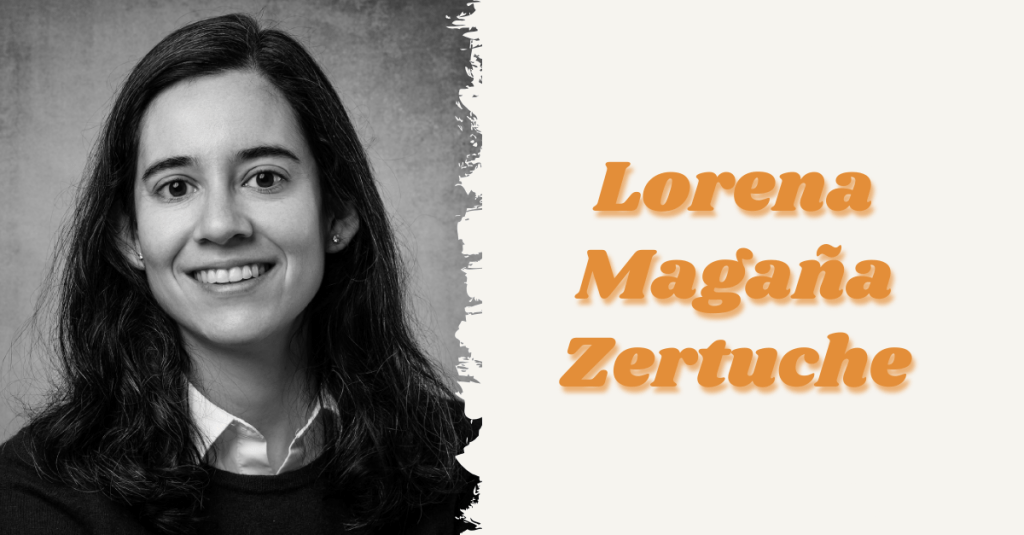
Lorena Magaña Zertuche is a Postdoc at Niels Bohr Institute, University of Copenhagen
What motivated you to pursue a career in physics, and how did you choose your area of specialization?
When I was younger, I was interested in space, and so for many years I wanted to be an astronomer. It was not until I read a book on stars and planets that I was introduced to neutron stars and black holes. I found these objects so mysterious that I was immediately pulled in. After some internet searching, I learned about the field of astrophysics and how it helps explain our universe. At that moment, I knew I wanted to study physics with a focus on black holes and gravity. Fortunately for me, there were black hole experts at my undergraduate university, where I was able to get started on research.
Where have you studied, and what did your career path look like until now?
I got my Bachelor’s degree in physics with a concentration in astrophysics at Georgia Tech in the US. Then, I went on to complete my Master’s degree at Syracuse University in New York. This was a very nonlinear process since I initially intended to complete my Ph.D. there. Due to unforeseen circumstances, I moved to the University of Mississippi, but my Master’s degree was not recognized, so I had to retake all the courses as well as the Ph.D. qualifying exam. On top of that, a year into the Ph.D. program my advisor moved institutions, so I sought a new advisor to work with. In the end, I still consider myself lucky since it all brought me to where I am today.
What is the focus of your current research, and why is it significant?
My research has mainly focused on the aftermath of a binary black hole collision. Once two black holes merge to form one final black hole, the remnant object ‘vibrates’ at a set of frequencies that are dampened with time. Since each black hole system has a different set of masses and spins, among other parameters, they will also vibrate in a different way. My work is to investigate the contributions of the different vibrations of these ringing black holes based on the initial configuration of the system. Once we can estimate the ringing amplitudes, we can build models that may be used for real observations. Not only does this allow us to more rigorously test Einstein’s Theory of General Relativity, but we also expect the next generation of gravitational-wave detectors to capture this ringing with more sensitivity than ever before.
Looking ahead, which area of work are you most excited to explore (in or outside of academia)?
Within my field, many exciting lines of research are making significant progress. It is too difficult to choose just one, so I will mention three. The first is gravitational wave lensing. It is something I have just begun to learn more about. In short, when you have a system of binary black holes merging, and they emit a gravitational wave, the wave will travel through space unimpeded by matter. However, objects between the source and us will deform the signal as it travels. The second area I would like to keep exploring is machine learning applied to gravitational physics. Machine learning can do a lot of the tedious, heavy-lifting so that we have more time to do more interesting physics. It can also be used in many different ways, from waveform modelling to quick data analysis.
What keeps you motivated in your research and work, and how do you maintain that drive?
For many people, including myself, motivation comes in waves. There are times when curiosity keeps me hooked on my research and times when I daydream of opening a coffee shop-bookstore. It is easy to keep motivated when one gets nice plots/results, and I usually allow this excitement to propel me forward. When I feel little motivation, I try to break tasks into smaller pieces and reward myself at the end of the day by trying out a new recipe or starting a new book/TV series. Moments of low motivation are usually when my impostor syndrome kicks in, so I make an effort to increase positive self-talk. This is something new I am trying, and it seems to be working.
Do you engage in public outreach or science communication related to your research? If so, what does that involve?
I have done a lot of outreach in the past, mainly during my PhD. It is a responsibility of being a scientist that I greatly enjoy. My favourite outreach events are those that have been held at museums. I get to interact with hundreds of kids ages 5-16, so it is a fun challenge to explain my research at different levels. The best part is seeing the excitement in their faces when they understand something. Another event I’ve participated in is going to schools to show demonstrations, such as using liquid nitrogen or a vacuum chamber to make marshmallows expand. I also really enjoy giving talks to a general audience, such as the Astronomy on Tap talk I gave in Copenhagen.
Do you have any hobbies or activities outside of work that you are passionate about, and what makes them meaningful to you?
I always make sure that I do not make my research my life (of course, that is a very personal choice and not necessarily the best one for everyone). I really enjoy playing tennis because it allows me to fully disconnect from work and just enjoy the present. Since moving to Denmark, I have not played much, so I have taken up other hobbies to substitute it, such as playing padel and cycling. Cycling had been very enjoyable since it allows me to explore different areas of Denmark and its culture. I also enjoy reading, cooking, and watching sports. My hobbies have changed over time but there is always something fun to do.
What are your thoughts on the importance of being a mentor and advisor to students and younger scientists, and what is your own approach?
Being a good mentor and advisor makes all the difference to someone’s academic journey. A good mentor/advisor has the opportunity to positively impact a student at any time in their academic path. They have the power to help a young scientist succeed in the field or push them away from science. I think more scientists should see their role as mentors/advisors to be as important as their research instead of as an inconvenience. I try to take all the positive aspects of all my mentors/advisors to make me a better scientist and mentor to my peers and students. I try to show patience, understanding, and empathy above all since we are all human and have the same end goal. I want to be supportive and help younger scientists grow and be the best version of themselves they can. I think it is important to show them that they can trust you to help them succeed.
Have any mentors played a significant role in your career, and how have they supported you?
The most impactful mentor I’ve had is by far my undergraduate research advisor, Deirdre Shoemaker. She gave me a spot on her research group as a first year university student, when I was just learning how to code. She gave me a chance that others did not and allowed me to begin my journey into gravitational physics. She gave me a strong foundation on the basics of black hole research and encouraged me to give my first talk at a conference for undergraduate women in physics (CUWiP) back when I didn’t know it was a possibility. Deirdre went beyond what most mentors do and taught me an incredible amount about the inner workings of academia, such as how funding works, what soft money and overheads mean, how large collaborations work, etc. She gave me advice when I was applying to graduate school and when I was struggling during my PhD journey. To this day, I go to her for advice because I trust her experience and her humaneness.
What advice would you give to young people, in particular women and minorities, who would like to pursue a career in science?
My advice would be to persevere and to allow your passion for science to lead you. It is not an easy path for most people, especially for women and other minorities, but it is intellectually rewarding. Do not let any negative comments take up your brain space. Wherever your path leads, it is because you worked hard for it and you deserve it.
 kvinderifysik.dk