
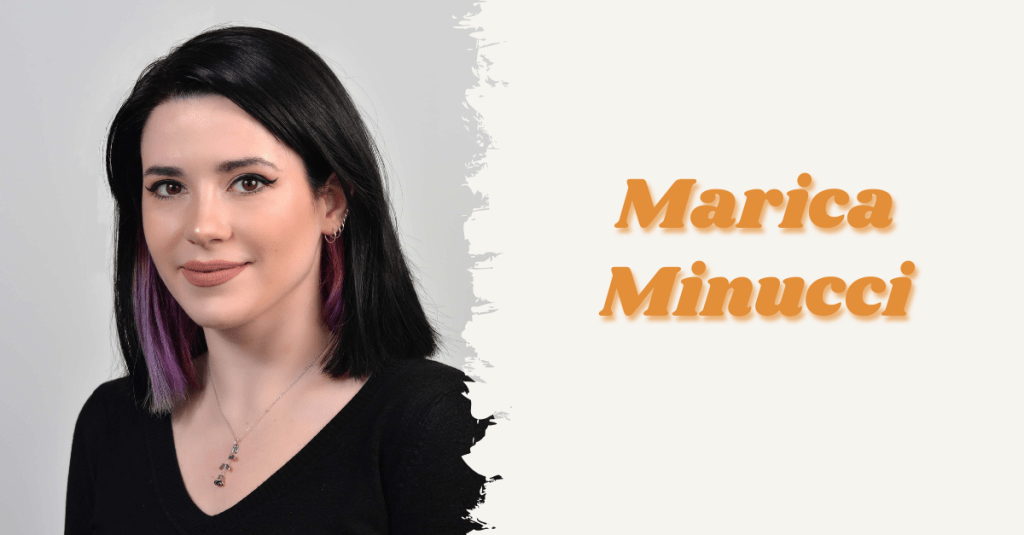
Marica Minucci is a Marie Skłodowska-Curie Postdoctoral Fellow at Niels Bohr Institute, University of Copenhagen
What motivated you to pursue a career in physics, and how did you choose your area of specialization?
I’ve always been curious about how things work. In high school, I was fascinated by electromagnetism and gravity, though I also loved literature and natural sciences. Choosing physics was a gradual process, and I was naturally drawn to the theoretical side. By the end of my master’s, I wasn’t sure whether I was more interested in mathematics or theoretical physics, and talking this over with my supervisor introduced me to mathematical general relativity, a field that perfectly combines both.
Where have you studied, and what did your career path look like until now?
I began my studies in Naples, Italy, where I graduated in Physics and developed a strong interest in theoretical physics. Fascinated by the mathematical structure of General Relativity, I moved to London to pursue a PhD in Mathematics at Queen Mary, University of London. After completing my doctorate, I secured a Lectureship in London and later became a Marie Skłodowska-Curie Postdoctoral Fellow at the Niels Bohr Institute, University of Copenhagen, where I am continuing my work at the intersection of mathematical general relativity and strong-gravity physics.
What is the focus of your current research, and why is it significant?
My primary research focuses on developing the mathematical foundations of black hole ringdown. After two black holes in a binary system merge, the newly formed black hole settles into a stable state through what is known as the ringdown phase. Establishing a rigorous mathematical framework that connects the merger dynamics to the ringdown behavior is crucial. Such a foundation can help refine theoretical models and improve the accuracy of gravitational-wave signals predicted for next-generation detectors, which will demand significantly higher precision.
Looking ahead, which area of work are you most excited to explore (in or outside of academia)?
Looking ahead, I’m most excited to continue working within academia, particularly at the intersection of mathematical relativity and strong-gravity phenomena. This field allows me to pursue rigorous mathematical questions that are deeply connected to fundamental aspects of spacetime and gravitational physics. I’m especially motivated by problems where strong-field dynamics challenge our current theoretical frameworks and where refined mathematical insights can influence how we interpret gravitational-wave observations. It’s this combination of conceptual depth, mathematical structure, and physical relevance that I’m eager to explore further in my academic career.
What keeps you motivated in your research and work, and how do you maintain that drive?
Curiosity is what motivates me most—the satisfaction of understanding something more deeply keeps me engaged. And since not every day goes smoothly, having a solid support network helps me stay grounded. I also rely on yoga to unwind and refocus.
Do you engage in public outreach or science communication related to your research? If so, what does that involve?
So far, my outreach has mostly involved working with bachelor students in physics and mathematics and presenting the research I’ve been involved in. I really enjoy making complex ideas more accessible, and in the future I’d like to take part in more public outreach events. Engaging with broader audiences is something I’m excited to develop further.
Do you have any hobbies or activities outside of work that you are passionate about, and what makes them meaningful to you?
Outside of work, I enjoy reading both classics and fiction, which allows me to explore different ideas and perspectives. I also love going to the theatre, particularly modern adaptations of classical plays. While in London, I saw several West End productions, and I’m excited to continue experiencing theatre in Copenhagen. These activities help fuel my creativity and provide a fresh perspective that often enriches how I approach my research.
What are your thoughts on the importance of being a mentor and advisor to students and younger scientists, and what is your own approach?
I think mentoring is really important for supporting the next generation of scientists. I try to find a balance between offering guidance and encouraging independence, helping students build confidence and critical thinking skills. Creating a supportive environment where questions are welcomed is key, and it’s incredibly rewarding to see mentees grow and succeed.
Have any mentors played a significant role in your career, and how have they supported you?
Every mentor I’ve had has shaped how I approach research, but one stands out from my bachelor’s. At a time when I was unsure of my path, I met a mentor who was not only an exceptional researcher in mathematical physics but also a woman, a powerful example of representation in a field where women were rare. Her guidance and example gave me confidence in my direction and showed me how rigorous science can be combined with integrity and humanity. This experience highlighted for me how important representation is in inspiring and supporting students.
What advice would you give to young people, in particular women and minorities, who would like to pursue a career in science?
I’d say follow your curiosity and trust in your abilities. Seek out supportive mentors and communities, and look to role models, especially those who break barriers, for inspiration. Stay persistent, ask questions, and remember that diverse perspectives are essential to advancing science.
 kvinderifysik.dk