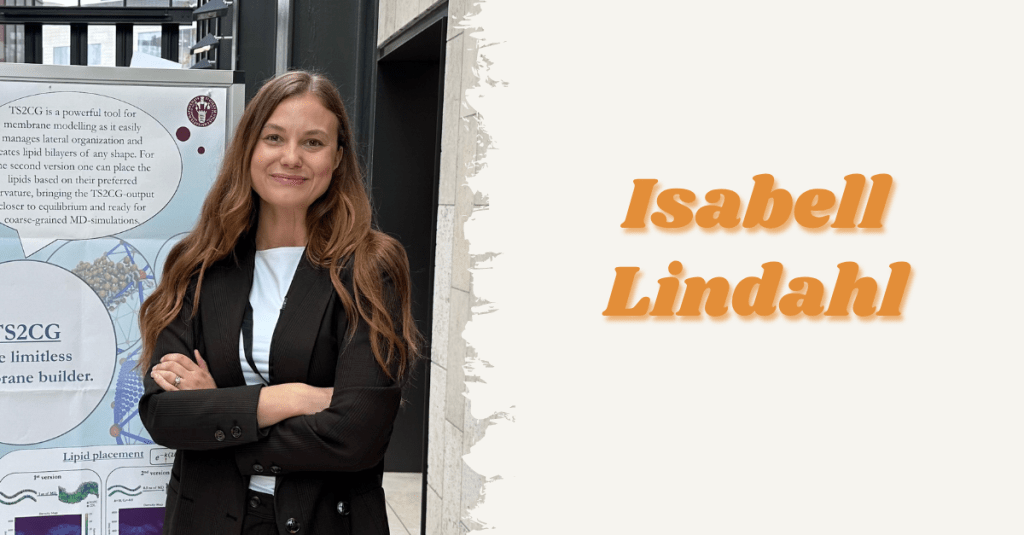
Isabell Lindahl is a PhD student at Niels Bohr Institute, University of Copenhagen, at the department of Biocomplexity.
What is your PhD project about?
My favorite question! It is a computational study about membrane shape remodeling in the inner mitochondrial membrane. More specifically, the cristae of the inner mitochondrial membrane where the respiratory chain complexes build the energy molecule ATP. The respiratory chain complexes are located in an area of high membrane curvature and I am exploring whether those complexes take part in inducing this membrane curvature. The shape of the inner membrane is dynamically organised and is linked to mitochondrial function and diseases, such as Parkinson’s, liver dysfunction and muscular atrophy.
What inspired you to study physics or engineering, and when did you realize you wanted to pursue this path ?
Nature inspired me. The gigantic forces that make planets spin, the tiny forces that form molecules and the unlikeliness of swallowing a pill with the ability to alter or even fix things in the body. I think I always knew that this was the path for me, I was always intrigued by how things work.
What made you choose to pursue a PhD degree?
From the first year of my bachelor’s I just knew that I wanted to pursue a PhD. I love the academic environment and the endless opportunities of learning. I have a MSc in chemical engineering and I felt like I needed more programming skills with regards to where the world is heading. And so I did my master thesis project in computational chemistry and molecular dynamic simulations. I truly enjoyed it and started looking for PhDs in that field. However, I wanted to be picky about both project and supervisor as you hear many horror stories, especially for women. It took about 1,5 years, while I was working in the industry, before I found my current PhD-position. Looking back, I’m very happy about taking some time as I sometimes can’t believe that I get paid to have this much fun.
What hobbies or activities do you enjoy outside of your studies, and how do they help you maintain a work-life balance?
Work-life balance is honestly one of the big challenges in my life for two reasons. The first one being that I truly enjoy my work which makes it difficult to stop occasionally. The second one is simply doing a full PhD in three years. However, I am also a mom to a six year old boy (my biggest accomplishment in life) and so when I get home we have determined mother-son time until he goes to bed and during those hours I’m 100% present with him which recharges me. However, I do have some “rituals” which reduce stress and help me maintain a functioning work-life balance: running or powerwalking in a beautiful area, reading novels in a cozy café and lighting candles in a freshly cleaned home. I’m the classic woman trying to do it all, sometimes crashing and sometimes thriving.
What are three important skills you have gained during your PhD, and how have they contributed to your growth?
- Learning fast and claiming knowledge: I’ve always seen myself as a fast learner, but now I learn not only quickly, but also deeply – I can apply new knowledge and appreciate the difference it makes in practice.
- Public speaking: Has helped me grow more confident and comfortable with attention. It helps me speak up more and hold my ground in both academic and personal discussions.
- Not everyone has to like you: Realising this has freed me from the weight of other people’s opinions and opened up new possibilities for what I can achieve.
What does being a physicist or engineer mean to you?
I’m proud to be a physicist and engineer because it gives me a sense of accomplishment and the feeling that I can make a real impact. Becoming a mother young, and coming from a family without higher education, has shaped how deeply I value this. I want my son to grow up believing that he can shape his own life, and I try to show him that through how I live mine.
What kind of career do you envision after your PhD?
As a notorious day dreamer I envision so many things, probably too many things, and so I’m currently in the process of narrowing down the options. I will most probably return to the pharmaceutical industry and probably not as a straight up researcher.
Do you have role models who have inspired you, and how have they impacted your decisions or goals?
My future self is the person I look to for inspiration.
Do you take part in public outreach, teaching, or science communication during your PhD? If so, what have you gained from those experiences?
The only thing I do with regards to outreach and science communication is that I share some snippets of my PhD-life on my TikTok account. It has been a lot of fun because there are so many like-minded women out there and connecting with them is surprisingly rewarding, fun and inspiring.
Are you involved in any student associations, networks, or initiatives, and what role do they play in your academic journey?
Unfortunately not. I would have loved to be involved in more student associations and networks as it is a great opportunity to connect with people, gain inspiration and support.
What advice would you give to young people, particularly women and minorities, who are interested in studying physics or engineering?
You do not need to be a genius to study physics or engineering. You simply need the interest and the rest will follow. Lastly, you don’t have to be liked by everyone.
 kvinderifysik.dk