This event is free and open to anyone interested. Please register here.
A century after the birth of quantum mechanics, we stand at a unique moment: quantum physics is simultaneously deepening as a field of knowledge and expanding far beyond academic walls. But do we understand what knowledge we are collectively building—and how to share it within and beyond our research communities?
Whether you are pushing the boundaries of quantum theory, developing new technologies, or exploring applications across disciplines, you are contributing to a rapidly evolving landscape. Yet the challenge remains: How do we understand our place in this broader picture, and how do we communicate it to those outside our specialized domains?
As quantum research fragments into diverse subfields—from quantum computing, communications and sensing to foundations and materials—it becomes harder to see the common threads. Meanwhile, quantum concepts permeate industry, policy, and popular culture in ways that demand clear translation.
As 2025 marks the 100th anniversary of quantum mechanics, join us to figure out how to tell your quantum story.
The workshop will be a bit experimental in that it will challenge researchers to see own works from different perspectives:
Program:
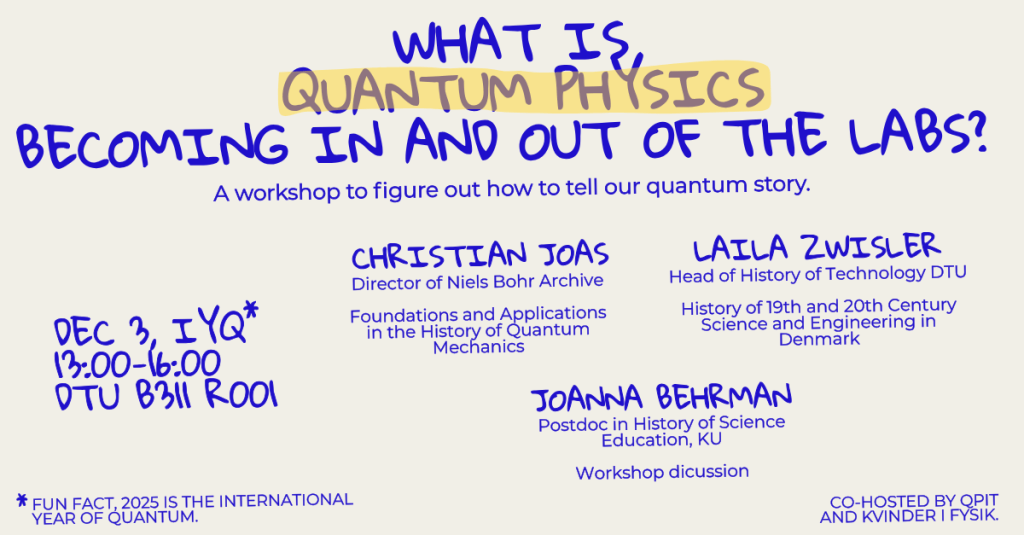
13:00 – 14:00 The Role of Applications in the History of Quantum Mechanics
Christian Joas, Director of Niels Bohr Archive
In my talk, I will challenge the conventional division between foundations and applications in physics and explore how physicists throughout the history of quantum mechanics have applied the theory and extended its scope beyond its original domains. Rather than merely solving specific problems, many applications of quantum mechanics to new domains (scattering, complex atoms, molecules, solids, nuclei) were drivers of conceptual innovation and played pivotal roles in shaping both the theory and its interpretation. I will illustrate this with a few examples from the early history of quantum mechanics. Without these applications, which are often dismissed as merely derivative extensions, the textbooks of quantum mechanics would look very different. There is untapped potential for physicists, historians, and philosophers to delve deeper into the applications of quantum mechanics. This perspective not only enriches historical studies and broadens the focus to include developments in fields that conventional wisdom considers less fundamental, but also provides tools for understanding contemporary developments in fields like quantum information and quantum computing, where practical applications carry considerable weight.
14:00 – 15:00 History of 20th century science and engineering in Denmark (title TBD)
Laila Zwisler, Head of History of Technology DTU
Focus on knowledge hybridization between physics, mathematics and engineering, which is a framework that quantum mechanics belongs to.
15:00 – 16:00 A curated discussion among researchers
Joanna Behrman, Postdoc in History of physics, gender and science education at Copenhagen University
– How to relate with other physics (or non-physics) disciplines?
– How to collaborate even more?
– How to disseminate knowledge to a general audience?
For more information, contact Clémentine Rouvière on clero@dtu.dk
 kvinderifysik.dk