
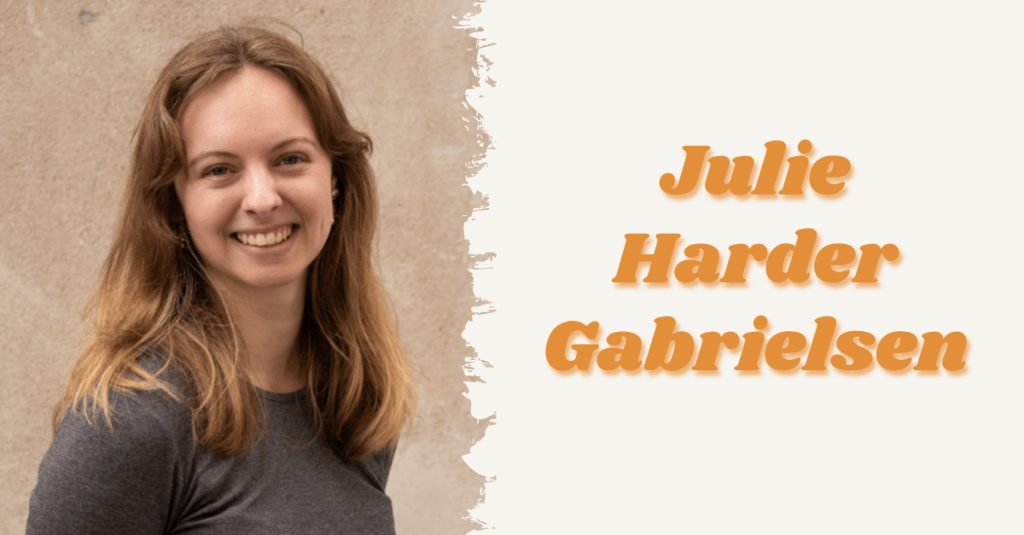
Julie Harder Gabrielsen is a MSc student at the Niels Bohr Institute, University of Copenhagen
Where are you studying, and what degree program are you enrolled in?
Right now I am doing my master’s in physics with a minor in mathematics at the Niels Bohr Institute (NBI).
What motivated you to choose physics or engineering as your field of study?
I have always been very interested in physics, especially theoretical physics, and had since primary school viewed it as being a “cool” field. Perhaps it spoke to me from the beginning because I found it challenging and I liked the logic of it.
To be honest, a lot of different fields have been on the table, though, as I have always had many different interests. Ending up in physics was mostly a coincidence, as I wanted to choose a gymnasium where I did not have to take PE, and this gymnasium did not offer humanistic fields of study.
Which course or topic in your studies has excited you the most so far – and why?
Theoretical particle physics is incredibly fascinating to me! I love the mysteries and the structure (as well as sometimes the lack thereof) of particle physics, and it seems there is always more to learn in regards to theory and ways to approach a problem.
I also really love science education and didactics, and surprising myself a lot, I have also taken a great liking to statistics and probability theory. Some of the best courses I have taken have actually been about this.
Tell us about a project you’ve worked on (in class or beyond) that you found especially fun or meaningful.
I have already mentioned my love for physics, but my first and one true love is actually education.
Unfortunately, I have found that the discourse about ending up as a teacher is simply not good at physics. It is worded as “with this degree you are well suited for so many cool jobs – and if that does not work out, you can always teach gymnasium”. Which, besides being a sad way to look at teaching, is simply not true.
There are a lot of requirements for being a gymnasium teacher, and next to no one actually fulfills those requirements as they are not aware of it. Most people I have courses with are stressed gymnasium teachers who are taking these classes next to their job as a requirement for their position – some of them even having to pay themselves for these courses.
Because the simple truth is that teaching is fun and important and a job many physicists will want to do later in life.
So, back to me, I have started an organization at NBI, trying to spread awareness of this and change the discourse, as well as creating a place for people who are interested in didactics. It is still early in the process, but I hope that this can create some permanent change for the better!
What kind of career or future do you imagine for yourself – in or outside of academia?
I know for certain that I want to teach gymnasium students, but I also want to travel a lot, hopefully work in a few different countries. Other than that, I am also toying with the idea of further educating myself in didactics, so I guess we will just have to wait and see what happens.
What does being a physicist or physics student mean to you?
I am very proud of being a physics student. I wholeheartedly believe that physics has the best study environment and is filled with some of the best people. Being a physics student means to me that I am part of this awesome community along with these great people. It means that I always have someone to go to for help or comfort or a laugh.
Do you engage in any outreach, student organizations, or science-related activities outside your studies? If so, what do you enjoy about them?
During my bachelor’s I was the director of FysikRevyen™ and now I am part of The Physics Didactics club and FemPhys (Female Physicists at NBI), both relatively new organizations. There are so many different student organizations here at NBI, and they are all incredibly welcoming to all, so the difficult part is honestly just prioritizing your time with all these amazing opportunities.
I enjoy being part of a community and feeling like I make a difference. I believe it is very important to be an active part of the student environment.
Through my studies I have also worked with outreach at different jobs at NBI, and I am currently hired by NQCP to teach quantum mechanics and to be a role model for young women and girls in science, e.g. working with the great organization High5girls.
Do you have hobbies or interests outside of physics that are important to you, and how do they shape your life as a student?
It can sometimes be difficult to prioritize hobbies when you are busy with your studies and work, but it is so important. Reading has always been an important hobby of mine, and I do my best to keep reading every week, even when things get busy. I find audiobooks and book clubs very helpful, and taking a trip to the library or comfying up with a book and a blanket is a great way to destress after an intense week.
Traveling is equally important to me, and though I do not get that done every single week, I make sure to always have the next holiday planned out so I have something to look forward to.
What advice would you give to other young people, especially women and minorities, who are considering a physics degree?
It can be difficult to see oneself in the stereotype of a physicist. Perhaps because the stereotype is so far from the truth. As in all fields of study, everyone in physics is incredibly different from one another, and there is room for all kinds of people.
So do not be afraid of not fitting in or not being good enough. Of course physics is difficult, but it is difficult for everyone, and we all get through it helping each other along the way!
 kvinderifysik.dk