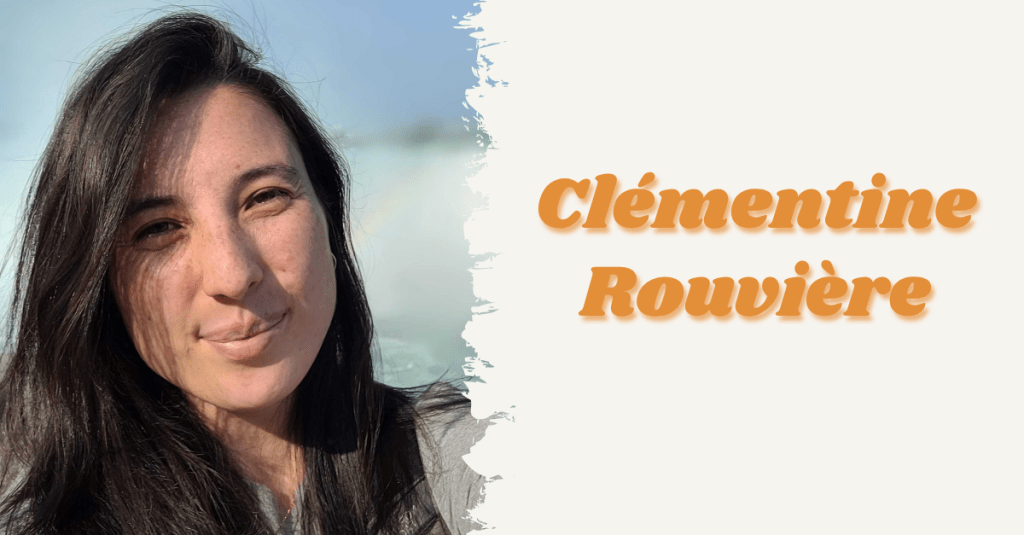
Clémentine Rouvière is a Postdoctoral Researcher at DTU Physics, Technical University of Denmark, in the section of Quantum Physics and Information Technology – and a member of the board of KIF.
What motivated you to pursue a career in physics, and how did you choose your area of specialization?
I’ve always been driven to understand physical phenomena and fascinated by light. This now led me to conduct research in experimental quantum optics because I like both the mathematical description and the experimental tools used for manipulating light.
Where have you studied, and what did your career path look like until now?
I did all my education in France, where I’m from. I got a bachelor and a master degree in Fundamental Physics from a “Grande Ecole” in Lyon, called Ecole Normale Supérieure, which is a selective institution that trains professors and researchers. I then got a master degree specializing in classical and quantum optics at Sorbonne Université in Paris, which also aims to train researchers in basic physics. Before coming to Denmark, I graduated with a Ph.D. in experimental quantum optics from Sorbonne Université, where I was hosted in the Quantum Optics group at the Kastler Brossel Laboratory. I am now in my first postdoc position in the Quantum Physics and Information Theory (QPIT) section at DTU Physics.
What is the focus of your current research, and why is it significant?
The QPIT section is a quantum optics group with both theoretical and experimental sub-groups. My current work is dedicated to understanding how to efficiently encode and extract information from light. This means engineering the light, developing optimized protocols and measurements, and comparing the experimental results with the theoretical model. I am currently involved in two projects within this framework, one aiming at improving the resolution of fluorescence microscopy and the other one focusing on the encoding and transfer of information with a protocol called quantum teleportation. These works fall in the scope of quantum metrology and contribute to improving the performances of optical measurements.
Looking ahead, which area of work are you most excited to explore (in or outside of academia)?
I am really passionate about working in academia. I started my career as an experimentalist, but I’ve been learning to like theory, and am now looking forward to improve my theoretical skills. I am also very excited about learning how to engineer my complex quantum states of light experimentally.
What keeps you motivated in your research and work, and how do you maintain that drive?
I enjoy learning new skills and concepts. The feeling of the pieces falling into place, either from experimental results or from new understandings drives me. Whenever I feel stuck, talking to other people helps me a lot to look at the project with a new perspective and keeps me motivated.
Do you engage in public outreach or science communication related to your research? If so, what does that involve?
Not at the moment, but I’ve participated in different science communication projects and I’m looking forward to do more of them.
Do you have any hobbies or activities outside of work that you are passionate about, and what makes them meaningful to you?
I enjoy roller skating and doing ceramics, especially throwing on the wheel, these activities make my head disconnect.
What are your thoughts on the importance of being a mentor and advisor to students and younger scientists, and what is your own approach?
I still feel very young to be a mentor and advisor, but this is something that is really important to me, especially towards people from underrepresented groups in physics. I think the culture change that we need in physics to have a more diverse field involves transmitting the unwritten rules and codes, and I hope that my experiences could help others save time.
Have any mentors played a significant role in your career, and how have they supported you?
My PhD supervisor is the first one that comes to mind, but I was lucky to have several mentors in my academic life. The most important thing, I think, was to hear my questions and ideas with openness and try to understand what I had in mind without judgment, which is very supportive to someone who is frequently hit by impostor syndrome.
What advice would you give to young people, in particular women and minorities, who would like to pursue a career in science?
Understand as best as possible how you function and what you need in your work environment, and surround yourself with people accordingly. Finding mentors and building a safe support group is what helped me the most.
What motivated you to join the KIF board, and what does the organization mean to you personally?
I want to help others feeling that they belong to the field and to take part in building us a safe research environment.
As an early-career researcher, what perspectives or experiences do you hope to bring to KIF’s work?
I hope to increase the visibility of KIF in academia and to locally create a welcoming place to people who need it.
What is your vision for KIF’s future – either in the physics community or in the broader landscape of STEM?
I hope that KIF would take part in discussions with physics departments in universities to provide safe work environments and improve diversity, and I hope I could contribute to it.
Are there particular issues or initiatives within KIF that you are especially passionate about working on?
I like organizing monthly meetups that bring together people at different life and career stages to build a supportive community.
 kvinderifysik.dk