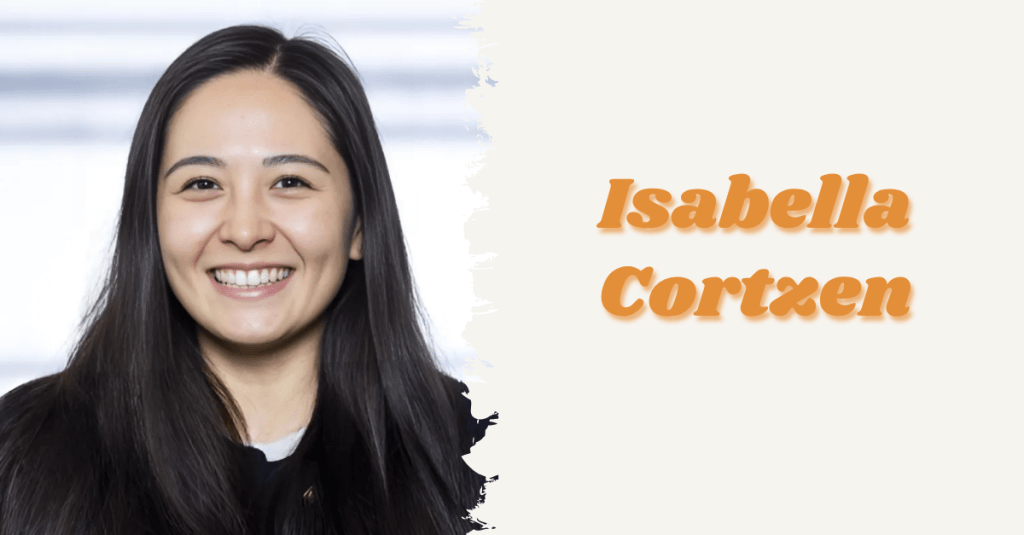
Isabella Cortzen is a Senior Data Scientist at Nykredit
Where did you graduate from and with which degree?
I obtained my Ph.D. in physics from the Niels Bohr Institute at the University of Copenhagen, where I had also completed my bachelor’s and master’s degrees with a specialization in astrophysics.
Please give a description of the work you do in your current position.
I currently work as a senior data scientist at Nykredit’s AI Center of Excellence. I prototype and deploy AI solutions, experiment with new tools and frameworks, and apply new research into practical approaches for the business. A large part of my role also involves building reproducible, production-ready systems and defining best practices so others across the organization can use AI responsibly. Although my official title is Data Scientist, a large portion of my time is spent on technical projects in close collaboration with data engineers, process consultants, and software engineers whom I truly enjoy working with and learning so much from.
What motivated you to study physics or engineering in the first place?
I’ve always been fascinated by space and how stars and planets form. An internship at the Niels Bohr Institute in ninth grade convinced me to study physics, and that curiosity and excitement ultimately guided me through my studies and into a PhD in astrophysics (where I moved into extragalactic astronomy by studying star formation in galaxies!).
What made you decide to pursue a career in the private sector?
After finishing my Ph.D. in 2020, I accepted a postdoc position at the IRAM headquarters in Grenoble, France. It was an exciting research project with a great research team, but moving to a new country during the pandemic made me realize I wanted to apply my skills more directly to problems that affect people day to day. I eventually made the difficult decision to leave academia and move back to Copenhagen, where I started as a data analyst at the Copenhagen Police Department. It was a steep learning curve and a fascinating industry, where I eventually discovered I wanted to pursue a role closer to data science. I then joined an NGO as a data scientist, focusing on decarbonizing the shipping industry. The experiences and skills I developed taught me how to deliver practical value, navigate cross-functional collaborations, and prepared me for industry roles. Now I focus on delivering practical AI solutions while staying engaged with new research.
How do you use the skills you learned as a physicist or engineer in your work?
Physics taught me to approach problems with structured, critical thinking. I use this method to break bigger problems into smaller testable parts, design experiments and hypotheses, and apply statistical analysis. My research habits have also been valuable for critically reading literature and writing clear documentation that ensures solutions are transparent, robust, and explainable.
What does being a physicist or engineer mean to you?
I think being a physicist is about understanding how things work and building models that explain behaviour of a system and its components.
What advice would you give to young people (in particular women and minorities) with a background in physics or engineering who would like to pursue a career in the private sector?
The decision to leave academia was not easy, and finding my path after that was far from straightforward. However, I feel fortunate to have worked with supportive people across research institutes, universities, the public sector, and private companies. Your first role after transitioning might not be exactly what you expected – and this is okay, as every position teaches you new skills and helps you understand what you truly enjoy doing.
 kvinderifysik.dk