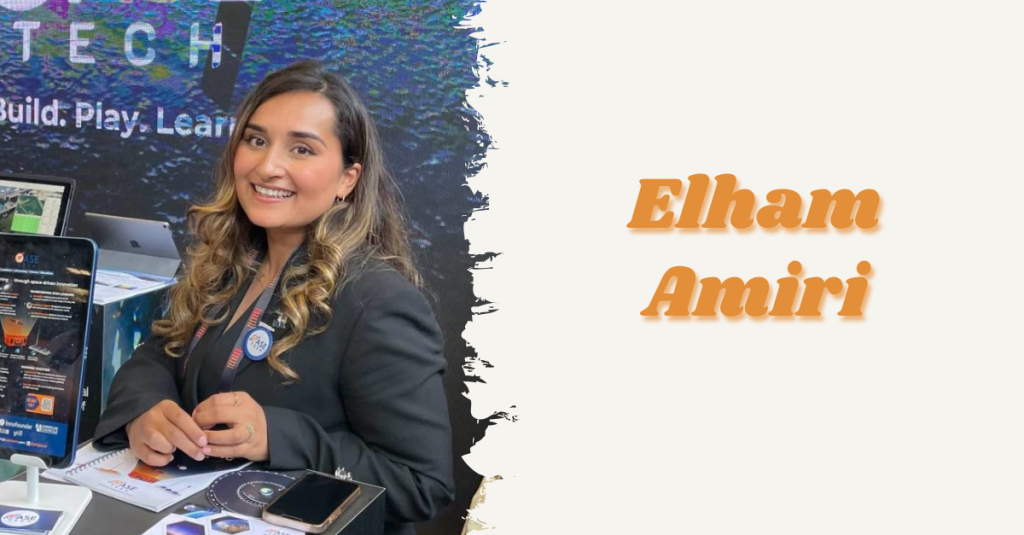
Elham Amiri is an Innovation Specialist at Ørsted & Founder and Director of QASE Tech
Where did you graduate from and with which degree?
From Aarhus University where I completed my bachelors in physics followed by a masters in astronomy with elective courses in medical physics.
Please give a description of the work you do in your current position.
I divide my time between two roles: as founder and director of QASE Tech, and as an Innovation Specialist at Ørsted.
At QASE Tech, I am leading an ESA-incubated EdTech startup I founded after my master’s. Our mission is to bring space technology and quantum physics into classrooms through kits that supplement the curriculum. We combine storytelling of space narratives with hands-on experiments to transform the way STEM is taught. Building on my thesis work, I’ve worked closely with teachers to co-design our kits, ensuring they meet real classroom needs while inspiring students through innovative space narratives.
At Ørsted, I work in the Innovation Department, where I’ve found a knack for bridging the gap between technical specialists and business leadership translating highly technical concepts into frameworks and objectives that decision-makers can understand and act on. I began my journey at Ørsted as a global graduate, changing work & teams every 8 months for a 2-year period.
Balancing both roles has given me a unique perspective: I apply what I learn in corporate innovation to my startup, while my entrepreneurial experience keeps my work at Ørsted rooted in creativity, agility, and impact.
What motivated you to study physics or engineering in the first place?
It’s a little special for me because I’ve always known that I wanted to work with space. I can back this claim up with a proof: I’ll bring you an exclusive look into an essay I wrote in 5th grade!
For the essay we had to write what we thought our future would look like. I wrote (translated from Danish) “I want an international job. It’s between an astrophysicist, physicist and astronomer. To put it briefly: something with the natural sciences. That’s the subject in school I like the most”.
I of course had no idea what it meant to study physics and astronomy back then in 5th grade and I definitely had my struggles with it during university years but I persisted and I’m super proud that I followed this childhood dream of mine.
What made you decide to pursue a career in the private/public sector?
I founded QASE Tech directly after university, encouraged by my bachelor’s thesis advisor. At the same time, I was eager to experience the corporate world, so I joined Ørsted’s graduate program. It offered structured training and the chance to learn from established leaders while working on real global challenges in renewable energy.
Today, I combine both paths. At Ørsted, I’ve gained methods in program management, problem solving, and strategy development. At QASE Tech, I apply those skills to scaling an early-stage venture. Each role strengthens the other: the corporate experience provides structure and frameworks, while entrepreneurship keeps me driven by creativity and mission.
How do you use the skills you learned as a physicist or engineer in your work?
Physics taught me to be an adaptive generalist. Beyond mathematical and numerical skills, I learned how to immerse myself in new theories quickly, analyze them deeply, and then communicate them clearly to different audiences.
At Ørsted, this has been invaluable in shaping the cool work I got to do with summarizing the company’s quantum strategy: I can follow technical discussions while also translating them for leadership.
At QASE Tech, the same skillset allows me to build and scale ideas into reality with an entrepreneurial mindset. Whether it’s designing educational content that makes complex topics, like space communications or quantum physics, engaging and understandable for users or it is pitching our concept to investors and collaborators.
What does being a physicist or engineer mean to you?
I always knew I wanted to pursue this path, but it was not without doubt or difficulties. Studying physics was tough, and I often wondered if I was “smart enough”. Add to that the reality that I didn’t fit the traditional image of a physicist: I am a woman of color in a field still dominated by men, and I carried a strong sense of imposter syndrome.
That is why QASE Tech’s mission is personal. I want to create playful, hands-on learning experiences that give students a feeling of accomplishment and belonging in physics. When students leave their classroom after using our kits learning about physics & space thinking “I can do this,” we take a step toward a more diverse and inclusive STEM community.
What advice would you give to young people (in particular women and minorities) with a background in physics or engineering who would like to pursue a career in the private sector?
My advice is: be bold and seek opportunities, even if you don’t feel 100% qualified. Women and minorities in particular often underestimate themselves judging themselves with a much harder set of standards than what others in reality might.
What I’ve learned is that the list of requirements in job descriptions are often wish lists, not rigid checklists. The worst outcome of applying is a “no” which can happen even when you are fully qualified. So don’t hold yourself back. Advocate for yourself, apply for the role, take up space – and dream big!
Coming from a minority background myself, I know how easy it is to doubt your place in physics. But I also know that opportunities open when you put yourself forward. We need more diverse voices in science and innovation, and you deserve to be one of them.
 kvinderifysik.dk