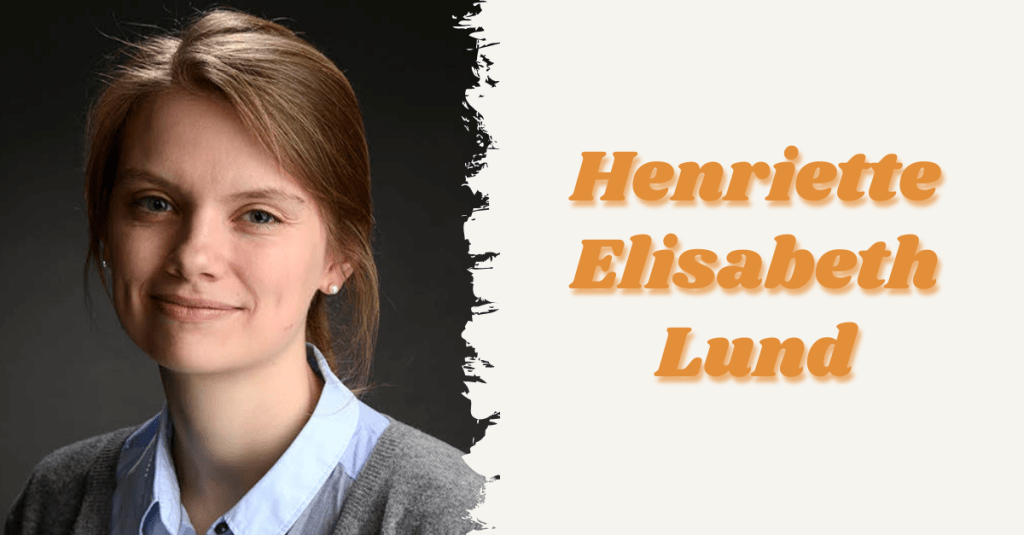
Henriette Elisabeth Lund is a Postdoctoral Researcher at DTU Physics, Technical University of Denmark, in the section of Surface Physics and Catalysis – and a member of the board of KIF.
What motivated you to pursue a career in physics, and how did you choose your area of specialization?
I have always been fascinated by the natural sciences. I remember learning about quantum mechanics in high school and reading the course catalogue for the physics bachelor program and thinking “yes, this is it!”
Where have you studied, and what did your career path look like until now?
I did my bachelor and master degrees at Aarhus University with an exchange semester at the University of Calgary, in Canada. My PhD degree in physics is also from Aarhus University. After completion of the PhD I worked at Novo Nordisk A/S for a little over 1.5 years before starting my current position as postdoc at DTU. I decided to do a postdoc to pursue a new specialization.
What is the focus of your current research, and why is it significant?
I am currently building a high pressure cell for catalytic activity tests of different materials potentially applicable as catalysts in connection with ammonia synthesis.
Looking ahead, which area of work are you most excited to explore (in or outside of academia)?
Both academia and industry are interesting career paths – there are many ways to use a degree in Physics! I am most motivated in environments where I get to exploit my scientific knowledge in a collaborative setting.
What keeps you motivated in your research and work, and how do you maintain that drive?
I enjoy learning new techniques and specializations and collaborating with colleagues. I therefore make sure to have several ongoing collaborations so that there is always something to work on.
Do you engage in public outreach or science communication related to your research? If so, what does that involve?
At this moment no, but it is likely that I will in the future!
Do you have any hobbies or activities outside of work that you are passionate about, and what makes them meaningful to you?
I enjoy reading, hiking, kayaking and cooking. Being outside always clears my mind so I prioritize outdoor activities every day – something as simple as going for a walk always makes a huge positive impact.
What are your thoughts on the importance of being a mentor and advisor to students and younger scientists, and what is your own approach?
I believe that role models play an important role in all stages of life. In the special case of students and younger scientists, role models have the possibility to inspire different career paths as well as induce scientific confidence. This is something that I keep in mind whenever I give advice.
Have any mentors played a significant role in your career, and how have they supported you?
I had excellent teachers in high school that gave me the confidence to pursue a university degree in physics. The positive environment among fellow students during my bachelor and master degrees and in the research group where I did my PhD played a big role in my completion of the degree.
What advice would you give to young people, in particular women and minorities, who would like to pursue a career in science?
Pick a field that interests you and trust your intuition. Build a supportive network (it does not necessarily have to be within science, it could also be at a spare time activity, for instance) since that will help you if you encounter any challenges on the way. Make sure to prioritize other activities apart from science since maintaining a healthy work/life balance will make you more efficient and motivated in the long run.
What motivated you to join the KIF board, and what does the organization mean to you personally?
I first became acquainted with KIF at Aarhus University while completing my PhD degree. When I started my postdoc at DTU the organization made me feel really welcome. By being part of the board I hope to be able to contribute to the inclusive atmosphere and network building for minorities which to me personally are two of KIF’s key qualities.
As an early-career researcher, what perspectives or experiences do you hope to bring to KIF’s work?
I hope to be able to contribute with a perspective on the difference between academia and industry since I have experiences from both types of careers.
What is your vision for KIF’s future – either in the physics community or in the broader landscape of STEM?
KIF is already a great platform for network building and mentorship within the physics and STEM communities. With my knowledge I hope to be able to contribute to that purpose.
Are there particular issues or initiatives within KIF that you are especially passionate about working on?
Inclusivity and mentorship. Building a supportive network.
 kvinderifysik.dk