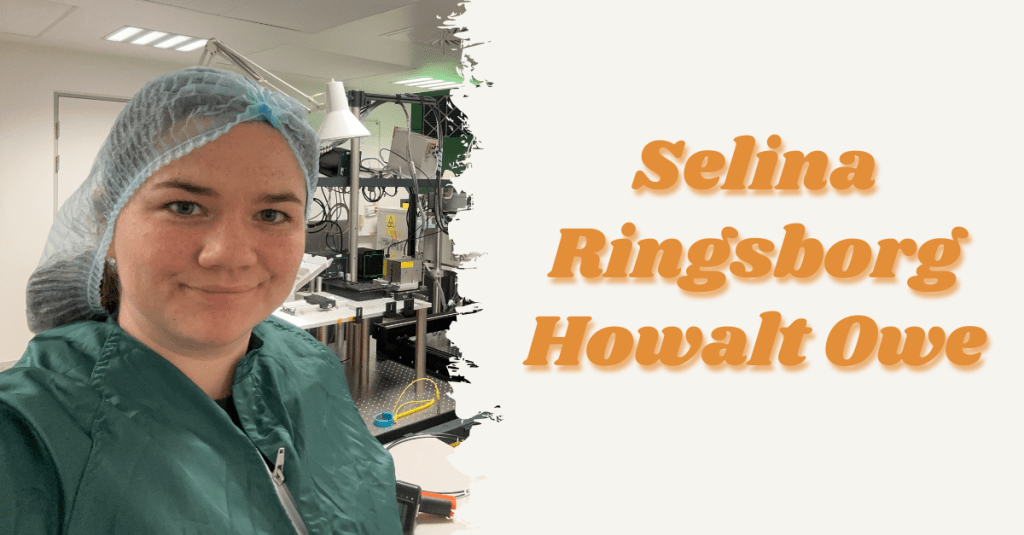
Selina Ringsborg Howalt Owe is a Postdoc at DTU Space.
What motivated you to pursue a career in physics, and how did you choose your area of specialization?
From an early age, I was fascinated by the universe and the many unanswered questions it holds. That curiosity naturally drew me toward physics. What truly motivated me, however, was the realization that advancing technology is often the key to unlocking these answers. I became inspired by the way scientific challenges drive innovation, pushing technology beyond its current limits to reveal new insights about the universe.
My decision to pursue an engineering degree was strongly influenced by reading about the Apollo 13 mission, where a team of engineers on Earth worked under immense pressure to design a life-saving solution for the astronauts in space with only limited resources. That story resonated with me because I am highly motivated by tackling concrete problems and finding creative, practical solutions. This combination of curiosity about the universe and passion for problem-solving continues to shape my career in physics and my chosen area of specialization.
Where have you studied, and what did your career path look like until now?
I earned my engineering degree from the Technical University of Denmark. After graduating, I briefly stepped outside academia to work as a consultant. However, I soon returned to DTU Space to pursue a PhD. During my PhD, I had two children, which extended the timeline slightly. Following my PhD, I was fortunate to continue in my group as a Postdoc, contributing to a new project that aligned closely with my research interests within space technology development.
What is the focus of your current research, and why is it significant?
My current research is part of the i-RASE (Intelligent Radiation Sensor Readout Systems) project, funded by the European Union. The project’s goal is to design, build, test, and implement the first on-the-fly photon-by-photon radiation detector. This advancement is significant because it enhances detector technology in one of the least explored domains of the universe, giving us the opportunity to unlock some of the unanswered scientific questions. At the same time, the broader technological impact is equally important. By improving tools for environmental monitoring, industrial inspection, and medical imaging, the project contributes to progress in areas that directly affect society.
Looking ahead, which area of work are you most excited to explore (in or outside of academia)?
Anything that allows me to learn something new while applying my passion for technology development and problem-solving excites me. I am drawn to fields where challenges are complex, and where it is possible to push boundaries beyond what is currently achievable. Being in an environment that encourages innovation and creative solutions is what motivates me most.
What keeps you motivated in your research and work, and how do you maintain that drive?
What keeps me motivated is maintaining a clear division between my work and personal life, with a strong focus on a healthy work–life balance. Academia and research can easily become all-consuming, with endless deadlines and intense competition. I believe that to stay creative and productive, it’s essential to step back and take the necessary breaks.
For me, that balance is especially important because both my husband and I are deeply committed to our careers while also raising two children (and with a third on the way). Making space for family life not only keeps me grounded but also gives me perspective and renewed energy. By taking that time to recharge, I return to my work with fresh ideas, a clear mind, and a stronger drive.
Do you engage in public outreach or science communication related to your research? If so, what does that involve?
Yes, I do whenever I have the opportunity, for example by giving public talks or participating in podcasts. I find it very important to share not only the wonders of the universe but also the equally fascinating story of the technology that makes these discoveries possible.
Do you have any hobbies or activities outside of work that you are passionate about, and what makes them meaningful to you?
I spend most of my free time with family and friends, which is very important to me and gives me balance outside of work. I also enjoy knitting and sewing, activities that let me get out of my head while keeping my hands busy. In addition, I like playing games on the PS5 or Nintendo Switch. And whenever I can, I love getting absorbed in a good Stephen King novel.
What are your thoughts on the importance of being a mentor and advisor to students and younger scientists, and what is your own approach?
I see mentoring and supervising students as an inherent part of research, and it is something I truly enjoy. It is always inspiring to see the talent, curiosity, and fresh perspectives that students bring. Throughout my own studies and academic career, my mentors and supervisors played a crucial role in my development and well-being. Because of that, I view it as both a responsibility and a privilege to pass this support on to younger scientists whenever I have the opportunity.
In my approach, I also try to push back against some of the unhealthy work cultures that can thrive within academia and other scientific careers. I strongly believe that we can do excellent science without experiencing burnout or sacrificing other important parts of life. Learning how to structure your time, and knowing when to take a step back and when to push through, is essential. By encouraging this balance, I hope to help students build not only strong research skills but also sustainable careers.
Have any mentors played a significant role in your career, and how have they supported you?
The many mentors who have given me their time throughout my career have been pillars of both my well-being and my professional growth. They have reminded me of my own ambitions and helped pull me out of the difficult moments that inevitably come with doing research. I have learned an incredible amount from my academic mentors, both at my own university and at institutions around the world, as well as from industrial collaborators.
They continue to play an important role in my career, and I truly believe that you are never too far along or too experienced to benefit from having a mentor. Their guidance, encouragement, and perspectives have been invaluable, and I am deeply grateful for their support.
What advice would you give to young people, in particular women and minorities, who would like to pursue a career in science?
There is no single “right” path to a career in science. What matters most is staying true to your own values and letting your passion guide you. It’s important to remember that you can succeed in academia without sacrificing everything in your personal life. Be kind, stay curious, and don’t let feelings of impostor syndrome hold you back when surrounded by brilliant people, but choose to be inspired by them instead, and trust in your own ability to learn and grow. And finally, don’t be afraid to take necessary breaks; the work will still be there when you return, and you’ll come back with fresh energy and perspective.
 kvinderifysik.dk