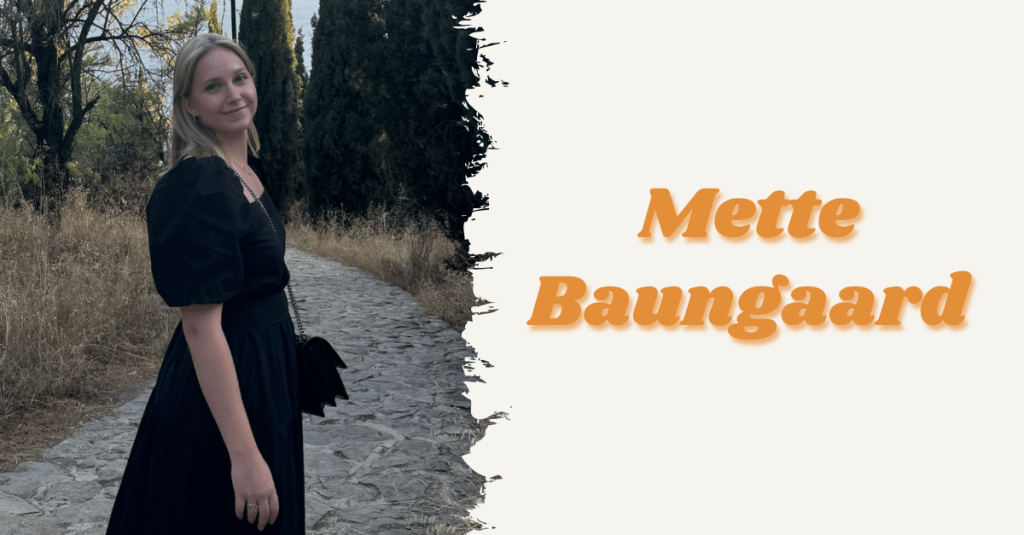
Mette Baungaard is a Project Coordinator at Statens IT
Where did you graduate from and with which degree?
I graduated in June 2023 with a Master’s degree in Astrophysics from the Niels Bohr Institute at the University of Copenhagen. I wrote my thesis in collaboration with the Exoplanet Group at DTU (Technical University of Denmark).
Please give a description of the work you do in your current position.
Right now, I’m working as a project coordinator at Statens It, where I’m specifically assigned to our client, the Ministry of Foreign Affairs. My work is a mix of project planning, coordination, and more practical tasks that keep things running day to day. I’m sort of a bridge between the technical side and the people who use the systems, which I really enjoy. Every day looks a little different, and I love that I get to help solve problems that matter.
What motivated you to study physics or engineering in the first place?
When I started high school in Denmark, I had to choose my academic track. My parents asked me, “What do you want to be when you grow up?” I remember saying I didn’t know exactly, but I had always been fascinated by the stars and the universe. My parents responded, “Then maybe you could become an astrophysicist.” That idea stuck with me, so I chose my courses based on this. My interest deepened when a guest speaker at my high school gave a talk on black holes and his research. He recommended the film Interstellar, which I watched the same evening – and I was completely mesmerized. That movie changed something in me. I couldn’t stop thinking about space and time and how little we really know about the universe. That was the moment I knew: I want to understand this. I want to study physics.
What made you decide to pursue a career in the public sector?
Finishing my degree was exciting – but also a bit scary. I realized that staying in academia didn’t feel like the right fit for me, even though I loved the subject. I started exploring other directions and realized I was really drawn to IT, data, and programming. I just didn’t know where exactly I’d land.
Then I found the graduate programme at Statens It, and it felt like such a good opportunity – a place where I could explore different roles, learn on the job, and grow. On top of that, working in the public sector really appealed to me. It’s nice to feel like the work you’re doing is part of something bigger and contributes to society in a real way.
How do you use the skills you learned as a physicist or engineer in your work?
Studying physics teaches you so much more than just equations or theories. You learn how to think – how to break down complex problems, look at things from different angles, and not give up when something’s tough to figure out. That mindset has been incredibly useful in my job.
I’ve also been able to use my programming skills quite a bit, which has been really satisfying. I’ve created small tools to automate parts of our work, which saves time and makes everything run more smoothly.
What does being a physicist or engineer mean to you?
For me, being a physicist is about curiosity. It’s about wanting to understand how the world works – from the tiniest particles to the vastness of the universe. Even though I don’t work in research anymore, I still carry that curiosity and way of thinking with me every day.
It also means being okay with not knowing everything right away. In physics, you often sit with uncertainty – and learn to trust that you’ll figure things out step by step. That’s something I’ve taken with me into the rest of my life.
What advice would you give to young people (in particular women and minorities) with a background in physics or engineering who would like to pursue a career in the public sector?
Don’t be afraid to take an unconventional path. A physics background gives you a strong foundation with skills that are highly valued in the public sector. You don’t have to follow a traditional research or academic route to make meaningful contributions, and you don’t need to know exactly what you want to do. Be open to exploring different roles, and don’t underestimate the impact you can have!
 kvinderifysik.dk