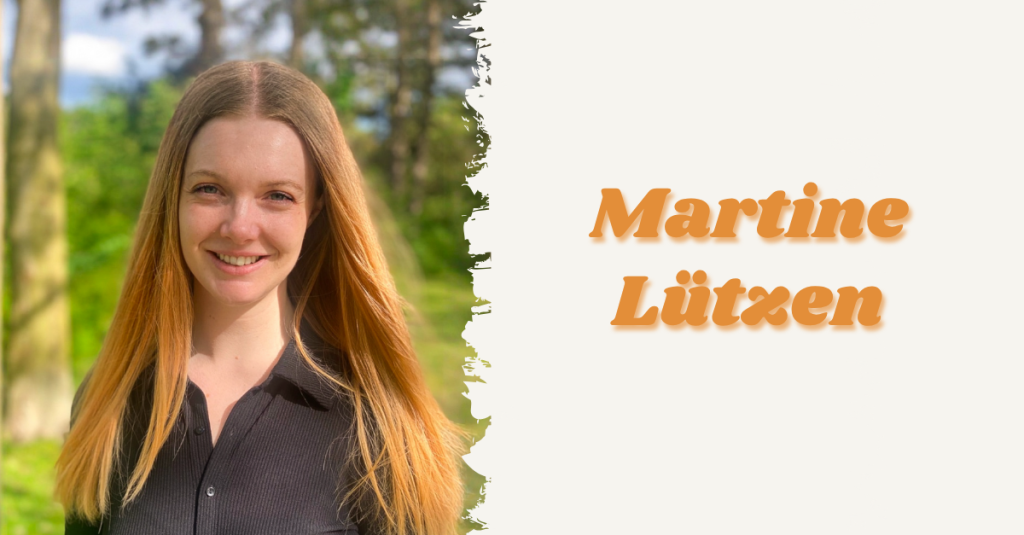
Martine Lützen is a Data Consultant at NetCompany
Where did you graduate from and with which degree?
I graduated from the University of Copenhagen with a bachelor’s degree in physics and a master’s in astrophysics. In the second half of my bachelor’s, we got to choose a specialization, and I chose astrophysics. Then while working on my final project, I ended up falling in love with a subfield of astrophysics called astrochemistry. That project was my first introduction to the topic, and it completely fascinated me and stuck throughout my master’s as well.
Please give a description of the work you do in your current position.
I work as a data consultant (technically the position is called “data management consultant”), which is exactly what you would expect: I consult clients on how to manage their data. It is a bit of a mix between technical problem-solving and understanding the client’s needs from a business perspective. On a day-to-day basis, I sit with the client at their offices and work on managing and transforming their data. I use a lot of SQL to pull out the data they need from large databases, filtering and sorting it, and then feeding it back in so it’s useful for reporting or decision-making.
We often use tools like SSIS (SQL Server Integration Services) to automate tasks and control the flow of when they are executed, however recently we have started using Python a lot more. This gives us a lot more flexibility since we can pull SQL data into pandas dataframes and do more advanced processing, before we feed it back into the database. Apart from the more technical aspects, a big part of my role is also about working closely with the client during the design and refinement phases of the solution. Here we have workshops in which we ask many questions to make sure that we are actually building something that solves their problems. So I would say it is a really good mix of hands-on coding and communication with the client.
What motivated you to study physics or engineering in the first place?
I have always been fascinated by space! Fun fact: the first book I ever read on my own was called “Stjerner” (which just means “Stars” in Danish), and I remember being so excited about learning all the facts I could and reciting them to my parents. I borrowed that book from the school library so many times.
Later on, I got into physics more broadly around 7th grade when we started having physics and chemistry in school. Here I had an amazing teacher who really nurtured that interest and gave me extra materials to dive deeper into the different topics. That encouragement made a huge difference and helped set me on the path I’m on today.
What made you decide to pursue a career in the private sector?
Honestly, it was actually not part of any long-term plans I had previously had. I originally wanted to do a PhD, but due to different circumstances, I was led into the private sector.
That said, I have been very pleasantly surprised by how much I have been able to apply my academic background in this line of work and how much more there was to learn! I have gained many new skills and experiences in this job that I would not have found elsewhere. I really respect both academia and the private sector. Each offers its own kind of value and opportunities, and I think we should always be open to exploring more than one route in life.
How do you use the skills you learned as a physicist or engineer in your work?
One of the things I really love about physics is how it teaches you to think. Physicists get very used to tackling complex problems, often with limited information, and breaking them down into something manageable. That mindset is just incredibly useful, no matter what field you end up in.
During my studies, I built a strong foundation in math, coding, and data analysis. I worked with large data sets, developed theoretical models to describe real phenomena, and got very comfortable using Python to process and visualize complex information.
Being a physicist has also made me a bit of a generalist. I have learned how to pull from different areas of knowledge and apply them creatively. That ability to understand things on both a technical and conceptual level really comes in handy when you are working with clients who need solutions that actually work in the real world.
What does being a physicist or engineer mean to you?
For me, being a physicist is about curiosity. It is the drive to understand how things work. It is about always questioning and challenging what you, or the world, might have previously thought was an undeniable truth.
Even now that I’m not working in research, that way of thinking still shapes how I approach problems. There is something really satisfying about using the tools and mindset from physics to bring clarity to very complicated real life systems.
What advice would you give to young people (in particular women and minorities) with a background in physics or engineering who would like to pursue a career in the private sector?
If you are a woman or belong to a minority within most STEM fields, know that your perspective is valuable both in academia and in the private sector! One of the biggest lessons I have learned is that you do not have to compromise who you are to be taken seriously. For a long time, I felt like I had to downplay my personality and femininity to fit in and be respected, especially in more tech-oriented environments. But I have come to understand that being true to yourself is not only possible but it is so powerful!
You might encounter outdated comments or implicit biases along the way. I know I did during my studies and still do today, and it is okay to acknowledge how those moments affect you. What helped me was finding strong role models and surrounding myself with people who lifted me up. I would encourage you to seek out mentors and allies who support your growth and trust that your skills, curiosity, and passion are what truly define your potential, no matter what path you choose.
 kvinderifysik.dk