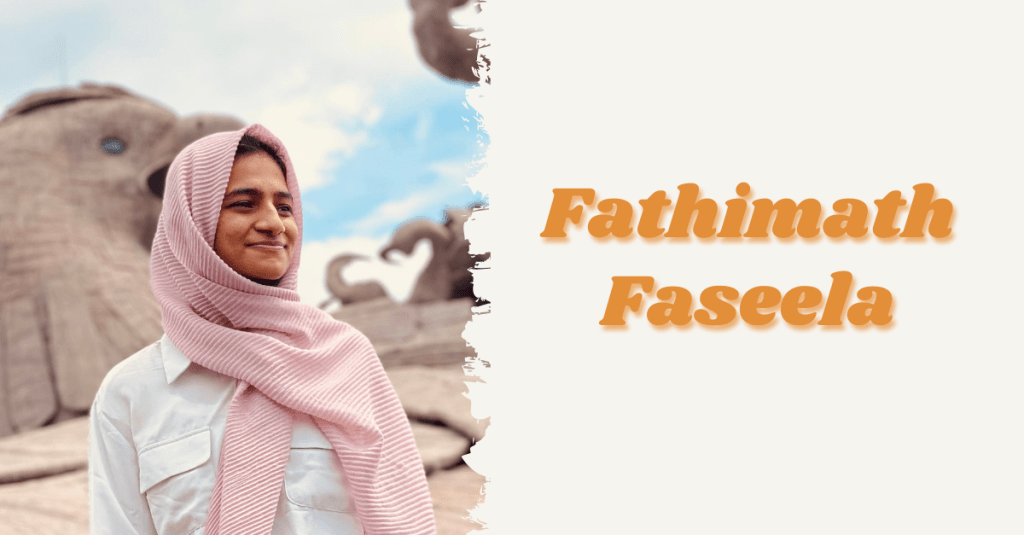
Fathimath Faseela is a Research Assistant at University of Southern Denmark (SDU) at Mads Clausen Instituttet (MCI) in Sønderborg.
What motivated you to pursue a career in physics, and how did you choose your area of specialization?
When I was in school, I was more interested in art than science. However, due to financial constraints in my family, I was unable to achieve it. Coincidentally, I learned about a scholarship that was available to top 1% Indian students pursuing science. I worked really hard to get money so that I could pay for my own education. I decided to pursue physics as my second passion after art. Despite her lack of education, my mother always encouraged me to think logically, which is what inspired me to pursue this career. Following extensive study of physics, I became aware of light-matter interactions at the ultrafast scale in my area of interest. I started to read and try to get into different projects throughout my research life connected with THz generation, spectroscopy, nonlinear optics and carrier dynamics usinging pump-probe techniques, opto-electronics and material characterizations.
Where have you studied, and what did your career path look like until now?
In my native India, I finished my schooling up to the master’s level. It was not an easy road. It was difficult to be in experimental physics since there was a lack of well-equipped labs, which are crucial for a physics student’s development. Our capacity to investigate novel concepts was frequently hampered by infrastructure limitations, and direct interaction with cutting-edge experimental methods was still unattainable.
I did my bachelors in Farook college. I became quite interested in photonics while pursuing my master’s degree at the Central University of Haryana. I joined the THz lab at the Tata Institute of Fundamental Research (TIFR) as a research project assistant to expand my knowledge of research and have practical expertise with instrumentation and experimental techniques. I spent a lot of time there studying light-matter interactions, especially those that occur in the terahertz range.
I then relocated to University of Southern Denmark (SDU), where I could collaborate with an exciting and motivating research team on an intriguing issue, with limitless technical support.
What is the focus of your current research, and why is it significant?
I’m in the SDU-CAPE lab right now as a research assistant . I’m fabricating organic photovoltaic systems and conducting research to increase their longevity and performance in a variety of ways. One method involves creating fabry-perot cavities using strong light-matter coupling to enable polaritonic actions inside the device, and another involves permutation and combination of various materials and optimizing them to be a good candidate in the layers of organic solar cells and taking them for large-scale fabrication using R2R and S2S coating techniques.
In order to improve organic photovoltaics and, consequently, next-generation energy solutions, I am researching the intersection of photonics and materials science. And I’m having fun with it!
Looking ahead, which area of work are you most excited to explore (in or outside of academia)?
My interest in laser physics and material science was heightened by my time spent in both a terahertz and an organic photovoltaics lab. The process of creating and modifying light through different materials has always captivated me, and I’m still enthralled with the idea of using this modulated light to investigate carrier dynamics and material properties. I like to do spectroscopic studies in materials and take the carrier dynamics using pump probe technique with different frequency pulsed light according to the need. Making the desired frequency light from others using higher harmonic generation crystals always makes you a fresh mind for a new optical setup.
Despite not working on it, plasma physics has always piqued my curiosity. In particular, the plasma wakefields, which use intense light-matter interactions for particle accelerators. I always wanted to work on that.
What keeps you motivated in your research and work, and how do you maintain that drive?
For me, the motivation to pursue research often comes from the very challenges I encounter. It’s the curiosity sparked by a single unresolved problem that drives me. I find excitement in the hope that somewhere perhaps in a paper I haven’t read yet or a theory waiting to be discovered, there lies a key that could lead to the solution. This process of exploring a wide array of ideas and resources, just to understand one question, is incredibly inspiring. Another thing that makes me drive is the intersection point of the theories and the experimental result, the chaos remains in the data, analyzing it, findings, and trying to make a closure on the things we are controlling.
I also find deep satisfaction in building our own setups, simulating geometries based on existing theories, and running overnight experiments. These moments, when effort meets discovery feel like a reflection of our own highs and lows, just like the fluctuating graphs we observe. Research, for me, is a continuous journey where the destination is unknown, but the path is full of purpose and wonder.
Do you engage in public outreach or science communication related to your research? If so, what does that involve?
No, I am not yet involved in any public outreach, but I used to go through the outreach programmes news, videos and try to read more about my field, to be updated.
Do you have any hobbies or activities outside of work that you are passionate about, and what makes them meaningful to you?
Since I was a little child, I have had a strong desire to create art through painting and designing. However, the circumstances and environment prevented me from making that my career. Physics, on the other hand, was given top importance. Therefore, I would like to combine them in a more adaptable manner. I’m using my ability to draw as a research tool. attempting to stay up to date with scientific illustration. More visual representations in my notes are preferable to lengthy paragraphs. This fusion of art and science not only aids my own understanding but also helps in communicating complex concepts more clearly. I spend my free time solo-travelling and painting.
What are your thoughts on the importance of being a mentor and advisor to students and younger scientists, and what is your own approach?
Mentors play a crucial role in shaping our careers. Their experience and guidance help us navigate the right path and make informed decisions. Without proper mentorship, efforts often go in the wrong direction, leading to wasted time and missed opportunities.
Have any mentors played a significant role in your career, and how have they supported you?
I come from a middle class, rural background where educational opportunities were limited, especially for women. Many of the women I’ve known, including those in my own family, remained confined to household responsibilities, with little chance to pursue work or education beyond school. My mother was once part of that cycle, but she chose to break it, through me. She prioritized our education, gave us strength, and became my first mentor. Through our academic journey, she herself came to understand the value of education, systems, and the world beyond our village through me and my siblings. Her unwavering support and prayers have been my foundation. Today, I am proud to be the first woman from my village to pursue research abroad, but I am determined not to be the last.
I did not receive strong mentorship in research during my early academic journey, including my master’s studies. I wasn’t among the top-performing students, and perhaps few expected me to pursue a career in experimental physics. My understanding of photonics, material science, and laser-based experiments only began to take shape after I started working with Prof. Shriganesh Prabhu at TIFR Mumbai. Under his guidance, I gained a deep understanding of how research truly works, not just within the domain of terahertz science, but beyond. He encouraged cross-departmental collaborations and hands-on work in various labs, which helped me refine my interests and firmly root them in ultrafast physics and light-matter interactions. His mentorship transformed the way I perceive science, teaching me to approach problems critically and with curiosity.
What advice would you give to young people, in particular women and minorities, who would like to pursue a career in science?
I am a middle-class, minority woman who has struggled to make connections and obtain opportunities in this cutthroat society. However, that doesn’t mean we have no options. There are other groups and labs all over the world that focus on the same subjects and areas that you are interested in. All we need is the spirit to locate them and establish connections and partnerships, and there are others who guide and assist us. Find them, take guidance, then go!
Break over that barrier and come out of your shells. Aid your sisters in breaking it as well. Until the barrier is broken.
 kvinderifysik.dk