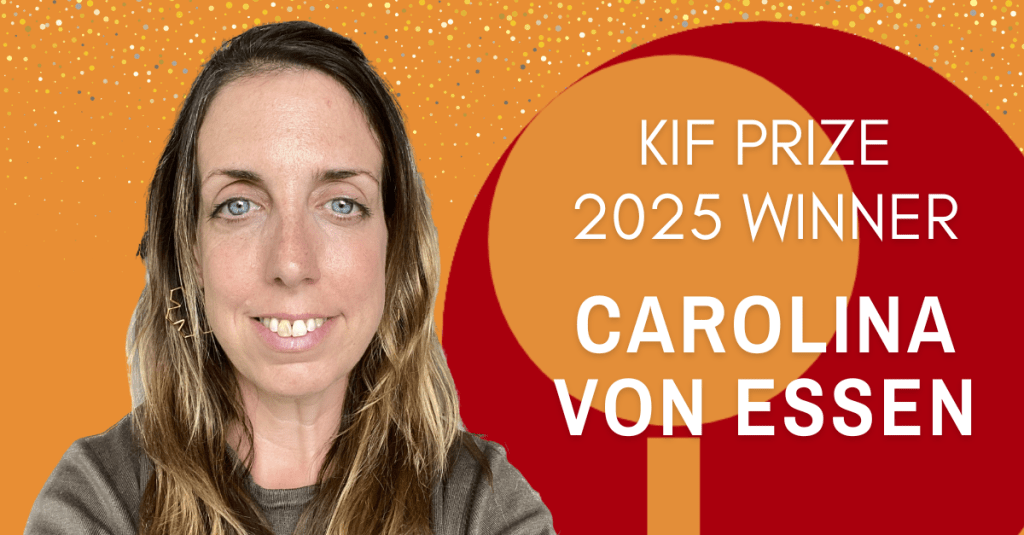
The KIF Prize is an honorary award that is awarded annually to raise awareness about the importance of women in physics and identify female physicists as role models.
To celebrate Carolina von Essen as the recipient of the 2025 KIF Prize, we invited her to reflect on her journey through science, advocacy, mentorship, and leadership. In this interview, she shares her experiences across continents and sectors—from groundbreaking work in astrophysics to corporate innovation, equity activism, and social entrepreneurship. Her insights are a testament to the many ways one can make an impact as a physicist and as a changemaker.
Congratulations on being awarded the KIF Prize 2025! What does it mean to you to receive this prize?
Receiving this prestigious award is an incredible honor and a testament to my dedication to my work as a whole. It recognizes my contributions to advancing our understanding of the universe, my innovative work with AI at Grundfos, and my efforts to support and inspire the next generation of women scientists. I can only feel proud!
What first drew you to physics, and how did you come to specialize in astrophysics?
Although my father passed away when I was a child, one of my cherished memories is him reading Carl Sagan to me, sparking my early fascination with the Universe. I have always been a nature lover, but before pursuing astronomy, I spent four years studying biophysics with the intention of exploring human genetics. During my biophysics studies, I would often lie by the pool at home at night, gazing at the stars with a map of the sky. One day, my brother-in-law asked, “What are you doing with your life? You love space. Go study that.” The next thing I knew, I was enrolled at the La Plata Observatory. Planets and the search for life on them was my passion, right from the beginning. The rest is history.
Your career has taken you from Argentina to Germany, and now to Denmark where you hold positions in both industry and academia. How would you describe your path so far, and what have been some of the defining moments?
A few weeks ago, I had the opportunity to visit Denmark’s largest telescope. Although it was relatively small compared to the telescopes I have used throughout my career, I felt right at home. Everywhere I looked, I knew exactly what each piece of equipment inside the dome was for. Returning to such a familiar environment made me realize the immense privilege I have had, being able to pursue my love for astronomy for over two decades. Certain memories, impressions, feelings about my life as an observer, will never leave me, and can only warmth my heart.
A defining moment in my life was understanding that, with two kids and the inability to relocate, finding a place in academia where I could grow was going to be an impossible task, no matter how hard I tried, how much I worked, or how good I was. For the sake of my children, I needed a stable solution that would allow me to stay in Denmark peacefully. As I was leaving that, which I loved, instead of applying randomly, I was going to be picky. I wanted to choose a company that made sense. I could never have imagined the stroke of luck I had in quickly finding a job as a data scientist at Grundfos. Although it wasn’t about planets and life anymore, it was equally challenging and rewarding. I still get to do a bit of what I love at DTU Space, while working hard to embrace this new career at Grundfos, which I am sure I will learn to love just as much.
You’ve remained active in astrophysics research while working full-time in industry. What keeps you connected to science, and how do you see your dual engagement benefiting both fields?
What keeps me connected to science is my profound love for astronomy and my constant need for intellectual challenges. I thrive on solving problems, and astronomy offers exactly that: a beautiful box filled with the world’s most intricate puzzles. The mutual benefit is clear: at Grundfos, I have quickly learned artificial intelligence, which I can apply to my work in astronomy. Additionally, skills in statistics, rational thinking, and data analysis have seamlessly transitioned from academia to industry. Both roles keep me sharp, engaged, and challenged, creating the perfect combination for me to thrive.
One of your most recognized contributions to astrophysics is the creation and coordination of KOINet – an international network for follow-up of Kepler exoplanet candidates. What inspired you to initiate such a global collaboration, and what have been some of the highlights and challenges of that experience?
When I started KOINet, I was a postdoc at Goettingen University. My boss at the time, Prof. Stefan Dreizler, was exactly what I needed: someone who trusted me without doubts. As the successful Kepler Space Telescope mission was coming to an end, there were still many planetary systems that required further observations for us to be able to characterize them well. Recognizing the need for ground-based follow-up, I took the initiative to address this. Goettingen University and Stefan’s support were exactly what I needed to kickstart this adventure.
I am not only task-oriented but also a people-person. Leveraging the connections I built during my PhD, I quickly organized a follow-up campaign, marking the beginning of a beautiful worldwide collaboration. The highlight, which was also the challenge, was coordinating a diverse group of observers using different telescopes and instruments to achieve a common goal. It was incredible. Full stop.
Today, you also contribute to the STEP-STONE project, which combines stellar and planetary signal modelling. How do you see the opportunities in bridging academic research and industrial data science?
Bridging academic research and industrial data science presents a wealth of opportunities, especially in projects like STEP-STONE, which combines stellar and planetary signal modelling. The integration of these fields allows for the application of advanced data science techniques and best practices, to complex astronomical data. This not only enhances the precision and efficiency of research but also drives innovation and proper knowledge sharing. Although STEP-STONE and Grundfos have no commercial point of contact, there is a clear benefit of both areas from the application of ground knowledge to both.
You’re also the CEO of two companies with a social focus related to rental homes. What led you into this kind of entrepreneurship, and how does it connect with your broader goals of equity and empowerment?
When I was pursuing my PhD at Hamburg University, I inherited some money from my father’s side that, if invested wisely, could ensure a stable financial future. At that time, I was alone in Germany, far from my family, and had to navigate the complexities of investing on my own. This experience taught me a great deal about financial management. During this journey, I noticed that many women were leaving financial decisions to their male partners, which often left them at a disadvantage in the event of a divorce. While I had often heard the phrase “money is power,” I came to realize that knowledge is even more powerful. Because it was challenging for me to learn everything connected with investments, I decided to share my knowledge with other women to help them avoid disadvantages. Deep down in me I believe, we women must do better than leaving our fate in someone else’s hands. I tried to advocate for that as much as I could. From the gender balance ERG at Grundfos, where I serve as Danish lead, one of my key focus points this year is to teach women about how to invest and take more control of their finances.
You’ve been described as a deeply committed and student-centered educator. Can you tell us more about what inclusive teaching and mentorship looked like in practice for you during your time in academia? Were there specific barriers or problems – systemic or cultural – that you tried to address through your work with students?
In academia, the significant gender imbalance and the scarcity of female role models at higher levels (associate professor and higher) presented two critical challenges I needed to address. First, I focused on keeping women motivated in a work environment that was far from optimal. I didn’t want them to feel infinitely frustrated and quit. Second, I aimed to equip women with as many tools as possible to help them thrive and leave academia with as many advantages as I could give to them. To achieve these goals as efficiently as possible, I dedicated 90% of my supervision efforts specifically to supporting women.
Have any mentors played a significant role in your career, and how have they supported you?
While I was doing my best to keep the women around me motivated, while trying to do some things for my own success and growth, I was, of course, facing challenges myself. I had the honor of sharing an office with Prof. Victoria Antoci, my current boss at DTU Space. Whenever I was in doubt about what to do or where to go, or if I needed a shoulder to cry on or someone to share my frustrations with, Victoria was there to listen. It is fair to say that I wouldn’t be where I am today without her support, wisdom and mentorship. I also had the pleasure of sharing an office with Prof. Mia Sloth Lundkvist. She was the empathetic, brilliant, and honest Dane I needed to help me make sense of the things happening around us. Knowing I wasn’t alone in the rocking boat called academia was priceless to me. Finally, every female student I had, and every success they achieved, certainly have kept me afloat. Through their achievements, I understood that what I was doing, what many of us were doing, had great value.
You’ve been involved in gender equity work both in academia and industry—from serving on university equality committees to initiating global change at Grundfos. How do you see the role of scientists and professionals in driving structural change, and what advice would you give others who want to turn values into action in their own institutions?
Scientists and professionals play a crucial role in driving structural change by leveraging their positions to advocate for gender equity, influence policies, and lead by example. They can use their research skills to present data that highlights disparities and the need for change and provide mentorship and support to underrepresented groups. My advice for turning values into action includes building alliances, leading by example, and staying persistent in advocating for inclusive policies and practices. Is hard and consistent work, but I am positive about the change these actions are bringing. We just need to be very good at not burning bridges while moving forward, while carefully choosing our battles to minimize frustrations and staying motivated.
You also co-founded Sun4Women, supporting Hispanic women in Denmark, and continue to advocate for underrepresented communities. What drives your work in this space, with intersectionality, and what impact are you hoping to create?
I founded the NGO this year, so it’s still very new. It focuses on helping Hispanic women in Denmark going through separation. I had already been privately advising many of them, helping them get their lives back on track when their partners left them and their children to survive in Denmark on their own. At some point, I realized that I needed financial support to provide these women with more structured advice and psychological support, and that’s how the NGO took shape. I received support from the Argentinian Embassy, and I hope to gain more support from other Hispanic embassies when I find the time to contact them. My goal is to empower these women with knowledge, to help them thrive and achieve the lives they deserve. This activity is 100% in my spare time, so it goes without saying that advancements are slow but steady.
What advice would you give to young people—especially women and minorities—who are considering a career in science but may face doubts or systemic barriers?
My advice to young people, especially women and minorities, considering a career in science is to believe in their potential and stay persistent, despite the challenges. Seek out mentors and allies who can provide guidance and support—males can be great allies too, I have the best at Grundfos. Don’t hesitate to reach out to communities that share your experiences. Use your unique perspectives as strengths and contribute to creating a more inclusive environment in your fields. While we may not witness true change within our lifetime, always remember that your presence and success in science can inspire and pave the way for future generations.
From your experience, what concrete strategies or changes would help advance the careers of underrepresented groups in physics today?
After many years of striving for gender balance, I’ve developed a perspective that may not always be popular. I believe that to advance the careers of underrepresented groups in physics, implementing quotas for hiring and promotions is essential to ensure more equitable representation. Without such measures, change happens too slowly. Additionally, creating mentorship programs and providing targeted funding opportunities can significantly support these individuals. Establishing inclusive policies and fostering a supportive community within institutions are also crucial. Collectively, these strategies help break down systemic barriers and promote diversity in the field.
 kvinderifysik.dk