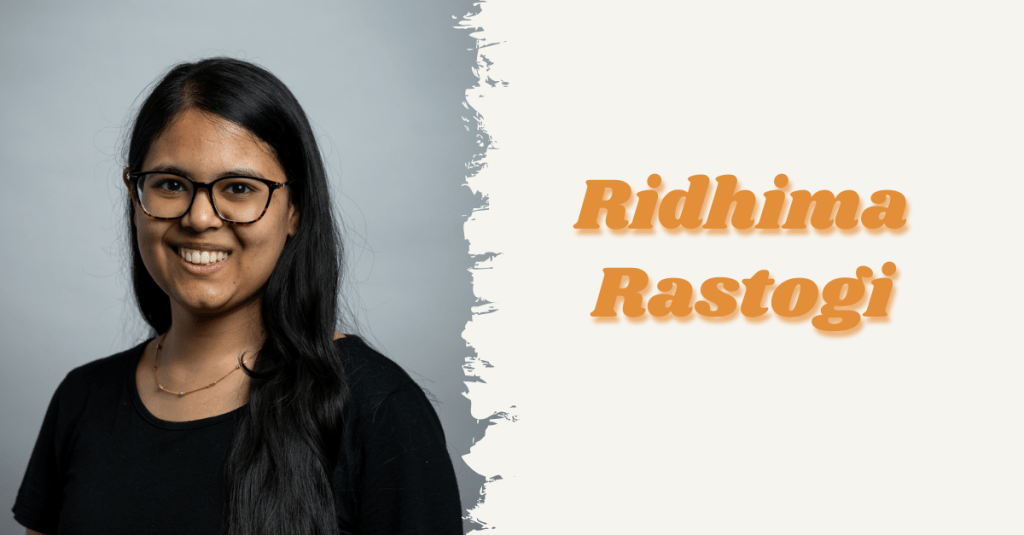
Ridhima Rastogi is a Bachelor student at the Institute of Mechanical and Electrical Engineering (IME) at the University of Southern Denmark, Sønderborg.
Where are you studying, and what degree are you pursuing?
I am currently in the 2nd semester of my Bachelor of Engineering in Mechatronics at the Institute of Mechanical and Electrical Engineering (IME) at the University of Southern Denmark, Sønderborg. Through this program, I am learning how to integrate mechanical engineering, electronics, and computer science to create intelligent systems – essentially I am learning how to build both the brains and bodies of machines!
What motivated you to study physics or engineering?
Honestly, I wasn’t one of those people who grew up always wondering how the world worked or trying to take apart machines. For me, it was a bit simpler: STEM subjects just made sense. While humanities subjects often felt abstract – lots of open-endedness and what I like to call “waffling”. Comparatively, science and math had a kind of clarity to them. There’s something satisfying about following a process or an algorithm and knowing that if you are on the right track, you will land at the right answer. Engineering gave me that structure and sense of direction, but also the freedom to explore how I got there. It’s like building a maze and also figuring out how to solve it. You are given a set of requirements, constraints for your product and then it’s up to you to design your own solution. I knew early on that this was the kind of problem-solving I wanted to do more of because that’s where my interest grew the most.
What has been your favorite course or topic in physics so far?
Since I am still in my early semesters of Mechatronics Engineering, I still have a lot more to learn and experience – but one thing that excites me is how physics directly feeds into real, moving systems. It’s one thing to learn about motion, electricity, or energy in theory – but watching those concepts turn into a robot that moves or a system that thinks? That’s where the fun is at! What really sticks with me is how forces and energy interact in systems – especially when we start combining mechanical elements with electronics and code. It’s not just about solving equations; it’s about watching something work because you understand how the physics behind it connects to the real world. I might not have a single favorite topic yet, but I’m definitely leaning into the parts that let me build and experiment. But what’s surprised me is how steep the learning curve has been for programming and electronics. At first, it felt like a different language entirely – a bit intimidating, if I’m honest. But the moment things start to click? It’s like a whole new world of possibility opens up.
Many of the courses have helped me build up a personal toolbox, allowing me to tinker and create. In product development, having that growing toolbox means you are constantly drawing on both old and new skills to bring ideas to life.
Tell us about a cool project you have worked on or are currently working on.
At my university, each semester comes with a hands-on group project – which is one of my favorite parts of the program. Last semester, we built a small robot car from scratch. This included dealing with its design, mechanics, electronics, programming and assembly. This included figuring out how to get power from a single motor to drive all four wheels in a straight line. It also included a separate system that would use a Slot type Optocoupler and an Encoder Wheel to measure the speed of our wheels and display it on our Nextion display screen.
But what I’m working on right now might be even cooler. It’s called the Solar Optimizing Blossom (yes, we gave it a dramatic name on purpose). It’s a compact, solar-powered security system that not only triggers a sound alert when it detects motion but also uses servo motors to adjust its solar panels in two dimensions. It tracks the sun to generate as much electricity as possible. Building a system that thinks about efficiency and sustainability? That’s when engineering really starts to feel exciting and relevant.
And here’s the twist: when I am not building things or studying on the ground, I am actually up in the air – literally. I am also a pilot! On weekdays, I study Mechatronics Engineering, and on weekends, I train as a glider pilot. I started flying in 2024, right around the time I began my degree when I was 17. Solving problems as an engineer is great, but solving them midair? That’s next-level. Honestly, being both an engineer and a pilot has been an incredible combination – it keeps things exciting, and there’s always a story to tell.
What kind of career do you envision for yourself after your engineering studies?
I am keeping my options open right now – there’s just so much to explore! But if you asked me what my dream is? Hands down, it’s to be in the flight deck of a passenger jet, ideally as a Captain flying an A330, A350, or (fingers crossed) an A380. Yes, I’m absolutely an Airbus fan – guilty as charged. And no, autopilot isn’t just “press a button and relax” – that’s one of the biggest myths out there [hahaha].
What I love about combining engineering and aviation is that it lets me approach flight from both sides: the one who flies the plane and the one who understands the systems that make it fly. Studying Mechatronics has deepened my appreciation for the complexity behind aircraft design, control systems, and automation. It’s like I get to geek out over the “how it works” AND chase the adrenaline of actually being up there flying. Whether I end up in a cockpit or an engineering team, I know that what I am learning now will always fuel that passion.
What does being a physicist or engineer mean to you?
To me, being an engineer means being part of an endless cycle of improvement – whether it’s perfecting a machine, optimising a system, or just making something work a little better than it did yesterday. And the truth is, you never really “arrive” at the end goal. There’s always something more to tweak, to learn, to explore. It keeps you curious. It keeps you grounded. In fact, honestly, it reminds you to stay humble – to touch some grass every now and then.
What advice would you give to young people, particularly women and minorities, who are interested in studying physics?
This is the big one, and here’s my honest advice: talk to people. That’s it. Whether it’s your classmates, professors, or professionals in the industry – just start conversations. Some of the most valuable things I have learned, and many of the opportunities I have had, came simply from putting myself out there.
Competitions, networking events, online communities – they have all taught me that there’s always 100s of people who know more than you and you can benefit so much from their experience and knowledge. It’s not about knowing everything – it’s about being open to learning. Don’t be afraid to ask questions, even the “silly” ones – especially at networking events. Remember, the people who show up to those events are there because they want to connect. You never know which conversation might shift your perspective or open a door you hadn’t even considered. That’s how you may end up flying planes and doing engineering at the same time! You got this!
 kvinderifysik.dk