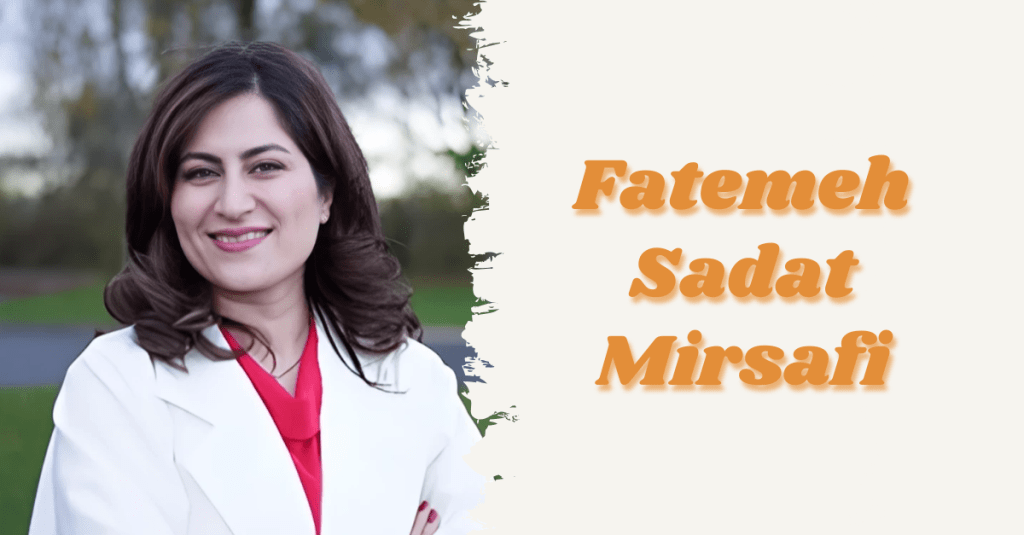
Fatemeh Sadat Mirsafi is a PhD student at University of Southern Denmark (SDU) at Mads Clausen Instituttet (MCI) in Sønderborg.
What is your PhD project about?
My PhD is part of the SOLID project, where I work on designing and studying nanofluids. I’m developing nanofluids made of tiny engineered nanoparticles like metal oxide and carbon to improve heat transfer in energy systems. What makes my project unique is that I synthesize these nanoparticles myself and design their shape and function. My goal is to create smart, stable materials that help make cooling systems more efficient and sustainable especially in small electronic devices.
What inspired you to study physics or engineering, and when did you realize you wanted to pursue this path?
It all started with my high school physics teacher. She had this special way of teaching, not by giving formulas, but by asking simple questions about everyday things we’d seen a hundred times but never really thought about. Like, “Why does water form a circle when it drips?” or “Why is the sky blue?”
I used to walk past these phenomena without noticing them, until she asked those questions. That made me want to look at the world differently, to question everything, even the simplest things. Years later, in my second year of university, I finally found the answers to some of those questions, and it felt like magic. That journey, from not knowing, to finding out, made me fall in love with physics. It made me realize that I want to keep asking, keep learning, and see every phenomenon through that curious lens.
What made you choose to pursue a PhD degree?
I simply wanted to know more. I’ve always felt that what I knew wasn’t enough, that there was always something deeper to understand. That feeling stayed with me, even after finishing my degree. So I decided to do a PhD, hoping to find answers and explore more.
The funny part is that now, after going through two PhD programs, I sometimes feel like I know even less! But maybe that’s part of real learning, realizing how much there still is to discover. It keeps me curious
What hobbies or activities do you enjoy outside of your studies, and how do they help you maintain a work-life balance?
I really enjoy sports—especially volleyball—and I’m also passionate about cooking. Funny enough, I often find myself using what I’ve learned in the lab when I’m creating new flavors or baking something sweet. Synthesis in the lab and mixing ingredients in the kitchen are not that different after all!
There’s something deeply satisfying about experimenting in the kitchen and then seeing people enjoy it. When I get good feedback from friends, it genuinely makes me happy. Cooking, doing sports, and spending time with family and friends help me stay grounded and bring me joy. That’s how I try to keep my work-life balance in check.
What are three important skills you have gained during your PhD, and how have they contributed to your growth?
In my opinion, the most important skills you gain during a PhD aren’t just technical—they’re personal and practical too.
First, you learn patience. Things often don’t go as planned, and experiments can take a lot more time than you expect. You have to stay calm and keep going, even when things don’t work.
Second, you develop a strong problem-solving mindset. You’ll face challenges no one else can fix for you—you have to figure them out yourself. It teaches you to think independently and creatively.
And third, you learn the value of communication and collaboration. Doing a PhD can be very isolating if you don’t build good connections with others. Talking to colleagues, sharing ideas, and asking for help is not a weakness—it’s essential for success.
What does being a physicist or engineer mean to you?
It means a lot to me—because science has shaped a big part of who I am. Over the years, being deeply involved in research has changed me. It has made me more patient, calmer, and more thoughtful. It taught me to think deeply, to stay with hard questions, and to approach problems with creativity.
Even if I weren’t a physicist or an engineer anymore, I know that this mindset—this way of seeing and thinking—would still stay with me. It’s not just about the profession; it has become part of my personality.
Do you have role models who have inspired you, and how have they impacted your decisions or goals?
Yes, I’ve had many role models throughout my journey—people who inspired me in different ways. But one of the most powerful figures for me has been Dr. Maryam Mirzakhani.
She was an Iranian woman who grew up and studied in Iran, and later became the first woman—and the first Iranian—to win the Fields Medal in mathematics. She reached one of the highest academic positions at Stanford University. Sadly, she passed away at the age of 40 due to cancer, but her story stays with me.
She showed us that no matter where you come from, or what limitations you face, you can still achieve your dreams with hard work and determination. Her life is a reminder that even the most ambitious goals are reachable.
What advice would you give to young people, particularly women and minorities, who are interested in studying physics or engineering?
I don’t see myself in a position to give advice—but I can share something from my own experience.
Give it everything you’ve got. Try your best. And most importantly, don’t give up. Even on the hardest days, if you stay hopeful, you’ll eventually find a way forward. There will be challenges, yes—but with persistence and belief in yourself, you can overcome more than you think.
What kind of career do you envision after your PhD?
I would love to have a job where I can apply what I’ve learned in a meaningful, real-world context. Ideally, I see myself in a role that builds a bridge between academia and industry—where I can take ideas born in the lab and help turn them into products that actually improve people’s lives.
I want to be part of a space where innovation meets impact, where research doesn’t just stay on paper but becomes something useful and tangible. That’s where I believe my strengths and passions truly come together.
But at the same time, I know we don’t always get to choose exactly what we want. As an Iranian, I face many limitations when it comes to working abroad—restrictions that have nothing to do with my skills or ambitions. It’s frustrating, but I try to stay hopeful and keep moving forward, doing the best I can with what I have.
You’re originally from Iran. What was it like studying science and engineering as a woman in Iran?
Unfortunately, in Iran, women don’t have many opportunities to grow in engineering fields. Every year, there’s a national entrance exam for universities, and over 60% of those who pass are women. But when it comes to engineering, the number drops below 20%. And when it comes to finding a job, the situation is even worse.
Many women who study engineering struggle with unequal opportunities in hiring, career advancement, and even receiving the same salary as men. Because of these challenges, many young women lose motivation to enter these fields in the first place, which makes it even harder for those who still want to try.
On the surface, it might seem like opportunities are equal, but in reality, there are many hidden barriers—like the lack of female role models, subtle gender bias, and not being taken seriously in male-dominated environments. It takes extra determination, confidence, and emotional strength to be seen and heard as a woman in STEM there. But things are starting to change. Women are waking up, raising their voices, and supporting each other. Slowly, the environment is becoming more open and supportive for women to grow, lead, and succeed. Still, the few who continue do so with incredible strength—and they’re slowly making space for those who will come after them.
What challenges did you face when moving abroad to continue your education, and how did you overcome them?
Moving abroad was both exciting and overwhelming. The first challenge was adapting to a new academic culture. The way people think, work, and communicate was very different from what I was used to. On top of that, I had to deal with language barriers, paperwork, and being far from my family and everything familiar.
But one of the biggest challenges was internal—I had to rebuild my confidence. In a new environment, no one knows your background or how hard you’ve worked to get there. I often felt like I had to prove myself all over again.
What helped me the most was finding kind, supportive people—friends, colleagues, and mentors—who made me feel seen and heard. Slowly, I found my place. I learned to ask for help when I needed it, to believe in myself again, and to grow through every difficult step.
How has your background shaped the way you approach your research and career?
Coming from Iran—where I had to study and work in a highly male-dominated environment—has shaped me in many ways. I learned how to be resilient, patient, calm under pressure, and to work incredibly hard to prove myself through my abilities rather than words.
That experience made me stronger, but also more grateful. It taught me to appreciate what I have now, especially the support and opportunities that weren’t available to me before. My background gives me perspective. It reminds me not to take anything for granted, and it drives me to make the most of the space I’ve fought to be in.
And now, I want to support others who are coming after me—to help make their path a little smoother. If I can ease even a small part of their journey, I will gladly do it. I believe that part of growing is helping others grow too.
What message would you like to send to women and girls in Iran who dream of a career in science or engineering?
Don’t give up. Follow your dreams and believe in them—because the only real barrier between you and your dreams is you. On hard days, don’t lose hope. If one door is closed, open a new window. There is always a way forward if you keep looking.
And once you move forward, reach back and help others who are coming after you. We need to stand on each other’s shoulders to rise. That’s how we create real change—by lifting one another up. There will be challenges, but also people who believe in you. Look for them. you’re not alone, I was once there too.
 kvinderifysik.dk