Anne Gladbo Platz is a Senior Business Developer at Deep Tech Lab – Quantum.
Where did you graduate from and with which degree?
I earned my Master of Science in Physics from the Niels Bohr Institute, specializing in theoretical quantum mechanics and solid-state physics.
Please give a description of the work you do in your current position.
In my current job I work as a business developer at BII, a non-profit organization, and my main focus is to create more startups within quantum technology. We achieve this by providing funding and expertise on how to build and scale a business. A key part of my role involves identifying research and technological innovations at universities that have strong commercial potential.
What motivated you to study physics or engineering in the first place?
In many ways, I’m not entirely sure why I initially chose to study physics. I wasn’t particularly drawn to it in high school—in fact, I disliked school in general. It wasn’t until my second year at university that I really started engaging with the subject.
That said, I’ve always been driven by the desire to explore the very limits of human knowledge. As a child, I dreamed of being an adventurer and was disappointed to learn that the entire world had already been mapped. I’ve also always been deeply curious about the meaning of life and our existence.
For me, physics was the most logical way to approach these fundamental questions. While others might explore them through psychology, philosophy, or religion, I felt the answers lay beyond human perception—out in the physical world. Looking back, I believe that’s what ultimately led me to physics
What made you decide to pursue a career in the private sector?
I realized early on that I needed to see the direct impact of my work. Theoretical physics, while wildly fascinating, didn’t provide the sense of immediate contribution I was looking for. I also found the academic environment somewhat isolating—I met incredible people, but I never fully felt like I belonged.
In contrast, I thrive in the somewhat past paced world of the private sector.
How do you use the skills you learned as a physicist or engineer in your work?
I use it to understand the technology, the researchers, and the startups I talk to. I also use it to understand the market, the companies, the competition, and the challenges in quantum technology. The challenges are important since they are all opportunities to create value – and you can only see these opportunities if you know basic quantum physics.
In my first role, I worked in algorithmic trading, where we developed models for currency trading. A significant part of that job involved analysing vast amounts of data to detect patterns—an approach that is second nature to physicists.
In general, I think that the way you learn to think as a physicist is extremely beneficial; you see through the noise and look for patterns and that’s a skill you can use everywhere. For me studying physics has also taught me to be fearless when it comes to learning new things; I have no doubt I can learn anything. It might take a long time, but everything is possible and that is a kind of a superpower.
What does being a physicist or engineer mean to you?
It’s an integral part of how I see and interact with the world, even if I don’t fit the stereotype of a physicist (though, in reality, probably no one does). Physics has shaped my understanding, and the way that I see the world—and humanity’s place within it.
What advice would you give to young people (in particular women and minorities) with a background in physics or engineering who would like to pursue a career in the private sector?
One of the most important decisions you’ll make is choosing the right boss and workplace culture. Find a leader who sees your potential, supports your growth, and genuinely cares about your development—especially in your early career.
Beyond that, follow your curiosity. Work on something that excites you, not just for career advancement, but because it challenges and inspires you. Trust your instincts, seek out meaningful work, and focus on learning rather than chasing titles.
Basically: have fun and trust yourself.
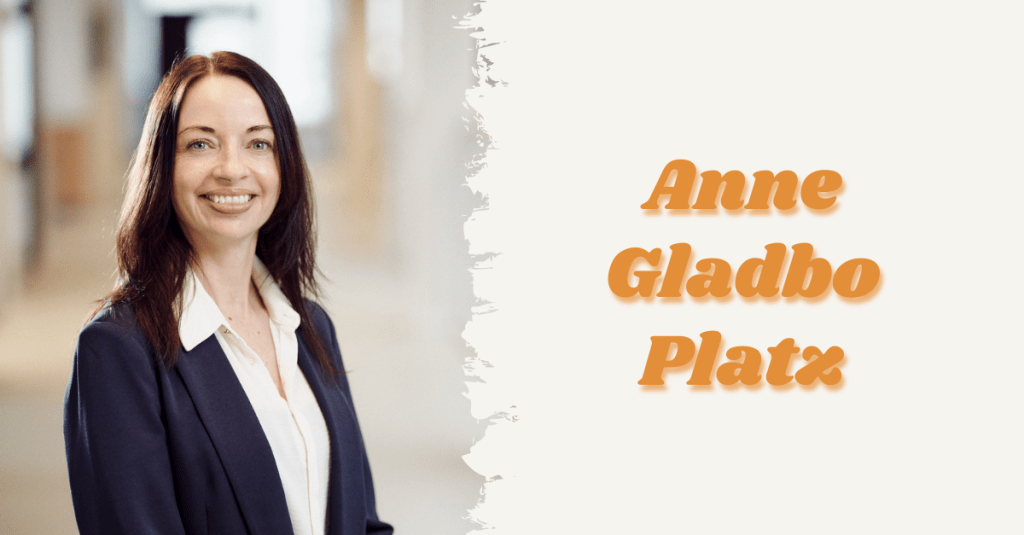
Interview with Anne Gladbo Platz
For more posts in this category, click here: Private sector
 kvinderifysik.dk