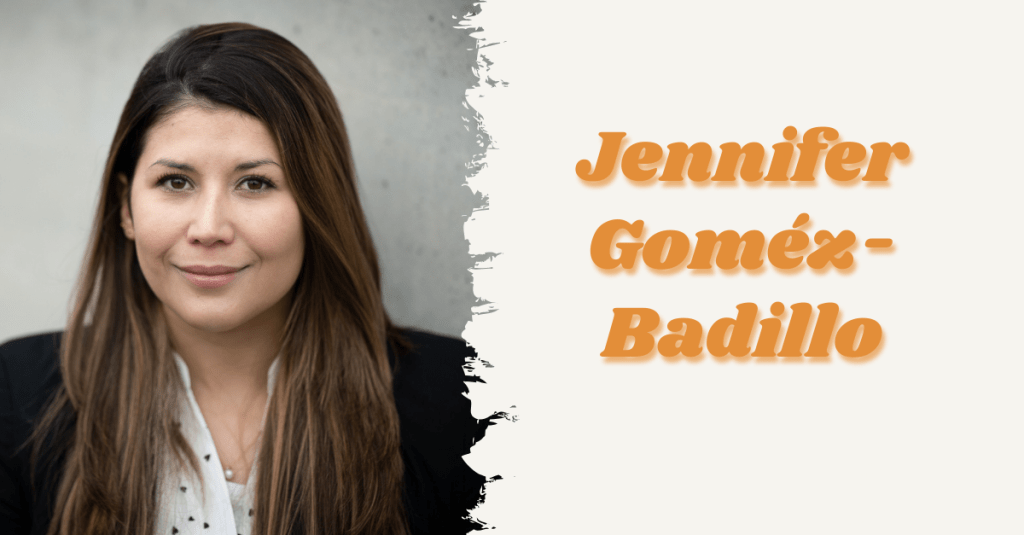
Jennifer Gómez-Badillo is a Postdoc at University of Southern Denmark (SDU) at Mads Clausen Instituttet (MCI) in Sønderborg.
What motivated you to pursue a career in physics, and how did you choose your area of specialization?
I am a chemist by training, but during my master and PhD studies, my topic of research involved a lot of physics, i.e. a physics component. My main research topic is within solid-state NMR (nuclear magnetic resonance). In this technique we study/observe the nuclear spin of atoms, which give information about the structure of molecules, and for instance, materials.
I chose this field because of the challenge it represented and also because of the unique information it provides. It was challenging because this technique was new in my country, and no one else specialized in it. We were pioneers in the field, so there was a lot to learn, and I wanted to specialize in it. Also because, as a chemist, I needed to learn about physics to understand more. Then I worked at the interface between chemistry and physics.
Where have you studied, and what did your career path look like until now?
I did my bachelor and master degrees in Colombia, my home country. Then, I went to France to do my PhD in NMR at the University of Lille. After this, I did my first postdoc at Radboud University in the Netherlands.
Until now, I used this technique to study many different materials, and gave me a lot of background in Materials Science. In my last postdoc, I worked within an European infrastructure to make NMR accessible to scientists with no experience with the technique, and this gave me the skills for my current job.
What is the focus of your current research, and why is it significant?
At the moment I am working for a new infrastructure called NANOCHEM, where I am learning other advanced techniques that involve optical imaging and spectroscopy and that are applied to materials science. As well, I am helping to promote this infrastructure and trying to make connections with companies that can benefit from it.
This new job is meaningful to me because I’m learning new techniques that weren’t part of my training but are very important for the development of new materials. I’m also learning new applications and keeping up with new discoveries.
Looking ahead, which area of work are you most excited to explore (in or outside of academia)?
I am looking forward to exploring more research that has an environmental impact, such as removing contaminants from water or designing more eco-friendly materials. I would also like to collaborate with industry to find more solutions that support the green transition.
What keeps you motivated in your research and work, and how do you maintain that drive?
What keeps me motivated in my work is discovering and learning new things every day. Being a curious person, I like to research and thoroughly investigate each topic. I like challenges and learning from them. To stay motivated, I remind myself of where I come from and everything I’ve accomplished. I also like to remind myself that my work matters and has a positive impact on the community. I think the world needs more women scientists, and by doing a good job, I can inspire more women to pursue a career in science.
Do you engage in public outreach or science communication related to your research? If so, what does that involve?
In my previous jobs, I didn’t do this very often, only at a conference once a year. But in my current job, outreach is very important. I dedicate myself to writing “stories,” which are one-page documents where I write about the research being conducted in our group, using simple language that can be understood by a wide audience.
Do you have any hobbies or activities outside of work that you are passionate about, and what makes them meaningful to you?
Yes, I do. I practice yoga and go to zumba classes. Yoga makes me centered and helps me to focus, while zumba connects me to my latin roots.
What are your thoughts on the importance of being a mentor and advisor to students and younger scientists, and what is your own approach?
Mentoring plays an important role for students and young scientists, offering guidance, support, and networking opportunities. It also helps them develop motivation, self-confidence, and resilience. A mentor should support the student, but also teach them how to work independently and take calculated risks. As a mentor, I like to show them that it’s normal to make mistakes and that we learn from them. I like to tell them stories of when I failed, but how I bounced back and tried something new. I also like to highlight when they’re doing well and help them build confidence.
Have any mentors played a significant role in your career, and how have they supported you?
During my training, I had two or three mentors who were important because they fostered my scientific curiosity and encouraged me to be good at what I do and to continue my studies. They helped me step out of my comfort zone and prove to myself that I could do it. They supported me with kind words of encouragement when I needed it and helped me connect with other researchers, which was very useful for my career.
What advice would you give to young people, in particular women and minorities, who would like to pursue a career in science?
As a woman from a developing country, I understand how difficult it can be to pursue a scientific career, but I think the most important thing is to believe in ourselves and our dreams. It is possible to study and dedicate yourself to science when you love what you do and have the desire to do it. All you need is desire and perseverance! Don’t give up when you get a no for an answer. There will always be someone who will respond to that email you sent, and they will give you the opportunity to learn.
 kvinderifysik.dk