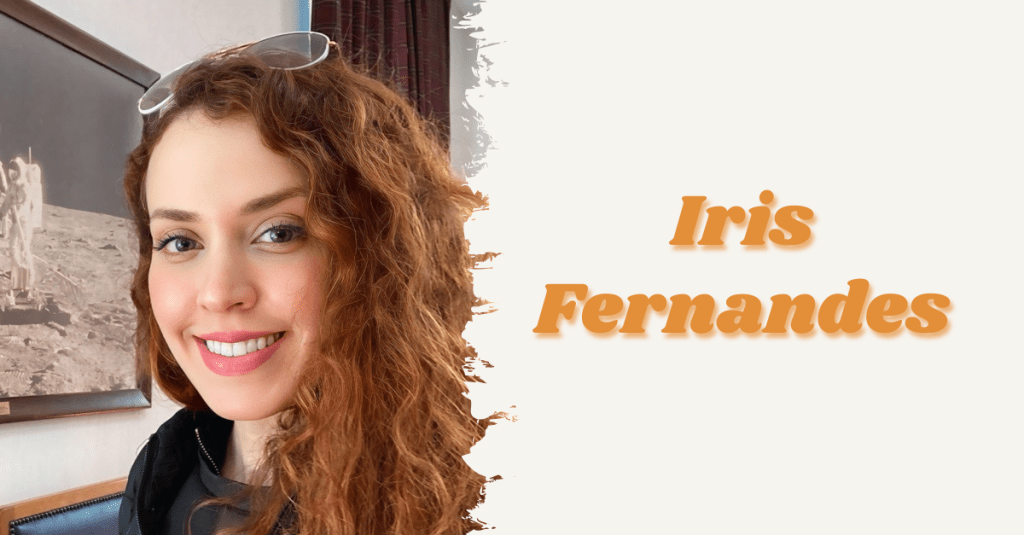
Iris Fernandes is a Postdoc at Niels Bohr Institute, University of Copenhagen, in the section for the Physics of Ice, Climate and Earth.
What motivated you to pursue a career in physics, and how did you choose your area of specialization?
My motivation comes from the deep excitement I feel when I see humanity achieving the extraordinary, pushing the boundaries of what’s possible, venturing into the unknown. From an early age, I was fascinated by space and the vastness of what lies beyond our planet. The idea that I could contribute to this collective effort, however small, was incredibly inspiring. Physics felt like the natural path to engage with those big questions. I chose to specialize in planetary physics because it brings together two things I deeply care about: understanding how planets form and evolve, and contributing to the future of space exploration. Space is unique, it challenges us to think bigger than ourselves, to contribute to something that will outlive us.
Where have you studied, and what did your career path look like until now?
I earned my bachelor’s degree in physics, where I was exposed to a broad spectrum of the field, from classical mechanics to quantum physics. During my master’s, I decided to focus on geophysics, driven by my curiosity about how planets form and the geological processes that make them habitable. Initially, this meant studying Earth, as that was where geophysics was most accessible. But with advances in space technology and remote sensing, we can now apply the same scientific methods to other planetary bodies. This led me to pursue a PhD at the Niels Bohr Institute, where I am now continuing my research as a postdoctoral researcher, specializing in planetary geophysics and remote sensing of the Moon.
What is the focus of your current research, and why is it significant?
My current research focuses on mapping the lunar surface using remote sensing data from orbiting spacecraft. This work has direct applications for future lunar missions, robotic and human, by helping identify safe and scientifically valuable landing sites. The Moon is not a uniform surface; terrain, illumination, resource availability, and accessibility all play crucial roles in mission planning. My work provides data-driven, geologically informed assessments of these factors, reducing the risks and uncertainties involved in space exploration. In short, it helps take the guesswork out of where we land and why, contributing to safer, more efficient, and more ambitious space missions.
Looking ahead, which area of work are you most excited to explore (in or outside of academia)?
I’m fortunate to say that I’m already working on what excites me most: planetary exploration. But looking ahead, I’d love to be even more closely involved in planning and supporting future human missions to the Moon or Mars. Contributing directly to mission design, whether through landing site analysis, surface mobility planning, or in-situ resource evaluation, would be a dream come true. I want to be part of the team that helps humanity set foot on new worlds.
What keeps you motivated in your research and work, and how do you maintain that drive?
What keeps me going is the sense of purpose, knowing that my work contributes, even in a small way, to humanity’s understanding of the universe and to future space exploration. Space research is inherently challenging, but that’s part of what makes it rewarding. I also find motivation in curiosity: every dataset holds secrets waiting to be uncovered. To maintain that drive, I remind myself often of the bigger picture, and I try to celebrate the small wins, whether that’s solving a tricky problem, getting a paper published, or sharing my work with others.
Do you engage in public outreach or science communication related to your research? If so, what does that involve?
Yes, I’m currently involved in science communication through my university’s outreach initiatives, and I’ve participated in interviews and events aimed at making science more accessible. I’m always happy to talk about my work, especially because space tends to bring out the curiosity in people, regardless of their background. Whether I’m chatting with friends, family, or colleagues from other disciplines, I find joy in seeing that spark of wonder when people engage with planetary science. I’d love to be more involved in outreach in the future, especially when it comes to inspiring young women to pursue STEM careers.
Do you have any hobbies or activities outside of work that you are passionate about, and what makes them meaningful to you?
I’m a very active person, I love sports and pushing my physical limits, whether it’s through weightlifting, running, kitesurfing or trying something new. It gives me a sense of clarity and balance, and in some ways, it mirrors the challenges I face in science. Both require resilience, strategy, and a bit of courage. That thrill of pushing boundaries, whether physical or intellectual, is something I carry across all areas of my life.
What are your thoughts on the importance of being a mentor and advisor to students and younger scientists, and what is your own approach?
I truly believe in the importance of supporting and encouraging younger scientists, especially those who are just starting out or who come from underrepresented backgrounds. I try to be approachable and open when students or early-career researchers reach out with questions or want to learn more about my work. Sometimes just sharing your experience can be helpful to someone navigating their own path. As I grow in my career, I hope to take on a more active mentorship role and create the kind of supportive environment that I’ve been lucky to experience myself.
Have any mentors played a significant role in your career, and how have they supported you?
Absolutely. I’ve been lucky to have mentors who not only guided my research but also helped me navigate the more personal and professional aspects of academia. A good mentor gives you perspective, on what really matters, on when to push forward, and when to take a step back. They’ve helped me believe in myself during moments of doubt, and that’s something I carry with me and hope to pass on.
What advice would you give to young people, in particular women and minorities, who would like to pursue a career in science?
Being a woman in science, and someone from an emerging country, I understand the challenges of feeling like an outsider. But I also know the strength that comes from bringing a different perspective. My advice is: don’t let anyone else define your path or your worth. Seek out mentors and communities that support you, and don’t be afraid to ask questions or take up space. Science needs diverse voices and experiences, and you have something unique to contribute. The road may not always be easy, but it is absolutely worth it.
 kvinderifysik.dk