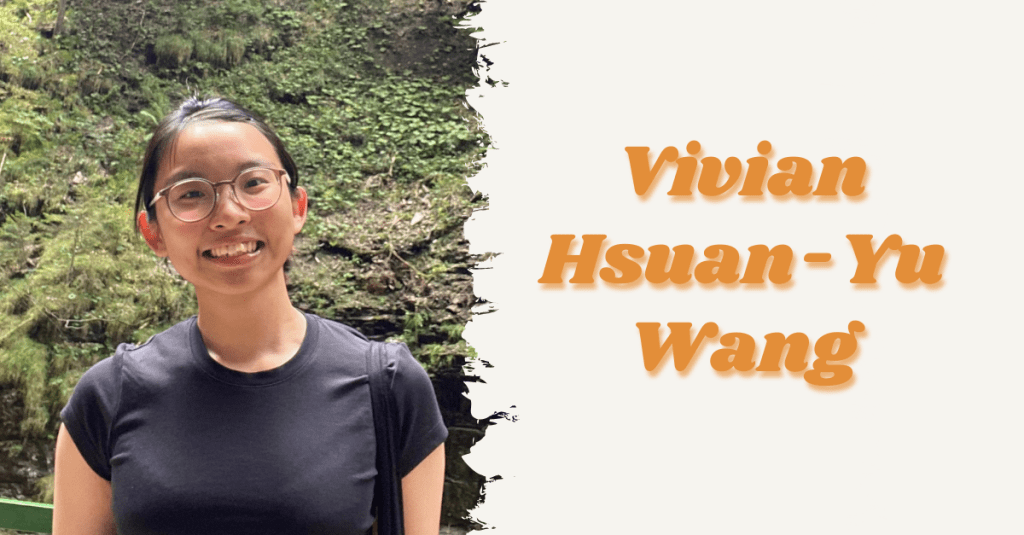
Vivian Hsuan-Yu Wang is a PhD student at University of Southern Denmark (SDU) at Mads Clausen Instituttet (MCI) in Sønderborg.
What is your PhD project about?
My project is about stabilising the active layer inside the organic solar cell with natural antioxidants like vitamins that you will find in your daily vegetables.
What inspired you to study physics or engineering, and when did you realize you wanted to pursue this path?
I actually have a background in Chemistry, but my Master’s and PhD are both on solar cells, which is an interdisciplinary field between chemistry, physics, and materials engineering. It was in highschool when I set on pursuing this path.
I am compelled by the potential chemistry and physical chemistry has, in being able to explain everything we see and we touch. It is also so powerful that it is capable of making a huge impact, e.g., nuclear power or plastic recycling.
What made you choose to pursue a PhD degree?
I always knew I wanted to continue working in science after studying, but was swaying between doing a PhD or being part of Research and Development within a company. I decided to pursue a PhD as I really enjoyed my master’s project, which is also on solar energy. Another key reason behind my choice was the flexibility I would have in terms of having the liberty to understand the ‘why’ behind the phenomenon instead of being driven by profitability.
What hobbies or activities do you enjoy outside of your studies, and how do they help you maintain a work-life balance?
I like to swim and do yoga outside my studies, both are a great way for me to slow down, reflect on both life and work, or just shut down my brain momentarily.
What are three important skills you have gained during your PhD, and how have they contributed to your growth?
I am still at an early stage of my PhD and I would say there are still so many that I am learning. However, so far I would say the three key skills are asking for help, record keeping, and presentation skills.
The first one sounded simple but can be difficult sometimes when you feel like you are putting yourself in a lower position by asking questions. But people around you have different expertise and knowledge, sometimes a few lines of their insight may save a week or more of your experiment time. The second one (lab record keeping) was actually taught to us since my bachelor’s study but has always been relevant especially during my PhD. This practice saves you the worry and stress of looking back into a piece of data you collected and unsure where exactly it came from. In terms of the final presentation skill, it is not only for when you present your work to your supervisor or to the team but also when you want to introduce yourself and your work briefly during workshops or conferences when one is limited by time.
What does being a scientist mean to you?
I would say being a scientist is about figuring out the ‘unknown’. It is failing before making discoveries that extend the boundary of knowledge just a little further. The idea that I, together with other scientists around the world, are contributing to the greater good and making an impact, is beyond exciting to me.
What kind of career do you envision after your PhD?
I hope to continue researching, either in academia or in industry depending on where the opportunities present.
Do you have role models who have inspired you, and how have they impacted your decisions or goals?
I think my greatest role model is my grandma, who is not a scientist, but she is really keen on knowledge. She always carried a book with her and encouraged all her grandchildren to read more. She is also the one that continuously encouraged me to ask for help when I needed it and really supported my decision when I decided to pursue a PhD.
What advice would you give to young people, particularly women and minorities, who are interested in studying physics or engineering?
I would say to just go for it, you never know what will happen until you give it a chance. Physics, engineering, and chemistry are all fields with immense potential, just like yourself.
 kvinderifysik.dk