
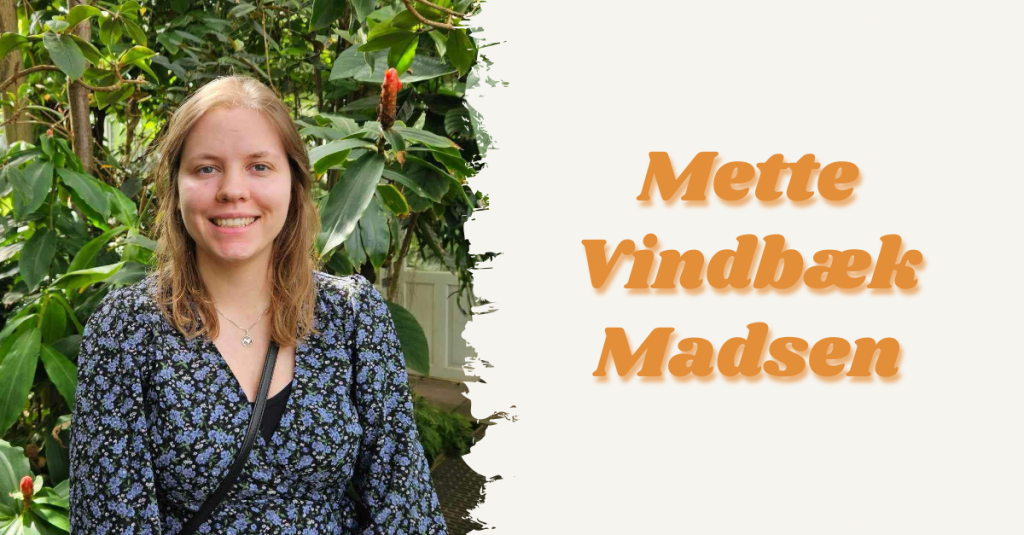
Mette Vindbæk Madsen is a Fuldmægtig/IT developer at Styrelsen for Grøn Arealomlægning og Vandmiljø/Agency for Green Transition and Aquatic Environment.
Where did you graduate from and with which degree?
I graduated from the University of Copenhagen with a master degree in Astrophysics at the Cosmic Dawn Center (DAWN).
Please give a description of the work you do in your current position.
I work as an IT-developer in the Agency for Green Transition and Aquatic Environment in the department Areal-ART, where we are working with developing area-based agricultural subsidy schemes.
The biggest subsidy scheme we have is Fællesskemaet, with a lot of smaller subsidy schemes, some of which focus on biodiversity and sustainability and others that focus on managing nitrogen in agriculture to reduce nitrogen in the environment.
The work I am doing is dependent on the time of year, because we have to prepare for the application round of Fællesskemaet, which starts every year in February.
When we are done with the application round, we start to develop the case worker module. Here we are trying to make the case worker module as automatic as possible, so only a few cases go to manual case processing.
In the team that I am a part of, we are developing the targeted nitrogen regulation subsidy scheme, which is part of Fællesskemaet. Targeted nitrogen regulation is a commitment scheme, where we are developing a module that prioritizes who receives a commitment and who receives a rejection.
Later we develop a case worker module, where we also try to make the case worker module as automatic as possible. When we are done developing the case worker module, we develop the payment module, so the farmer can get their payment.
We develop everything from the start of the application round to the end, when the farmer receives their payment.
What motivated you to study physics or engineering in the first place?
I was motivated to study physics, because of the teacher I had in high school, she was really inspiring to listen to and I could not get enough. I wanted to learn more, especially when we had a topic about the universe, dark matter and dark energy. At that moment I knew that I wanted to study physics and learn more about the Universe.
What made you decide to pursue a career in the public sector?
For me it has always been a choice between the public sector and a private industry. I always knew from the start that I did not want to be a researcher or work in the academic field. It was fun working on my thesis and it was an educational experience.
After I finished the thesis, I did not know which type of work I wanted to do, so when an opportunity came as an IT-developer at the Agency for Green Transition and Aquatic Environment I sent an application. I did not regret that decision and today I am part of developing the subsidy schemes to make the green transition in agriculture happen.
How do you use the skills you learned as a physicist or engineer in your work?
As a physicist we learn many different skills that can be used everywhere. The skills that I use the most are the ability to solve complex problems, how to acquire, use and understand new knowledge and a mathematical understanding. I use all these abilities on a daily basis, when developing the calculations and validations used by either the farmer or the case worker.
Programming is also one of the skills one learns as a physicist and a skill I use, but not as often as the other skills mentioned.
What does being a physicist mean to you?
To me, being a physicist means a lot of things, just as there are many different types of physics, there are just as many ways to be a physicist, but if I have to put a few words on, it is someone who is eager and curious to know more about the world and in my case it is about trying to understand how the early galaxies were made, and how the Universe came to be. So being a physicist is someone who wants to try to understand mysteries of the world.
What advice would you give to young people (in particular women and minorities) with a background in physics who would like to pursue a career in the public sector?
It can be hard to find a job after university and you may feel a little bit lost sometimes, but being a physicist means that you are equipped with many different skills, so if you find an interesting position, go and apply for it.
The skills you have learned from physics are highly valued and you can use them everywhere, this means it is possible to get a job in many different places. Even if it seems far away from physics, it could be fun, interesting and at least it is a valuable experience.
 kvinderifysik.dk