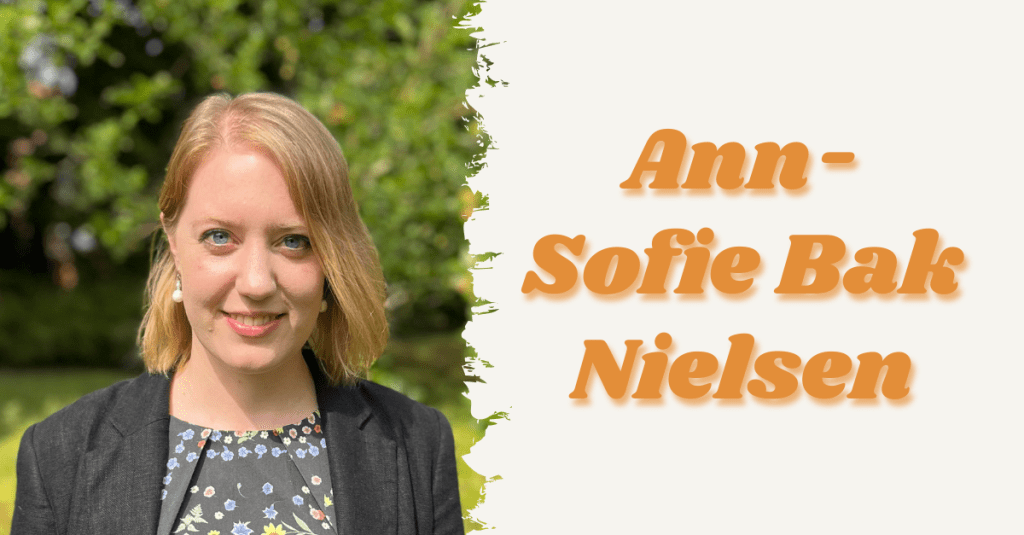
Ann-Sofie Bak Nielsen is Fuldmægtig / Head of Section at the Uddannelses- og Forskningsstyrelsen / Danish Agency for Higher Education and Science (Space Division).
Where did you graduate from and with which degree?
I was awarded my PhD in Astrophysics in 2018 from Leiden University. Before that I did both my bachelors and master’s at Dark Cosmology Centre at University of Copenhagen.
Please give a description of the work you do in your current position.
I work in the Space Division (rumkontoret), which is the interministerial coordinating space authority in Denmark. In the office we represent Danish research and innovation policy interests in international organisations, like the EU and ESA, as well as approval of, and supervision of launches of Danish objects into outer space.
More specifically, as well as participating in EU meetings, I am a delegate to two ESA committees, the Industrial Policy Committee (IPC) and the Space Situational Awareness programme board (PB-SSA). Being a delegate to ESA brings a lot of interaction with companies in Denmark, to try and facilitate their collaboration with ESA. Working with international organisations leads to a lot of travel, which I enjoy a lot.
Since I do work as part of the civil service in a ministry, there are also a number of administrative and management tasks to my job.
What motivated you to study physics or engineering in the first place?
In my first ever physics lesson my teacher explained the Bohr model, and introduced us to very simple atomic physics. I had a moment of feeling like the world just made perfect sense. That is when I decided I wanted to study physics.
What made you decide to pursue a career in the public sector?
It was a bit by coincidence that I ended up in the public sector. I have had a few different jobs since finishing my PhD. Immediately after my PhD, I went on to do a PostDoc at the Max Planck Institute for Radio Astronomy in Bonn and I was planning on continuing a career in academia, I even had a fellowship in France that I could move on to after my PostDoc. However, when the pandemic hit I lived abroad with a life that was very dependent on open borders. So, at that point I decided I wanted to eventually move back to Denmark. Finding a permanent academic position in Denmark is difficult, so instead of moving to France, I decided to quit academia and move to Oxford to work for a company as an SSA engineer. At the time, my reasoning was that a job in industry would give me a better chance at a job in industry in Denmark. At the end of 2022, after 8 years living abroad, I moved back to Denmark and worked remotely for a few months, before my current position was advertised. Working for the Space Division offers a perfect combination of tasks, from having to understand new missions and Danish involvement, contact with companies and research institutes, to administrative tasks. I feel really lucky to work in the Space Division and to continue to have a career related to space science and industry. What has surprised me a bit about working in the public sector is the satisfaction I feel when representing Denmark in international organisations like ESA.
How do you use the skills you learned as a physicist or engineer in your work?
As a physicist we learn a lot of transferrable skills. There are the obvious ones like programming, but we also learn to tackle complex problems and search for solutions, we are taught to be curious and encouraged to ask questions. Except for programming, those are all skills I use today.
While it is not something I learned as a student, through the different places and countries I have been employed in, I have become better at interpersonal interactions, which is really useful in my job, where there are regular meetings with international participants.
What does being a physicist mean to you?
It means being curious of the world, from the smallest particles to the biggest stars, and everything in between. It means asking questions and trying to find solutions, whether that be to a science problem or how to fund a specific mission with Danish interest.
What advice would you give to young people (in particular women and minorities) with a background in physics who would like to pursue a career in the private industry/public sector?
I might not be the best person to give advice on how to pursue a career in the public sector, as it is a bit by coincidence I ended up here. I have had a job in academia, the private sector and the public sector, and each has advantages and disadvantages.
In general, however, I would say keep going, and don’t listen to anyone telling you there is something you can’t do based on your gender or ethnicity. It sounds obvious, but it is important to keep in mind, because you will likely still experience someone treating you differently based on your gender, no matter if you choose academia, private industry or the public sector.
There are also three lessons I have learned through experience. First, if you are a student (or young professional) find someone, a mentor or professor or your thesis advisor, you feel comfortable asking for advice and who can write you a reference letter. No matter what, you will need that at some point. Secondly, if you are a PhD student, then work on a project with a different group from the one you are in. Be that a group at a different university or in a slightly different aspect of the field that you are otherwise working in. It will give you opportunities that you might not otherwise have had, and open up doors to other jobs. If you don’t know if you want a job in the private sector or public sector, try applying to both, you can switch between them. There are many jobs in the public sector that require analytical and coding skills, just as there are in the private industry.
And finally, have fun, spend time with friends and family, and work with what you enjoy, not what you feel you have to. Even if it does not give you the career you had originally envisioned, it will be worth it.
 kvinderifysik.dk