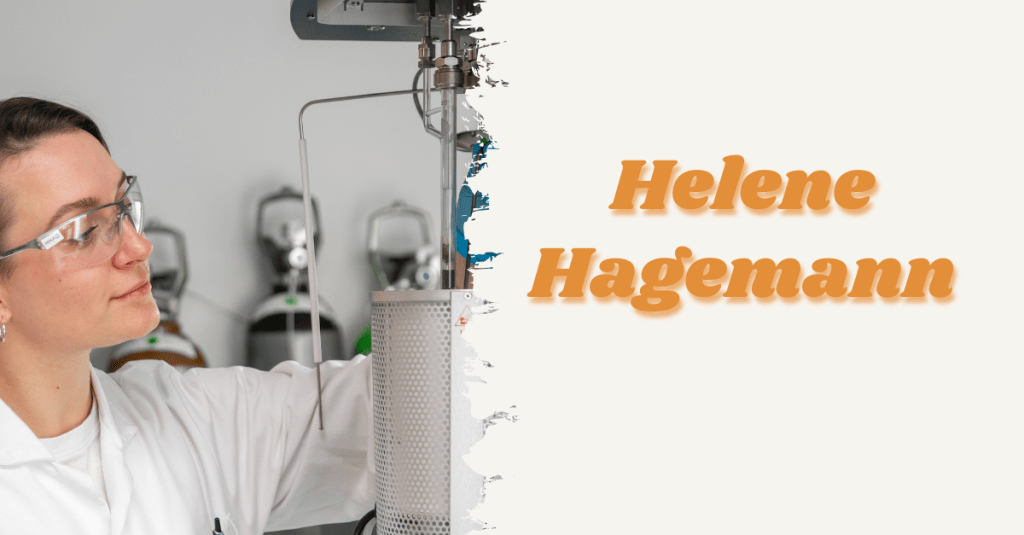
Helene Hagemann is a Specialist at Teknologisk Institut (Eng.: Danish Technological Institute)
Where did you graduate from and with which degree?
I graduated with a Master of Science in Physical Chemistry from the University of Copenhagen in 2019. In 2023, I graduated with a PhD in Physics from the section of Surface Physics and Catalysis at the Technical University of Denmark.
Please give a description of the work you do in your current position.
At Danish Technological Institute, our focus is the future: We are making the green transition happen, and we develop the technologies of tomorrow. We solve commercial tasks, helping Danish companies with the challenges that they do not have the resources or knowledge to address themselves, and we work on research and development projects in collaboration with Danish and international companies and research institutions. We are highly specialized in the production of nanocoatings, material examination, printed electronics, energy systems, Power-to-X, and nanomaterials.
In my current position as a specialist at Danish Technological Institute, I primarily work with research and development projects related to energy materials and Power-to-X. More specifically, I work with the development and characterization of materials (nano materials, catalytic materials, etc.), to determine for example the performance, efficiency, and structure of catalytic materials, as well as the pilot production of nanomaterials and the development of reactors. This is both something I do for customers who reach out to us, as well as in projects that are always in some way related to Power-to-X.
At the moment, I am busy with two projects, namely the DARE2X project and the AFLOAT project. They are both related to green ammonia: DARE2X is an international project working with the decentralized production of ammonia from renewable energy utilizing a novel sorption-enhanced plasma catalytic Power-to-X technology. The basis of the AFLOAT project, a project funded by the Innovation Fund Denmark, is the vision of ammonia being a key sustainable fuel for the marine sector. In this project, we will develop and demonstrate a solution that improves the combustion properties of ammonia by hydrogen enrichment – a solution that can be applied on already existing dual fuel engine designs.
What motivated you to study physics or engineering in the first place?
Because I knew I wanted to work with catalysis, I also knew I had to change gears during my last years at university. I was fortunate enough to be able to do my master’s thesis as a collaboration between Topsoe and the University of Copenhagen, and that experience really cemented my feelings about the industry and the subject of catalysis. One of my amazing supervisors at Topsoe, Hanne Falsig, was really the catalyst to my pursuit of a PhD in physics. She was (and is) truly a great mentor!
What made you decide to pursue a career in the private industry?
Once I finished my PhD, I knew I wanted a change of scenery to something that wasn’t academia. It is not a secret that academia is a challenge, especially if you are part of a minority group. I couldn’t see myself in academia anymore, and I went back to my ‘roots’ – my initial dream of industry. I went for an industry dealing with subjects such as energy materials and Power-to-X, as they are subjects I have a passion for and interest in. But I also went for a company with a flat management structure where I knew my voice would be heard and my opinions would be listened to, valued and taken into consideration. I think those three things are essential to my happiness at work.
How do you use the skills you learned as a physicist or engineer in your work?
I don’t define my skills as a physicist or a chemist by the formulas and constants I’ve learned over the years. For me, it’s my logical and critical way of thinking, how I approach a problem, and how I go about solving a challenge, bringing in different disciplines to tackle it. This way of thinking and working is something I use everyday, and I can really see the advantage of approaching problems and tasks at work with logical thinking and an almost holistic view.
What does being a physicist mean to you?
I am very proud of my multidisciplinary background and profile. To me, being a physicist as well as a chemist is proof that I can achieve whatever I set out to do. It was a very steep learning curve during my PhD, and I had a hard time being a woman in a lonely and competitive male-dominated field. What made me endure the tough times were my coworkers and close friends and the community we created. I was and am very proud to have been a part of a small initiative at DTU Physics, created by and for minority physicists, where we discussed our everyday struggles and joys. It made a world of difference to have this community of like-minded female physicists, and I am very proud to be a female multidisciplinary scientist who supports and shows up for people of minorities who have the same lived experience as myself.
What advice would you give to young people (in particular women and minorities) with a background in physics who would like to pursue a career in the private industry?
If you want to pursue a career in the private or public industry, I think you should do so! Put yourself out there and schedule a ton of coffee meetings with strangers. It can be nerve-wracking at first, but you get used to it. It made a difference for me to be open about my interests and passions to people I met this way, and to be curious about their work. People usually want the best for you, and you have to remember that when you go to a coffee meeting. The job market can be difficult to figure out, so contacts and networking are everything. And if you do send in an application for a position you really want, be persistent and show your future employer that you are passionate about the position and the company.
As far as personal advice goes, I believe the following will make a difference: Do what makes you happy, don’t let anyone put you down, and stand by what you believe to be right. I have a lot of advice, but I believe this to be the most important: Put yourself and your sanity first. If it means putting your foot down and saying no, do so. If it means taking a break (which is not just a holiday), do so. If it means opening up to a coworker, a supervisor, or a boss, do so. And if it means asking for help from a professional, definitely do so.
 kvinderifysik.dk