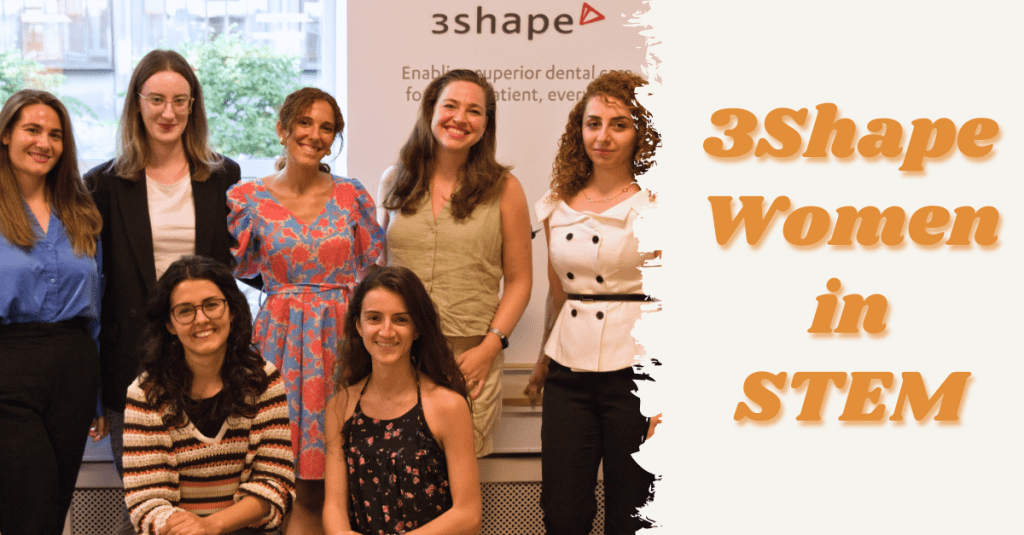
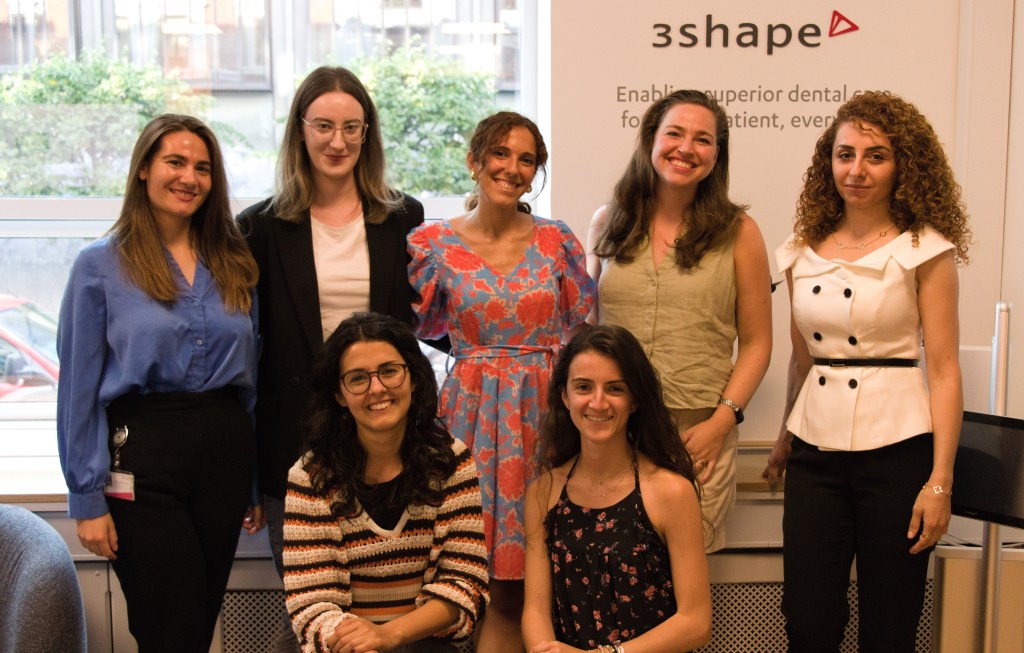
Banner photo from top left: Laura Montesdeoca Fenoy, Sara Qirko, Ersilia Guarini, Malene Leonora Nielsen, Roza Hasso. From front left: Andreea Ștefan, Andrea Sánchez Díez.
3Shape is a company that mainly develops scanners and software for the dental industry to provide both dentists and patients with an enjoyable experience and the best dental care possible. The company was founded in 2000 in Denmark and now has more than 2200 employees across more than 100 countries. 3Shape employs a great variety of people, but many have backgrounds in physics and other STEM fields.
A group of women at 3shape have started the initiative 3Shape Women in STEM and naturally, we were very interested to hear more and share their story with the KIF community. In early September 2024, we visited the 3Shape offices in Copenhagen and the women shared their thoughts on the importance of inspiring girls and young women to pursue science.

Thank you so much for having us! Can you tell us a bit about yourself and your background?
Andrea Sánchez Díez: “I am originally from Spain, but moved to Denmark four years ago. I did my bachelor’s back in Spain and my master’s here in Denmark. I studied for a bachelor’s in industrial design and product development engineering and then took my master’s in design and innovation. I’ve always had an interest in the technical side of STEM. That’s why I decided to go for an engineering bachelor. But I also had this passion for the creative side of things. So the bachelor that I chose allowed me to have both worlds. I have been working at 3Shape as a UX designer for the last 3 years. And that pretty much is what I was saying about combining both worlds. I have a very close relationship with the technical side and the developers in the company. My job is to hear out our dentists who use our scanners or products. And then on the other hand I work a lot with the business side and product managers to be able to meet the users’ needs. So basically, I focus on the user, but keep in mind the technical part. And so being able to still keep my roots in STEM.”
Sara Qirko: “I’m originally from Albania, but I moved to Denmark five years ago. I did my bachelor’s back in Albania in computer engineering and then my master’s here in Denmark in computer science. And then I had a specialization in machine learning. I’ve been working as a software developer here in 3Shape for three years now. I’ve been in one of our application teams, but very recently I moved to one of the AI teams.”
Andreea Ștefan: “I’m originally from Romania. I also studied computer science. I did my bachelor’s in Romania and here I did a master’s at KU in computer science. At the same time as I was studying for my master’s, I also started working in 3Shape. I was working as a student software developer, so part-time. And then after I graduated, I continued full-time and I’ve been working in 3Shape for over seven years in total. And at the beginning of this year, I got the title of software architect.”
In 2022 Andreea was awarded the Version2 IT Talent Award for IT Developers.
Andreea: “ Companies could nominate people for the prize and then my manager decided that we should submit the application for me and I ended up winning!”
Malene: “You’re way too subtle about it. That’s amazing. That’s so cool. And you never bring it up. We’re surrounded by talent here!”
Laura Montesdeoca Fenoy: “I’m from Spain. I did my bachelor’s in robotics engineering at Aalborg University. And then I did my master’s on something called vision graphics and interactive systems. Basically, it was a machine learning specialization. And now I’m working here at 3shape in the machine learning department. And then also recently, I became a scrum master for my team.”
Roza Hasso: “I’m originally from Syria. I moved here in 2015, so almost nine years ago. I did my bachelor’s in software engineering and master’s in computer science. I specialized in computer security but also had a focus on machine learning. I worked as a programmer or developer when I was a student. But now here at 3shape, I don’t code anymore. I’m a patent manager.”
Ersilia Guarini: “I come from Italy. And I moved here to Denmark almost four years ago. I did all my studies in Italy, bachelor’s and master’s. I studied physics in my bachelor’s and theoretical physics in my master’s. And then here in Copenhagen, I got my PhD in astroparticle physics. And now, I joined 3Shape back in March, actually. So, six months ago now. And I do something completely different. I work with Roza in the same team as an associate patent attorney. So, basically, I try to keep what I like from my PhD, which was the writing part. So, my main task is actually writing a lot. Specifically, patent applications, which have the goal of protecting the intellectual property of inventions and creations and new technology here at 3Shape.”
Malene Leonora Nielsen: “I have a Master of Science in Health Informatics from DTU and UCPH. I usually mention that my dad is an engineer and my mom works in healthcare and that I became a healthcare engineer. So, maybe I was destined to do this, I don’t know. But I feel very lucky because I also come from a long line of very strong women who all worked in healthcare. So, I’ve always had role models. I work as a product manager here at 3Shape and have done so for two years. As a product manager, you build roadmaps for different products. I manage a portfolio of products, and that means I also get to talk to a lot of different people. So, I actually just thought about that I’ve met each one of you, you know, in my capacity as a product manager. I meet developers, UX designers, patent managers, and all other kinds of people in my job. And it makes me so happy that everywhere I go, I see women. So, I think we are moving in the right direction on that front.”
Malene: “So, what I care about when we do these events for girls is to show them that they can do whatever they want to do. Even if you don’t have role models close to you or if you don’t have anybody in your circle who’s done it before you. And I don’t think the mission for me is that everybody should work in STEM or everybody should work in science, but at least they should know that you can if you want to. The role models are out there. You women here are also role models for me. Every time I interact with you in a capacity at work, I feel very inspired that you are all so accomplished and you know your stuff. I think it’s important to lift each other up, especially as women.”
How do you as women working for 3Shape experience the effects of the ED&I effort from your company?
Andreea: “When I started, I was the only woman in my team. And now it’s a very gender-balanced team. We actually have three women and three men. And also all the women in my team are in the leadership. So, it’s a project manager, a product owner, and me as an architect. There is an increase. I think it’s nice. I think 3Shape is putting in the effort for diversity and gender equality.”
Ersilia: “Another way that 3Shape is supporting this growth in gender equality is also by promoting our initiative. Women in STEM is an employee-driven initiative, but still 3Shape is supporting it. They also give us the chance to host events at 3Shape, like using the auditorium or book rooms for events.”
Malene: “I actually had two very close friends who both graduated in physics last year. And just supporting your [Ersilia, red.] point about 3Shape opening the doors: Because my two friends, they didn’t know what you can do as a physicist, and my manager allowed me to open the doors and have them shadow me for a day. And I got to show them how to develop a product. They met software developers and other people in the company. I tracked down all the physicists and introduced them. So, I think that 3Shape is open to whoever wants to explore. And if you reach for the opportunity, you are actually given the opportunity.”
Let’s talk a bit about the 3Shape Women in STEM initiative. How did it all start? And what sort of events do you do?
Malene: “Two women from 3shape got together to start this. I got to know about it from the intranet. There was a post that said, hey, if you’re a super cool woman, come join us! And then we were a couple of people there. And then it spread by word of mouth. I knew somebody and poked them and they poked someone, and we’re actually quite a large group now. It also started out with asking, what can we do? And then, I know somebody who is a parent in this school, should we do a school visit? That’s how it started.”
Andreea: “And then we started to do more workshops and collaborate with other organizations.”
Malene: “Yes, we collaborated with HelloAda and Naturvidenskabernes Hus.”
Ersilia: “So I think that, as you [Malene, red.] were saying before, it’s about bringing role models to young kids. Now, these young kids don’t have to be only girls, but also boys, because we think that it’s very important that boys also are exposed to the fact that it’s completely normal to have a female leader or manager, which is something that probably is not normalized in all environments. So for us that is very important. And also giving kids some inspiration and an idea of what they can do. Like, in this room there are people with very similar backgrounds, but each of us is doing something very different, right? So I think it’s also essential to show that there are a lot of possibilities out there when you go for a degree in STEM.”
Malene: “And also trying to do coding exercises that are actually tying in to products that we have in 3Shape. So instead of just saying, hey, do some coding, we tie it in to something practical.”
Ersilia: “And they usually have fun! That’s important.”
Sara: “But I think it’s also about changing some of the wrong perceptions that people have. Like kids, maybe from Hollywood movies, have this idea that programmers are just, I don’t know, men sitting in front of computers in a basement. So we are showing that we are normal people just doing this job. It’s not what you think it is.”
Malene: “Personally, as I mentioned, I actually never felt like I was not able to do science because I had a strong family and some strong friends as role models when I was studying. The gender ratio in my degree was 50-50, so I never felt restricted, but I’m not blind to the fact that it does happen still. I think we are moving in the right direction, but there’s still so many things to be done. Like being the only woman in a meeting and I don’t want to be the one who takes notes, right?“

Andreea: “Also about being the only woman in the room, I just don’t like that I always stand out like that. Whenever I join these meetings, they will remember me for what I say. I cannot blend in and be part of the crowd. So I will always stand out in all these meetings that I attend by myself. I think it’s an awful lot of pressure.”
You sort of have to represent your entire gender when you’re in a room as the only woman. I hope this Women in STEM initiative can help bring more women into the field down the line and change things over time.
Andreea: “I think it’s happening already. I see that a lot of the women here at 3Shape belong to the younger generation.”
Roza: “But we’re also all foreigners. I think it says something about the Danish culture. That’s also why I think it’s important to go to the schools and actually change their minds about science while they’re still young. Because if we wait until they’re in high school, they already chose what kind of degree they’re going to do, right? Then it’s a bit more difficult to change their mind. So if you get to them early enough and you break the misconceptions they might have about STEM, then you have a better chance at educating girls in STEM. In my team, all the women developers are also foreigners. And it happens a lot in the 3Shape, and probably because the pool of Danish women who work in STEM is not that big.”
Andreea: “We recently recruited a person for my team, and we had more than 50 people applying. And there was only one application from a woman among all of them.”
What would have made it easier for you as women when you were doing your degrees and choosing a career in STEM?
Ersilia: “Where I come from, I didn’t meet any women in physics besides my classmates when I was at university. I just had one woman professor. So I think that it would have been nice for me to have more women professors. I think that maybe while I was in high school, I would have liked to be more encouraged to go for a career in physics or in STEM in general with some kind of initiative. I actually did have this sort of thing, but it was not led by women. So in the end I was attending this initiative and they were talking about how it is important to have gender equality in STEM, but it was a man talking to me. Which is good! Because this is a problem which is related to everyone. It’s not just a women’s problem. Gender equality must be a priority for everyone independently of their gender. But when you’re younger, I think it really helps to see faces that are similar to you in a way, because you can recognize yourself there. She was a kid like me and she did it! This is very inspiring. And talking about the fact that we have this inequality and it’s important to go to schools and kind of involve them in this issue from the beginning. I think that HelloAda actually had a talk about it, and they showed that actually kids are very interested in technology and science when they are very young. And then at some point after elementary school the interest just dropped. And the question is, why is this? Maybe one thing that could be related to this is the fact that we are in a world where we are constantly being exposed to movies, TV shows and social media. And it would be nice to have some stories about women working with STEM and not stick to old gender stereotypes. Having this realistic media representation I think is very important, because we have to face that TV and social media are very important for kids now. So, I think that for this reason, initiatives like this are very important because it’s easier to reach kids this way. Sometimes I get a bit angry with the media, because when there’s a woman who works with, I don’t know, engineering or aerospace engineering especially, she is never introduced as a scientist or an engineer, but she is introduced as ‘mom of two kids goes to space’. And yes, it is important that she’s a mom, but she’s not only a mom. And this is not the focus of the article. Why do we have to relate her to someone else? There’s no need to do that. Let’s call people by their name and let’s give them their proper professional title, and that’s all. So I think that using the right words is very important.”

Andrea: “I would have liked to have something more hands on. We bring in kids around the age of 12 years old. They come in and basically they choose what job they might want to do in the future. And then they just follow you around and you actually give them real tasks that you do in your job, obviously simple ones, but so that they can get an idea of what this job actually is. That would have been very helpful for me because I knew what the bachelor title said, but I didn’t really know what opportunities I had in the job market.”
What advice would you give to women with STEM backgrounds in other companies who want to start a similar conversation or a similar initiative?
Malene: “Do school visits. I think that’s super impactful, both for the schools and the students, but also for you to get in touch with the future generations and see what they care about. It is good to get a reality check. And also blast your LinkedIn with pictures of women. I know, I do. It’s because I get so happy every time I see something on LinkedIn where I can recognize myself. So show it. Because there are so many cool women working in STEM and I really want to shout to the world: ‘Look at her!’”
Thank you to the 3Shape Women in STEM initiative for having us and sharing their experiences and insights!


 kvinderifysik.dk