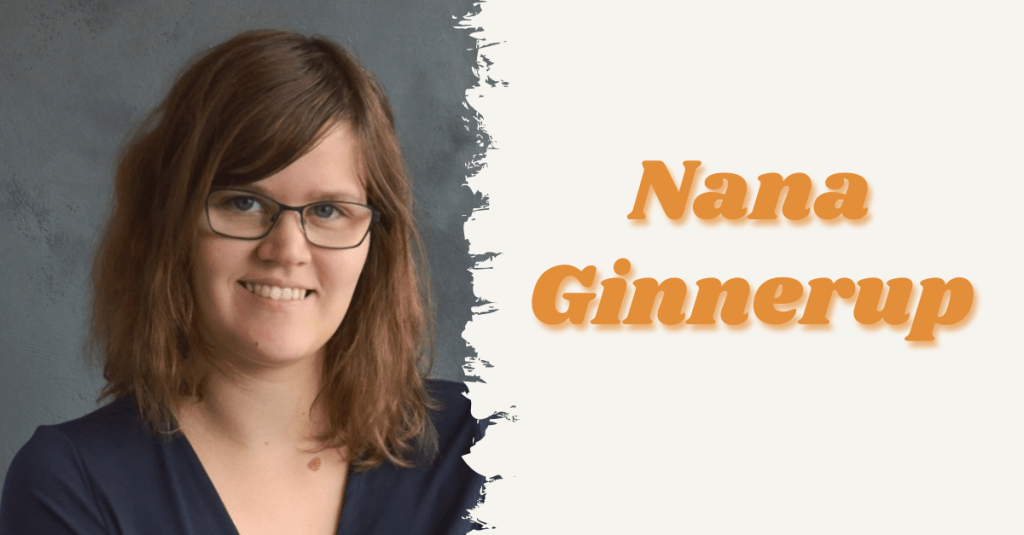
Nana Ginnerup is a Data Scientist at the company Lenus eHealth. She graduated from the Niels Bohr Institute, University of Copenhagen with a Master’s degree in Computational Physics. Her Bachelor’s degree was in Quantum Physics also at UCPH.
Please give a description of the work you do in your current position.
As a Data Scientist at Lenus my work consists of various tasks. The main objective with my work is to help the business optimize, learn and grow by giving data insights. To do that I do data mining, utilizing everything from eg. statistics and regression analysis to machine learning models.
Every task demands its own considerations of tools and models as you have to weigh explainability and performance against each other while also taking account of time frames and potential resource limitations. It’s rare that there is a reason to use 10x the ressources and time for a 0.1% increase in performance, after all. Especially if it also comes with a price of the model being much more complicated to explain and understand. What makes sense in each case is a discussion between me and the relevant stakeholders of that project
Furthermore, I also work with transforming data and setting up models in our data warehouse. This is a task I share with our Data Engineers and BI developers such that we create a shared data logic we can use in our respective work
What motivated you to study physics or engineering in the first place?
I wanted to learn about the world and the fundamental building blocks of the universe. It was especially quantum theory that had caught my eye during my high school years, but the interest for science started even earlier, all the way back during my primary education. Here I remember how I was thinking how fun it would be to run around as a scientist in a lab like a saw in some cartoons. When I was told that scientists were an actual thing and not something made up for cartoons, I was sold.
What made you decide to pursue a career in the private industry?
Except for wanting to avoid being constrained by a heavy, bureaucratic structure that the public sector is somewhat infamous for, I didn’t have a strong preference either way. I like the freedom and responsibility, where I have the biggest say in how I approach my tasks.
How do you use the skills you learned as a physicist or engineer in your work?
One part is having learned the foundations of programming and gaining a good mathematical understanding that I apply on a daily basis when I work with data and analysis in Python and SQL. But another very important aspect is how to tackle a problem by breaking it down in smaller bits to avoid drowning in the big picture.
What does being a physicist mean to you?
First and foremost being curious. Secondly, having a basis in logic and mathematics when attacking problems.
What advice would you give to young people (in particular women and minorities) with a background in physics who would like to pursue a career in the private industry?
Don’t sell yourself short, but don’t be afraid to reach out for support when needed either. Everyone starts somewhere and we all have more things to learn, but the openness to learn and some patience will get you far.
It is also important to try out different areas of work and get to know where your interests lie. This is both for you to be able to influence where and what you’ll be working with, but also so you get to know your strengths and where you might want to improve.
On a more practical note, I’m a big believer that solid mathematical and statistical foundational knowledge creates the best possibilities to truly understand what you’re working with as a physicist.
Publication date: June 28th, 2024
 kvinderifysik.dk