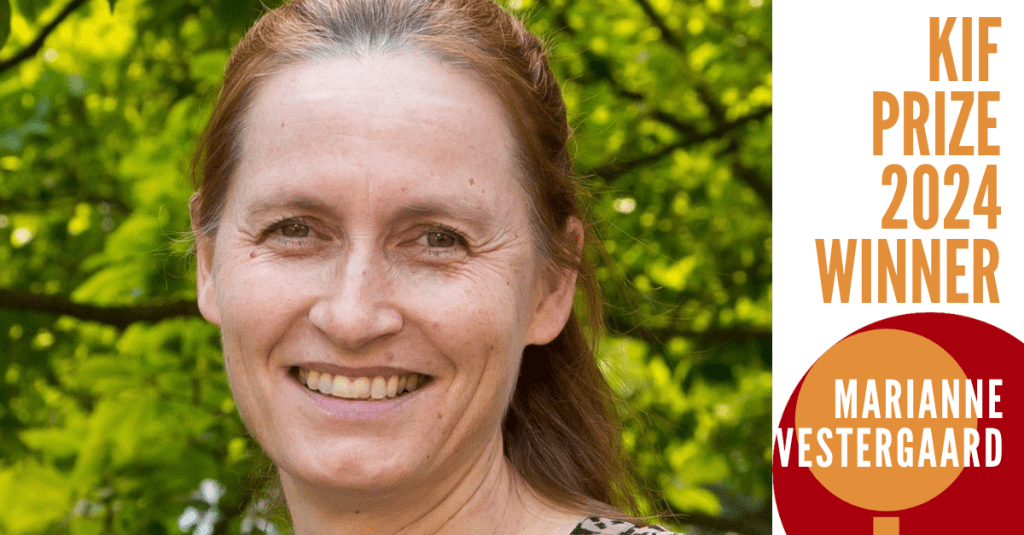
The KIF Prize is an honorary award that is awarded annually to raise awareness about the importance of women in physics and identify female physicists as role models.
Congratulations on being awarded the KIF Prize 2024! What does it mean to you to receive this prize?
Thank you! I am incredibly honored to receive the KIF Prize. It means a lot to me that my students and colleagues find me worthy of this prize. I am particularly delighted to learn that I have made, at least, some difference for my students and younger colleagues. It gives me great confidence knowing that how I approach supervision and mentoring has a positive impact. It motivates me to continue to strive to be an even better supervisor and mentor for early career scientists.
What was your motivation for pursuing a career in physics and how did you choose the field you are now specializing in?
My dad! He passed on his curiosity and fascination of the skies to me when I was quite young. My dad had no physics background or university education, but simply a general interest and fascination that he shared with me. Often on summer evenings we would sit for hours in the dark and look out at the night skies. He would tell me about all the various objects out there, including galaxies and black holes, shooting out radio jets. I was hooked! Already at the age of 9 or 10, I decided that I wanted to become a scientist because I wanted to understand how the Universe – and the interesting objects in it – work. This fascination lingered. So I went on to study math and physics in high school and later at University.
My interest in quasars and active galactic nuclei became cemented during a MSc class on how to analyze spectra. We were given a quasar spectrum with the aim to analyze and characterize the intervening absorbers. Seeing the broad emission lines, I became curious about what could be learned from them. Other senior MSc and PhD students tried hard to talk me out of it, insisting that one cannot learn anything because of the very large velocity widths and strong blending. “It is a waste of time. Forget it!”, I was told. But I couldn’t! The fact that it was a hard nut to crack, attracted me even more. I was convinced that somehow there is physics to be extracted and understood. That sealed my interest in trying to understand how the black hole driven central engine of active galactic nuclei produces its emission spectrum.
Where did you study and which positions have you held before the current one?
I studied physics, math and astronomy at the University of Copenhagen where I obtained my Master’s of Science (MSc) and later my PhD from the Niels Bohr Institute. I did my PhD research as a pre-doctoral student at the Center for Astrophysics | Harvard & Smithsonian in Boston, working with specialists in AGN and AGN emission lines. After graduating, I spent four years at the Ohio State University as the Columbus Postdoctoral Fellow and then four years as a research fellow at the Department of Astronomy and Steward Observatory at the University of Arizona before I took up a tenure track faculty position at the Department of Physics and Astronomy at Tufts University in Boston. Two years later, I was offered a FREJA Fellowship at the Faculty of Natural Sciences at the University of Copenhagen. I took this fellowship to The Dark Cosmology Centre at the Niels Bohr Institute in 2009. I received tenure as associate professor two years later. Four years ago, I applied for and was offered a full professorship at the NBI, which I gladly accepted.
Please tell us about your research and why it is important.
I use observations across the electromagnetic spectrum, from radio to X-rays, to understand how supermassive black holes in centers of young galaxies grow and create their energetic output by accreting gas transported from galactic scales to the center. Because the energy released by the central black hole is capable of heating and expelling the gas in the interstellar medium in its host galaxy, the black hole can have a large impact on the galaxy’s star formation rate and history. Since stars produce the chemical elements in the universe, the building blocks for life, it is important to understand the role that accreting supermassive black holes play in the chemical and structural evolution of galaxies.
You have taught several courses at University of Copenhagen and are currently co-lecturing introductory classical mechanics to ~140 first-year physics students each year. In 2015 you were awarded the Niels Bohr Institute excellence in teaching award (the Jens Martin Prize), and in 2016 you received the University of Copenhagen Teaching Award for excellence in teaching, (Årets Harald). Can you share your thoughts on the importance of teaching and some insights into your own approach?
In my opinion, it is more important that the students obtain a high learning outcome and not just retain enough to pass the exam at the end of the course. What they learn, they need to be able to use later in their studies or in their career. It requires some effort especially when the curriculum is large. But, the immediate benefit is that it is easier – and much more fun for everyone – when students understand the underlying (astro-)physics that they can use to reason. Then it is easier to remember a certain relationship, say, because the physics make sense. To increase the learning outcome, the students need to be active learners and work with the material. Ideally, they stay critical and ask themselves `Why?’, while they also seek the answers. I try to engage them in class and when they prepare for class, in a way that the students realize the benefit of the extra efforts they put in. My overall aim is for the students to realize how they best study and help themselves learn.
A key aspect of increasing the student learning outcome is to ensure that the teaching environment in class is such that the students feel safe providing wrong answers to questions or revealing their lack of understanding. This alignment of expectations sometimes takes time but is well worth it.
As the leader of your own research group, you hire young researchers for your projects. What do you look for in the people you hire and what are your thoughts on the importance of being a mentor and advisor?
In addition to having the right qualifications, I look for candidates who are driven, motivated and truly interested in the job. One way for candidates to express this is to address all the ‘requirements’ of the job posting and to relate their research and interests to the job. It seems trivial, but sadly many do not do this. An applicant who makes an effort to describe how they can contribute to the job, signals higher interest and that they really want the job. A generic job application does not get far because the reviewer cannot `see’ the person behind the application.
It is extremely important for senior scientists to be supervisors, advisors and mentors, both to help educate the next generation of scientists but also to provide on the one hand support and encouragement and on the other hand a perspective on the job of a scientist and possible paths to a successful career. There is not a one-size-fits-all path, and a single mentor doesn’t necessarily have all the answers for a given individual. But it is still very important that each scientist provides the support that they can. Science needs all the bright heads it can get!
You have been awarded the KIF prize for being a role model to other women in physics, and this is certainly very well deserved. Who have been your own role models and mentors and how have they inspired and supported you?
I did not have role models in science growing up, but through my studies multiple people have inspired me or been a support in one way or the other. I would like to highlight some of them, as what I learned from them may be helpful to others.
I probably wouldn’t be here today if Dr. Peter Barthel in Groningen had not responded to my inquiry and agreed to supervise my MSc thesis research. I wanted to study emission lines and he offered his time and data. He showed that when your projects don’t go as planned, you adapt and exploit available opportunities. Also, he had fun doing research! His approach has been a great inspiration to me.
During my PhD, my daily supervisor, Dr. Belinda Wilkes, showed by example that to be successful in science and a great scientist, you do not need to be arrogant or passive aggressive. I found that quite helpful, since this is so far from my personality.
As a postdoc, working alongside and with very experienced AGN specialists at Ohio State University, Rick Pogge, Brad Peterson and Pat Osmer, has provided much inspiration by the way they approach science and their well-balanced way of dealing with fellow scientists that behave inappropriately toward others. And Dr. Peterson managed in his career to be a unifying force in an otherwise competitive field (which is often common in science) by being inclusive and supportive of young scientists regardless of their gender, background, etc., with impressive research achievements for the collaboration as a result. All three have also been great mentors by providing perspectives on life as a scientist and by nudging me to consider my next moves in my career when it didn’t occur to me as a young postdoc to be important.
I am grateful to all these people and many other colleagues who have been generous with their time or data, and who have made me feel welcome and my efforts and competences valued. This inspires me to this day.
What advice would you give to young people (in particular women and minorities) who dream of pursuing a career in physics?
There is room for everyone in science and research, not just one particular profile. We all work and think differently, and it is through the collaboration of a diverse set of scientists that we make the most progress in advancing the research frontier. Thus, we do not all have to fit a specific mold or be a specific personality type to be successful. We need specialists with each their own competencies and strengths.
Also, we can all do much more than we often think we are capable of. We have it in us to do great things. The key is to believe in yourself and keep working toward your goal (here, support networks can help). I also recommend that you don’t compare yourself to others. Compare only to yourself: are you making progress toward your goals? Are you having fun? This is what matters! After all, you need to find your own path – and find what works for you.
In general, what can in your opinion be done to advance the careers of underrepresented groups in physics?
Having a support network is quite important. It can provide you with perspective (where you see that you are not alone with your challenges), sound advice, and a sounding board. All this can give you the confidence needed during times of doubt.
A career in the field of natural sciences is filled with hurdles, challenges and constant rejections that can easily be demotivating or even seem unsurmountable. A support network consisting of mentors and colleagues at a range of career stages is gold in helping you realize your potential. You have to believe in yourself to make it. It is easy to become discouraged and feel `alone’ with the challenges. The network can help provide the path and the confidence you need.
 kvinderifysik.dk