
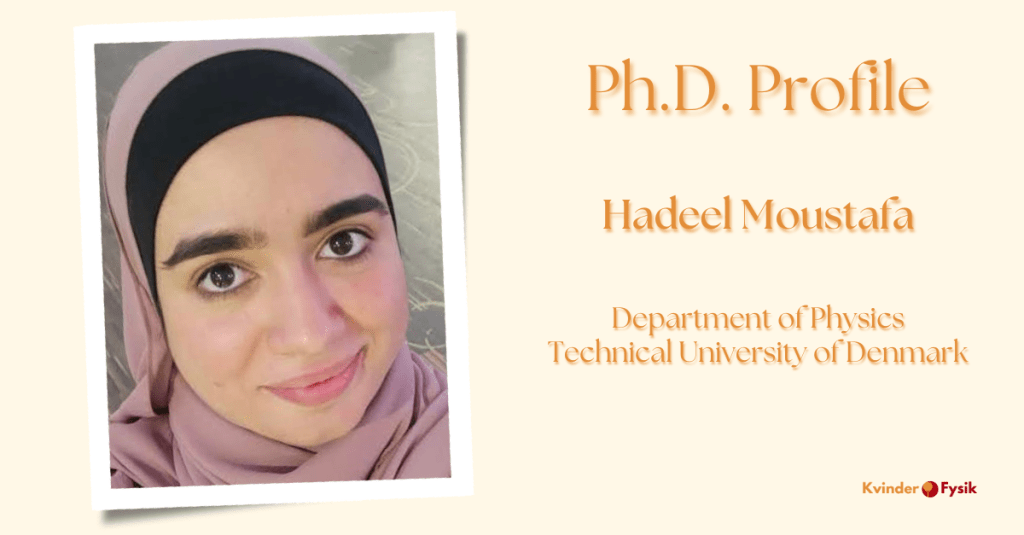
Hadeel Moustafa, a dedicated PhD student at the Computational Materials Repository (CMR) within the Department of Physics at DTU, successfully defended her doctoral thesis in late May. Her research focused on the computational properties of one-dimensional materials, an interesting class of materials with tremendous potential applications in areas such as battery technology, photonic crystals, and electronic interconnections.
One-dimensional materials offer exciting prospects when combined with other low-dimensional materials, forming new hetero-structures with unique physical properties. Hadeel’s work culminated in the development of a computational database containing approximately 2000 one-dimensional materials, with calculated structural, thermodynamic, electronic, magnetic, and optical properties. The database is open source and can be found via the link below.
To identify this database, an extensive screening process was employed, drawing from large experimental databases containing structural information. The screening involves analysis of the detailed atomic structure to identify low-dimensional materials. The selected materials constitute the core of the database, which is further extended with new materials by performing substitution of atoms with similar chemical properties.
Furthermore, Hadeel’s research utilized a generative neural network model to generate novel structures. This model was trained using the existing database, opening the door to the creation of previously unexplored materials. This database has proven invaluable in computational screenings, allowing researchers to identify materials with the potential to exhibit phenomena such as Majorana bound states or possessing interesting chemical properties. Finally, she studied the defect properties of one-dimensional selenium, which is of interest as a photovoltaic material.
Hadeel has published 4 papers and submitted another 2 papers.
A systematic computational database for one-dimensional materials
 kvinderifysik.dk