
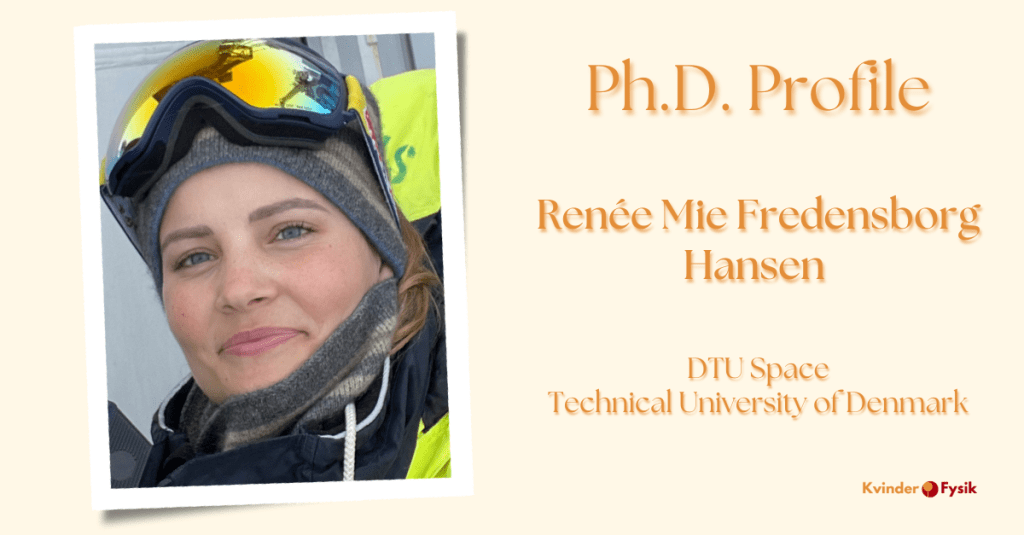
Renée Mie Fredensborg Hansen is currently in her final year as an alliance-Ph.D. student/candidate at DTU Space (The National Space Institute at the Technical University of Denmark) and NTNU (the Norwegian University of Science and Technology). She studies sea ice topography and roughness using remote sensing observations from spaceborne, airborne, or ground-based observations.
Sea ice plays a vital role in the Earth’s energy budget and system by maintaining the Earth’s energy balance through reflection of incoming solar radiation. However, the polar regions – in particular the Arctic – are experiencing rapid changes due to climate change, which has resulted in the ice cover thinning and receding. These rapid changes mean that we must monitor the Arctic regions better to understand and capture these changes, which at these remote and harsh conditions of the Arctic is best accomplished using Earth Observation (EO) satellites that remotely sense the sea ice cover. Renée specializes in lidar and radar altimetry, which is used to measure the topography (or elevation) of the ice cover. This can for example be used to derive the sea ice thickness, or with the high-resolution airborne or spaceborne data of today, can even be used to detect specific ice obstacles like ice ridges or icebergs.
Renées project focuses on investigation of extreme sea ice features, such as deformed ice, as well as investigating what an exciting new satellite constellation, known as CRYO2ICE, can provide of information along satellite orbit tracks. Currently, she is investigating the possibility of estimating snow depth on sea ice – which usually ranges from 5-40 cm in the Arctic and currently remains the largest uncertainty contributor to sea ice thickness estimates – using a combination of radar and laser altimetry, these CRYO2ICE tracks, which are sensed from more than 700 km above ground. Later, she will investigate the CRYO2ICE orbits on the Southern hemisphere, over Antarctic sea ice, which is significantly more challenging for EO satellites to measure than the Arctic due to the very different sea ice conditions. The aim is to investigate what current methods and techniques can provide of information, and what will be necessary to further evaluate before future satellite missions launches.
As an alliance-Ph.D., she is spending 1/3 of her Ph.D. at her host university (NTNU), which through the Norwegian collaboration between NTNU and the University Centre in Svalbard (UNIS), has resulted in the majority of the abroad stays being spent in the Arctic – on Svalbard – where the action is happening. She has also participated in airborne validation campaigns in Greenland, and recently finished a 5-week research cruise in the Fram Strait, reaching 82.9°N, while drilling in ice ridges. Before she started her Ph.D. studies at DTU Space, she completed a double-degree in Cold Climate Engineering at DTU in Denmark and Aalto University in Finland, and worked a year as a Young Graduate Trainee at the European Space Agency (ESA) in Rome, Italy.
Photo credit: Daniel Albert, SINTEF/GoNorth.
 kvinderifysik.dk