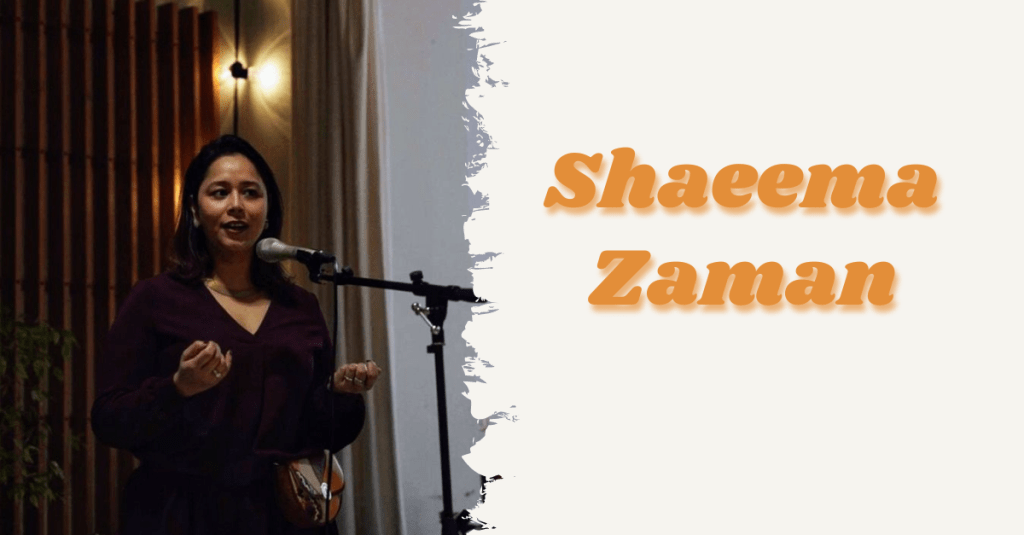
Shaeema Zaman is the Director of her own startup, QASE Tech. She graduated in astrophysics from University of Delhi, India. Thereafter, she did her PhD in quantum physics from Aarhus University in Denmark. In between her master’s and PhD, she worked at a science communication and education startup called Zlife Education (now called Yucky Science) in Delhi, India.
Please give a description of the work you do in your company.
As QASE Tech is my own startup, I work with everything ranging from writing funding applications, pitching our idea to developing a prototype of our first do-it-yourself (DIY) space radio communication kit. Every day is different, and I get to decide on what I want to work on – so there’s a lot of freedom there. That’s the best part about having your own startup!
Currently, I am working on developing a kit on space radio communication that high-school students can assemble themselves. Students will be able to send and receive radio signals from their classmates as well as receive signals from satellites. Hence, I’m looking at the technical setup now. For example, what kind of electrical and electronic components are needed, and what should the circuit diagram look like depending on the radio frequencies at play. Thereafter, thinking about the design of all of these components such that they are intuitive and playful so that students can build our kit, experiment with it and learn about space radio-communication.
How do you use the skills you learned as a physicist in your work?
My physics skills are always at play in my work. This includes both domain knowledge from physics such as topics like electromagnetic waves, and knowledge of electronics as well as my analytical skills like in-depth search, problem-solving and decision-making, which I’ve sharpened during my PhD in physics.
What motivated you to study physics in the first place?
My motivation to study physics came from wanting to be a pilot. I was in India then where being a pilot required a bachelor’s in physics, so I took it up. What was intended for a career as a pilot, turned into a love for physics eventually that I decided to pursue it in my master’s and PhD.
What made you decide to become an entrepreneur?
My desire to become an entrepreneur stemmed from my wish to have a career where I have freedom, creativity and make science learning fun. This was because I remember most of my physics learning from experiences when I was in a creative and fun environment, like a science museum or festival. Initially, I was looking for jobs that would give me this. However, I didn’t get what I was looking for. My applications were either getting rejected or I would have had to lower my expectations. This is when I thought – why not create my own job where I can experiment with my own ideas of how to make physics learning fun.
Have you had role models or mentors? If so, what inspiration did you get from them?
One of my mentors is Christiane Koch, a German quantum physicist. She really inspired me to start my own company. I remember discussing the idea with her, and her support and encouragement really motivated me to start my own companies (both QASE Tech and Science Melting Pot, my other startup). She was also one of the first ones to give me feedback on my ideas and provide suggestions on how I could do it better.
What advice would you give to young people (in particular women and minorities) who would like to become entrepreneurs?
My advice would be to join a university startup accelerator or incubator while you’re a student. These are spaces where you can attend workshops or join startup programs to give you a head-start, as it did for me when I joined The Kitchen, Aarhus University’s startup accelerator. Getting a head-start can be difficult sometimes as you might have an idea brimming but you don’t know where to begin when it comes to starting a company. Startup accelerators, especially those connected with a university or provided by the government are very helpful as they have many support schemes to help build your company both in terms of funding as well as mentoring, especially when you’re a student. In some cases, starting a company can count as an internship or a project during your studies, so it’s a really great addition to your CV.
These accelerators are also a good place to find other entrepreneurs like yourself or from different backgrounds. This will help you to feel at home and build your network. This is valuable, especially for women and minorities, because feeling at home is key for self-confidence and happiness. This is important because the road will be challenging and lonely sometimes, so if you find a place where you have a good network and feel at home, it will help you tide over these challenges.
What do you think can be done to advance the careers of women and minorities in science and encourage a more diverse group to become entrepreneurs?
I think giving women and minorities credit for their work is essential. Time and again, women have been forgotten for their contributions to science in papers, textbooks, movies or talks (Ross et al. 2022). Research indicates that the underrepresentation of women in faculty positions could stem from early discouragement among junior researchers. Women are often less likely to receive recognition for their contributions, particularly on crucial projects, which may consequently hinder their career advancement.
In entrepreneurship, we need to increase venture capital (VC) investment in women-led startups. For example, Denmark lags behind in venture capital investments for women-led startups. Merely 1.5% of VC funding in the country goes to startups led by female founders, while 6.7% is directed to startups with mixed-gender founders. Despite the limited capital allocated to female-led startups, investors reap a higher return on investment (ROI) from these businesses. Recent data from the Danish Chamber of Commerce (February 2022) reveals that every 100 DKK invested in a startup led exclusively by female founders yields a 25% higher ROI compared to investments made in businesses led solely by male founders (Source: Tech Nordic Advocates).
 kvinderifysik.dk