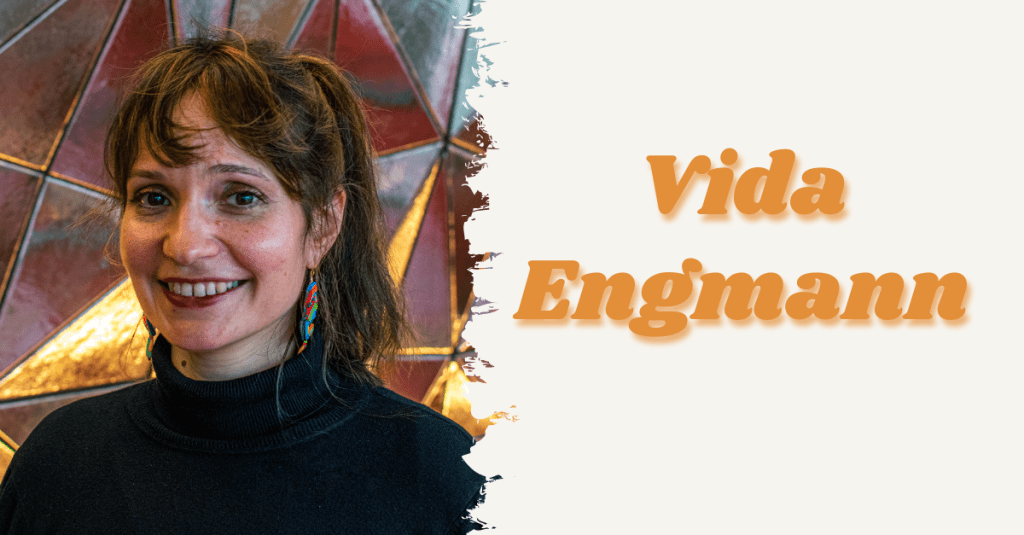
Vida Engmann is Associate Professor at Mads Clausen Institute, University of Southern Denmark
Congratulations on receiving a Sapere Aude grant from Independent Research Fund Denmark!
Please tell us about your research and why it is important.
I am a material scientist with a master’s degree in electrical engineering and a dr. rer. nat. in physics. My research focuses on developing novel organic and hybrid semiconductor material systems. This field – besides offering an exciting scientific playground involving different aspects of chemistry, physics and electronics – also has a great potential for finding solutions to the grand challenges of today, specifically the sustainable energy production (e.g. solar electricity production, hydrogen production by water splitting, flexible electronics and much more also still waiting to be invented 😊).
My greatest impact to the field so far was a new method for suppressing photooxidative degradation mechanisms of organic solar cells (OPV). My method consists of introducing a carefully chosen third compound into the donor:acceptor blends of the organic solar cells’ active layers, which prevents the photooxidative decay of the blend molecules and thus extends the device lifetime. This was a rather controversial concept, as it involved interfering with the optimized morphology of the blend, which is of ultimate importance for obtaining functional devices. By developing a methodology consisting of advanced spectroscopic and microscopic techniques I could demonstrate successful stabilization of state-of-the-art OPV devices, by dramatic lifetime enhancements even under accelerated testing. This method is now being applied by many OPV groups worldwide, extending even into the field of perovskite PV (another family of solar cells). My research in organic semiconductor materials is also important for many other aspects of sustainable energy production.
What are your plans and what are the possibilities that this grant opens for you?
My plan is to recruit a little team consisting of theoretical and synthetic chemists, curious about the fascinating world of conjugated polymer blends. We will develop novel additives which interact with electron donor and acceptor molecules, similarly as lecithin does with egg and oil to give well-blended mayonnaise. The goal is to explore the interactions between state-of-the-art non-fullerene acceptor and conjugated polymer donor molecules, and describe how their different structural units affect the morphological stability of the active layer over time. Guided by computational chemistry we will develop a series of antioxidant additives with differing substituents, thus different molecular interactions in OPV blends, and investigate their effect on the efficiency, morphological and photooxidative stabilization of resulting OPV devices. This will allow us to develop synthesis guidelines for bifunctional additives which render OPV thermodynamically and photooxidative stable, by increasing the attraction or repulsion between the additive and the active layer molecules. Besides gathering exciting scientific insights, this project will also give me an opportunity to build my own group and fix it on the world’s research map of organic electronics. 😊
Where have you studied and which positions have you held before your current one? What was your motivation to pursue a career in physics and how did you choose the field you are now specializing in?
During my MSc studies in electrical engineering, I went for an internship to a university group working with organic electronics. I instantaneously fell in love with the unusual world of polymers, and ever since I keep on stumbling on interesting research questions that are fun to be answered. That lead me to pursuing a PhD degree in physics at Ilmenau University of Technology in Germany, which had a strong emphasis on nanotechnology and printed electronics. After being awarded a PhD degree in 2014, I joined the University of Southern Denmark in Sønderborg, first as a postdoctoral researcher, and over time, since 2020, as an associate professor.
Have you had role models or mentors? If so, what inspiration did you get from them?
My most important mentor is my mom, a strong, independent, curious woman that was always there to encourage me to care, set goals, never choose the easy way, and never give up without trying. I am also lucky to have always had excellent colleagues from which I keep learning and drawing inspiration on a daily basis.
What advice would you give to young people (in particular women and minorities) who would like to pursue a career in science?
Forget all the irrelevant external characteristics (gender, race, nationality, religion… – after all, none of these does affect the laws of physics or chemistry! 😊), just follow what is in your head and your heart, and never give up. Remember that failure is a way to learn, and the more times you try and fail, the sweeter it will feel every time when you succeed.
 kvinderifysik.dk